Automated F-Tag Gap Detection Tools for Skilled Nursing Facilities
These tools help nursing homes catch F-tag violations before surveyors do.
F-tags are the numbering system through which federal nursing home regulations get identified during a survey, and they determine how a skilled nursing facility's compliance record becomes public and enforceable. Each rule under the Code of Federal Regulations has its own F-tag number, so when a surveyor finds a facility has not met a given standard, that finding gets written against the tag on the Statement of Deficiencies. Facilities have to post that document in a public location, and the same data feeds into federal databases and the Care Compare rating system that families use to choose a home for a parent or spouse. The list of tags is not fixed: CMS revised it in April 2025, and a further revision took effect April 28, 2025. Facilities are tracking a moving regulatory target. Some tags carry more citation exposure than others, among them F689 for accident hazards and falls, F686 for pressure ulcers, F692 covering both hydration and nutrition, F880 for infection control, F641 for accuracy of assessments, and F605 covering freedom from chemical restraints. Families, regulators, and surveyors could already see F-tag history because facilities had to post it publicly. Starting October 8, 2026, CMS will mark qualifying facilities on Nursing Home Care Compare with a "High Performing Facility" icon, turning a clean F-tag record into a direct competitive advantage in a market where families compare homes side by side online.
The Regulatory Environment in 2026 and the Cost of an Undiscovered Gap
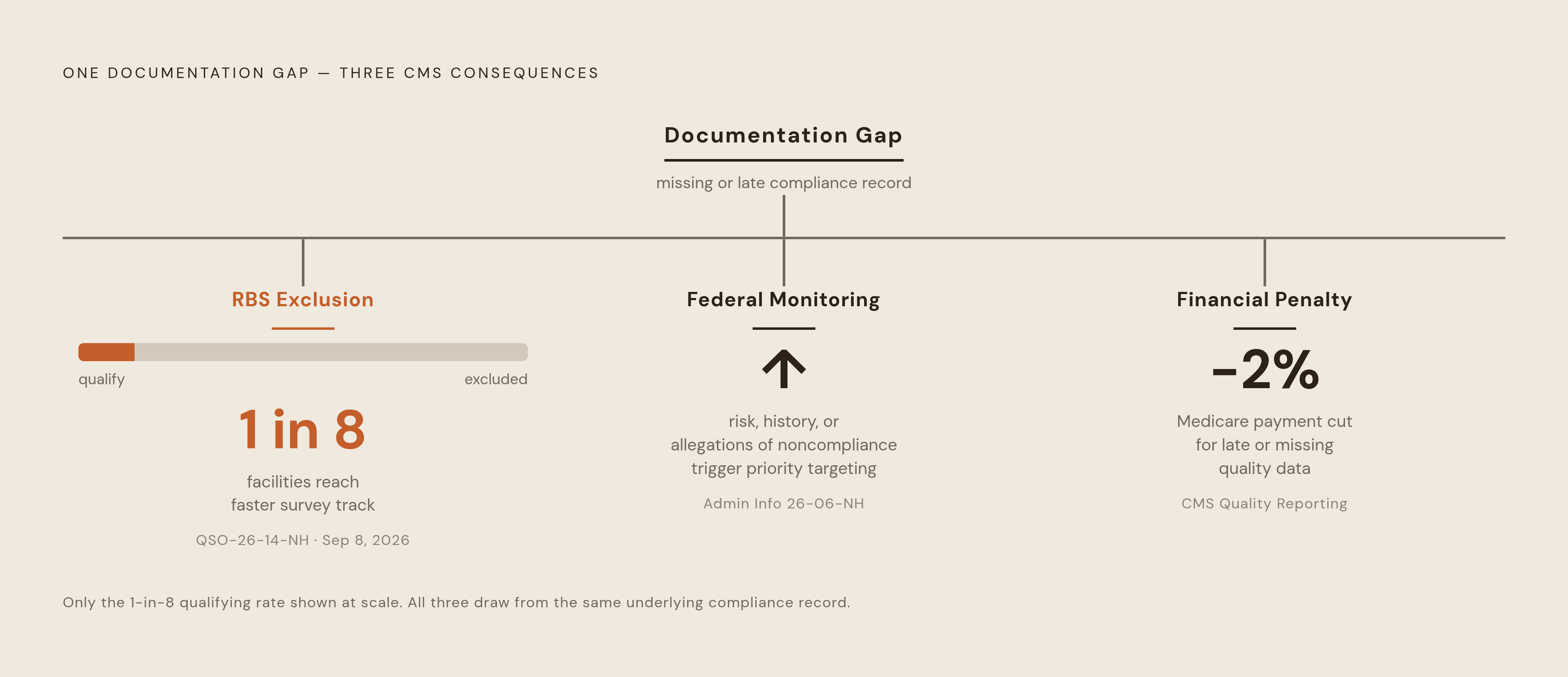
Three separate CMS actions taking effect in 2026 share a single source: the facility's own documentation record. The Risk-Based Survey system, effective September 8, 2026 under QSO-26-14-NH, offers a faster recertification path, with a smaller resident sample, fewer survey activities, and roughly half the time a standard survey takes. Qualification depends on a facility's ability to demonstrate continuous, data-supported compliance, and CMS estimates that only about one in eight nursing homes will qualify when the pathway opens. Most facilities will be working from the slower, more exposed track by default. CMS Admin Info 26-06-NH adds a second layer on top of that exclusion: Federal Monitoring Survey selection can now prioritize providers based on data showing a risk of noncompliance, a history of noncompliance, allegations of noncompliance, CMS Location-specific concerns, or media attention. A facility excluded from the RBS pathway because its data record looks uneven is also a facility more likely to be flagged for the kind of monitoring survey Admin Info 26-06-NH describes, because both decisions draw on the same underlying compliance data. The third layer involves financial penalties. Facilities that fail to report quality data on time face a 2% pay cut, and the number of providers hit by that penalty has grown sharply in recent years. The proposed FY2027 pay rule would add a substantial volume of new data collection and submission obligations across the sector, driven largely by expanded quality reporting requirements across all Medicare payer types. None of these three actions is isolated. A documentation gap that once produced a single line on a Statement of Deficiencies now also risks RBS exclusion, monitoring targeting, and a direct cut to Medicare payment, all from the same underlying record.
Where F-tag Gaps Originate: the Documentation Problem Inside the EHR
Most F-tag exposure does not start with a failure in care. It starts with the fact that sound clinical actions get written into narrative notes that nobody, and no system, cross-checks against the coded fields a surveyor or auditor actually reviews. The large majority of data in an EHR is unstructured: clinical notes, shift summaries, patient narratives written in the nurse's own words. That narrative text often holds the only record of something clinically important, but it cannot be systematically reviewed at scale in its raw form, so it sits there unread by anything other than the next clinician who happens to open the chart. The financial consequence of that gap is already measured. CMS's own compliance data shows that insufficient documentation accounts for more than three-quarters of improper payments in SNF inpatient claims, so most audit exposure traces back to paperwork that failed to prove the care was delivered correctly, not to care that was actually delivered incorrectly. Content analysis of Statements of Deficiency across nursing homes reveals the same handful of failure categories again: early detection failures, communication failures, failures to follow policy and procedure, inaccurate documentation, and delays in initiating a clinical response. Every one of those categories leaves a trace somewhere in a shift note or progress note, even when the coded fields show nothing wrong. MDS Validation Audits, run annually by Healthcare Management Solutions LLC on a randomly selected sample of SNFs, require facilities to supply medical records in PDF format to support a set of MDS assessments. Those audits expose a vulnerability that sits in the space between what a nurse wrote in a narrative note and what the corresponding MDS field actually records. The clinical evidence usually exists somewhere in the chart. It simply exists in a form nobody has built to read.
How NLP Converts Narrative Nursing Notes into a Compliance Signal
Natural language processing turns that narrative text into something a compliance system can act on, reading unstructured notes the way a surveyor reads a chart, except it does so continuously and across every resident in the building rather than during a sampled, scheduled visit. NLP extracts and structures unstructured text from EHRs, so that text can now get the same documentation accuracy review and decision support that structured, coded data has always allowed. For compliance work specifically, NLP scans unstructured records to find care gaps, near misses, and quality deviations that coded fields alone never surface, and in value-based care arrangements, that detection translates directly into stronger quality metric performance. A deployed example from outside long-term care shows the pattern at work: a major health information company uses NLP to pull cancer staging details and radiology findings straight out of physician documentation, automating registry reporting, improving data accuracy, and replacing a manual chart review process that used to take a staff member's full attention. The SNF equivalent runs the same logic against a narrower, high-stakes target: cross-checking narrative nursing notes against MDS-coded fields to catch the inconsistencies that produce F-tag citations before a surveyor finds them first. Consider a nurse who documents a fall in a shift note. NLP reads that note, checks whether a formal incident assessment was initiated in response, checks whether the MDS fall-coding field reflects the event at all, and flags the record if the two don't match. The same check runs against hydration observations, wound descriptions, behavioral changes, and medication administration narratives, covering every category of clinical event that maps to one of the high-frequency F-tags described above.
What automated gap detection must monitor to match where surveyor scrutiny lands
A gap detection tool is only as good as the F-tags it actually covers. If a system watches wound documentation closely but says nothing about falls or hydration, a facility is still exposed on its highest-risk categories, so incomplete coverage amounts to a false sense of security. Falls illustrate the stakes clearly. An OIG finding showed that nursing homes failed to report 43% of falls that involved major injury and hospitalization on required assessments. Falls data now factor into Special Focus Facility selection, and falls with major injury has long served as a Care Compare quality measure, but OIG found that this kind of underreporting distorted that measure. So accurate MDS fall coding, backed by documentation that actually supports it, becomes one of the highest-stakes monitoring targets heading into 2026. Hydration and nutrition carry a quieter version of the same risk. Both areas need documentation tied to each resident's individual needs, but when dehydration risk appears in a shift narrative, it is often just a passing observation that never gets coded into anything resembling a systematic alert. Pressure ulcers raise a related standard: a resident who enters a facility without a pressure sore should not develop one unless it is clinically unavoidable, and a resident who already has one should receive documented care aimed at healing it, with narrative wound descriptions lining up against assessment timing and care plan updates in the coded record. Behavioral and psychosocial change rounds out the list: it appears as a pattern across many shift notes that looks unremarkable note by note, but it signals real clinical decline when read together, and coded data typically misses it on its own. A buyer evaluating any gap detection tool should ask, tag by tag, whether it covers this full range or only a comfortable slice of it.
Resident Risk Stratification and Prioritized Clinical Action
Finding a gap is the first step, not the whole job. What makes gap detection useful day to day is the ability to rank residents by risk, so the most urgent clinical and compliance exposures rise to the top instead of asking a nursing manager to treat every flag as equally urgent. Residents can be sorted into high, medium, or low risk groups, with that grouping feeding directly into individualized continuum-of-care plans. That sorting serves two purposes at once: it is a clinical tool that tells a manager where to look first, and it is a compliance instrument, because it creates exactly the kind of documented prioritization logic a surveyor expects a well-run facility to show. A study tracked AI-enhanced SNF communities against communities running on EHR alone and found that 16 out of 18 quality measures improved by a statistically greater margin in the AI-enhanced group. The same mechanism explained every measure that improved: issues were caught early and addressed early, instead of caught late and documented after the fact. That is the practical argument for pairing detection with stratification. A tool that projects risk forward from trends already visible in the existing record lets staff intervene before a condition turns into a deficiency, instead of only producing a clean record of the deficiency once it has already happened. Risk stratification also changes what a nursing manager does with the time automated chart review frees up. Rather than reviewing every resident's chart in sequence, a manager works down a ranked queue where the residents carrying the highest compliance risk and the highest clinical risk are already sitting at the top. Detection without that ranking produces a flood of alerts with no order to them. Ranking without detection is a guess dressed up as a system. The two only work as a pair.
Documentation burden as the adoption barrier tool design must solve
Any tool that asks nurses to change how or what they document in a skilled nursing facility is a tool likely to fail, regardless of how well it detects gaps, because the documentation burden nurses already carry is close to its limit. Nurses working in EHR-based systems document somewhere between 600 and 875 discrete data points per 12-hour shift. The U.S. Surgeon General's Advisory on health worker burnout found that nurses spend roughly two-fifths of a shift on documentation, so they have less than three-fifths of their working hours left for direct patient care. A nursing manager reading a pitch for a new compliance tool is right to ask, first, whether it adds one more field, one more click, one more prompt to a workload that is already crowding out time at the bedside. That skepticism deserves an answer: the tools worth adopting surface missing elements, flag potential risk events, and highlight inconsistencies earlier in the existing workflow, replacing a manual chart review that already happens with a faster, more consistent version of the same review. The tool has to be built around nursing documentation patterns from the start rather than adapted after the fact. The interoperability limits on incoming hospital data make this design choice more than a preference. Few hospitals can reliably find, send, receive, and integrate patient information electronically with nursing homes, with only about 17% of hospitals routinely sending that information to long-term and post-acute care providers, and a smaller share still routinely receiving it back. If a gap detection tool depends on clean data arriving from referring hospitals, it inherits those same gaps before it even starts. A tool built to read from the facility's own EHR narrative notes sidesteps that constraint entirely, because its data source sits inside the building rather than depending on a referral pipeline that most of the industry has not solved.
Continuous compliance readiness as a daily operational state
Compliance readiness, understood this way, is the condition a facility sits in every day, produced by a system that reads every shift note as it's written, checks it against the coded fields a surveyor will eventually examine, ranks residents by the risk that check reveals, and surfaces the result to a nursing manager without asking a single nurse to chart differently. Under that kind of system, a fall gets cross-checked against its MDS coding the same shift it happens, not the week before a survey when someone finally pulls the chart. A dehydration risk noted in passing during a Tuesday shift appears on a ranked list before it becomes a Thursday hospitalization and an F692 citation. The financial and reputational stakes built up through 2026, the RBS exclusion, the targeted monitoring, the quality reporting penalties, the public High Performing Facility designation, all come due at the moment a surveyor opens a chart. A facility that has been reading its own documentation continuously meets that moment with a record that already matches what the coded fields say. A facility relying on a pre-survey scramble meets it with narrative notes nobody has checked against anything, and hopes the gap isn't the one the surveyor happens to find.