Nursing License Risk From Incomplete Resident Safety Documentation
Incomplete charting can cost your license even when care was sound.
A nurse can deliver sound, attentive care through an entire shift and still end up in a weaker legal position than the care itself would justify, because the record of that shift, not the care, is what a board or surveyor will eventually judge. This thin paper trail, not the clinical work itself, produces nearly every licensing complaint in long-term care: competent care can leave behind a thin paper trail, and when that happens, the thin paper trail is what gets examined. A verbal handoff between shifts, a mental note about a resident's mood, a skin check completed but never charted: none of it exists for an investigator. Only the written record exists, so if that record falls short, you can't prove what a nurse actually did.
The exposure compounds with time. Complaints can surface months or even years after the care in question was delivered, and by the time that happens, a nurse's memory of one shift among hundreds is the only thing left to stand against a chart that cannot speak for itself. CM&F Group's description of this pattern reflects a basic fact about how licensing review works: investigators are not reconstructing a nurse's intentions or character. They are reading what was written, on the date it was written, and drawing conclusions from the gaps.
None of this requires a bad nurse or a dangerous shift. It requires only a documentation gap wide enough that a reviewer, months later, cannot tell whether care was skipped or simply wasn't recorded. That distinction, invisible in the moment, becomes the entire basis for a disciplinary case later. A nurse attorney's caseload makes the scale of this plain: Nancy J. Brent, a nurse attorney based in Chicago with decades of practice, identifies documentation mistakes and omissions as among the most common reasons she defends clients, not failures of clinical judgment, but failures of the record that judgment left behind.
How nursing boards distinguish honest gaps from conduct that ends careers
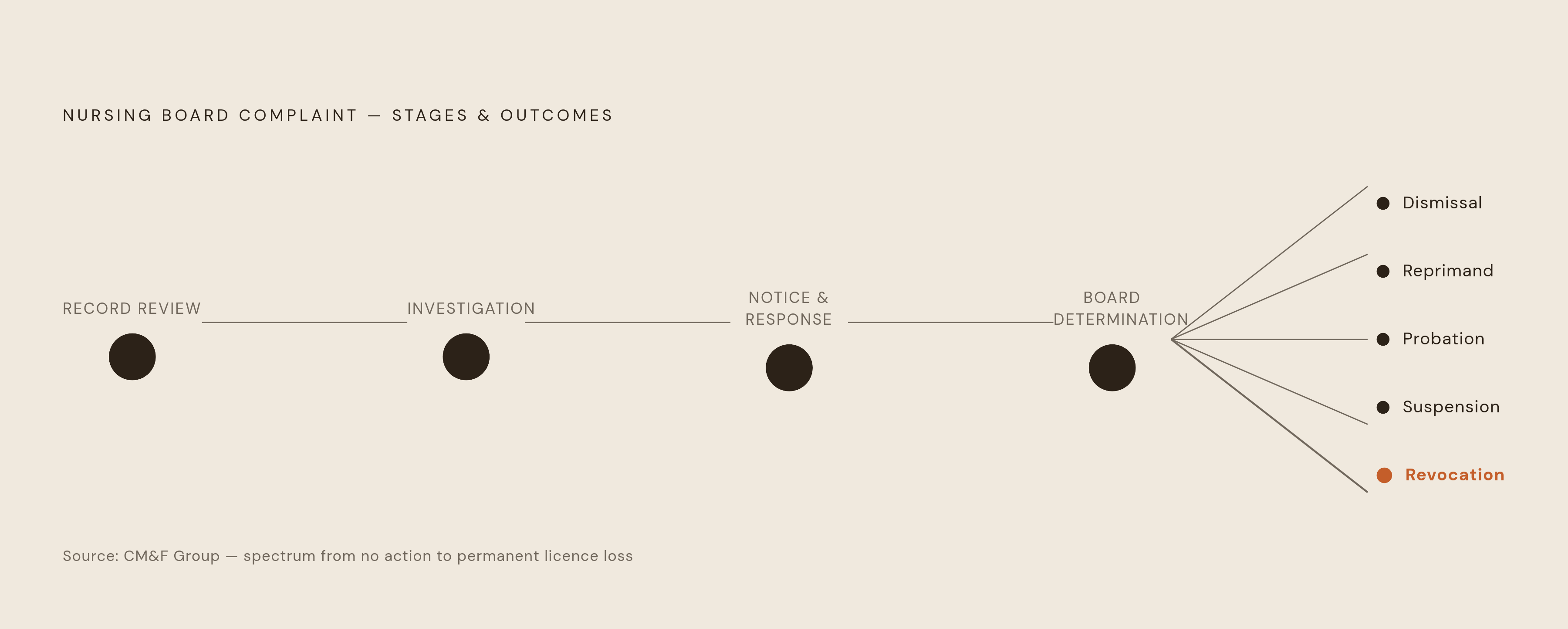
State boards of nursing do not treat every charting failure the same way, but even an honest mistake faces a floor lower than most nurses assume. CM&F Group describes the process that follows once a complaint is filed as a fairly consistent sequence: a record review, a formal investigation that gathers patient records and medication logs, a notice to the nurse requiring a response, and then a board determination that can range from dismissal to reprimand, probation, suspension, or revocation. Where a given case lands on that spectrum depends heavily on what the board believes it is looking at: a lapse, or a pattern.
The Texas Board of Nursing's approach illustrates the distinction most clearly. Lype, Dest & Smith describe how the board evaluates whether conduct was intentional and whether it fits a broader pattern before deciding how to proceed, and an isolated honest mistake is generally treated differently than conduct suggesting dishonesty. That distinction matters enormously to outcome, but it offers less protection than it sounds like it should, because the standard nurses are held to does not bend for honesty alone. Under 22 Tex. Admin. Code § 217.11, nurses are required to accurately and completely report and document a client's status, the nursing care rendered, and the client's response to that care. Incomplete or delayed entries can trigger board review under that rule even where no intent to deceive exists.
Falsification sits on a different floor entirely, and it is considerably less forgiving. Lype, Dest & Smith note that a nurse can lose a license for false documentation in a single instance, because the conduct itself calls the nurse's trustworthiness into question, independent of whether any patient was harmed. Falsification does not require proof of harm for the board to act. Brent's case files include an instance that shows how this plays out: an overworked nurse, alone on a floor, falsely documented completing overnight checks on a patient. When that patient was later found on the floor, injured after attempting to get out of bed unassisted, the documentation became the immediate problem. The staffing conditions that led to the lapse in checks explain the lapse, but the false entry undermined the nurse's credibility regardless of that context, because a board reviewing a falsified record cannot easily separate the falsification from everything else the nurse reports. The lesson in that case is that intent determines severity, but its absence does not guarantee safety, and its presence removes safety.
The six documentation mistakes that most commonly trigger board investigations in LTC
Most documentation-related board complaints trace back to a small, recognizable set of charting failures, and in long-term care, these failures cluster tightly around the resident safety incidents that already draw the most regulatory attention. Lype, Dest & Smith place incomplete or missing patient assessments at the top of that list: skipping or abbreviating an assessment leaves a gap that, to a reviewer, can look indistinguishable from care that was never provided. Delayed charting creates a related but distinct problem, since entries made hours or days after care was delivered raise questions about accuracy on their own, and can suggest a nurse is reconstructing what happened from memory rather than recording it as it occurred.
Omissions tied to a change in a resident's condition carry their own weight, because failing to note a decline in status, along with any intervention or provider notification that followed, can suggest to a reviewer that a clinical change was missed entirely rather than simply left out of the chart. Medication documentation failures occupy similar territory and tend to draw particularly serious scrutiny: missing dosage, time, or administration detail, or charting a medication as given before it was actually administered, can generate hard questions the moment a medication error is investigated, a pattern confirmed by both CM&F Group and Brent's case experience. Failure to document patient education is a quieter version of the same problem. When instruction is given to a resident or family member but never recorded, the board has no way to confirm that the education occurred at all, regardless of whether it actually did. Poor recordkeeping quality rounds out the list: illegible notes, entries that contradict one another, or documentation that does not align with what other staff recorded all weaken a nurse's credibility the moment a record comes under formal review.
In long-term care specifically, these six failure modes do not distribute evenly across all clinical areas. Falls, medication errors, hydration, skin wounds, and behavioral changes carry the highest citation and audit risk in LTC settings, and in every one of those categories, it is the pattern of documentation gaps, not a single missed note, that turns an ordinary clinical event into a regulatory one. American Nurse offers a useful illustration of what separates a defensible note from an indefensible one. A chart entry that reads "patient on the phone, patient off the phone" documents an event but nothing about the resident's clinical status. A note that instead records clinical status, the intervention performed, and the resident's response to it tells a reviewer that an actual assessment took place. The first kind of entry, however well-intentioned, creates the impression that no clinical judgment was exercised at all, and that impression is what boards and surveyors act on. None of these six patterns originates in carelessness so much as in the conditions under which the charting happens. That is where the more difficult part of this problem begins.
Why the conditions of long-term care nursing make documentation gaps structurally inevitable without system support
The six failure patterns above are not primarily a matter of individual skill or diligence. They are a predictable output of the conditions under which long-term care nurses work: persistent staff shortages, patient assignments large enough to make thorough charting difficult within a shift, and electronic health record systems whose flowsheets were not designed around the pace of LTC care. Under those conditions, it becomes structurally unlikely that any single nurse can maintain a complete, pattern-level view of a resident's documentation across shifts, simply by doing the job well.
Much of the gap between intention and completion comes down to time, not judgment. Nurses frequently intend to finish documentation later in a shift, only to have another resident's needs take immediate priority, and the entry never gets completed the way it was meant to. The Bedside Standard identifies workload pressure, not poor judgment, as the primary driver behind delayed and incomplete charting in long-term care. The electronic health record was supposed to fix this, replacing paper charting with faster, more structured entry. In practice, the burden it introduced has been substantial: American Nurse found that inpatient nurses at a major health system spent roughly two hours per shift simply navigating the EHR. In long-term care, where nurse-to-resident ratios are stretched further than in acute hospital settings, that same navigational burden lands on fewer nurses covering more residents. That leaves less time available for the charting the system was built to streamline.
The deeper structural problem involves visibility rather than effort. A resident whose fall documentation has gone quiet over two weeks, or whose hydration notes have gradually thinned out, will not surface in any single day's chart review, because no one nurse's shift gives them a view of that trajectory. The Bedside Standard notes that you only see that kind of pattern when something tracks the resident's full documentation history across every shift and every caregiver, not when a nurse reviews their own notes alone. That creates an accountability mismatch nurses are rarely in a position to correct on their own: they are held to a documentation standard they have no practical way to verify they are meeting, because the aggregate pattern a surveyor will eventually see is not something any individual nurse can assemble from a single shift's vantage point. The gap sits between what gets written on any given day and what becomes visible only in the full record, and a surveyor or auditor will see that full picture before the nurse who generated any single entry ever does. Closing that gap is not a matter of individual nurses trying harder. It requires a system capable of watching the aggregate pattern continuously, because no amount of individual vigilance substitutes for that view.
The 2025–2026 Regulatory Changes and Fraud Exposure
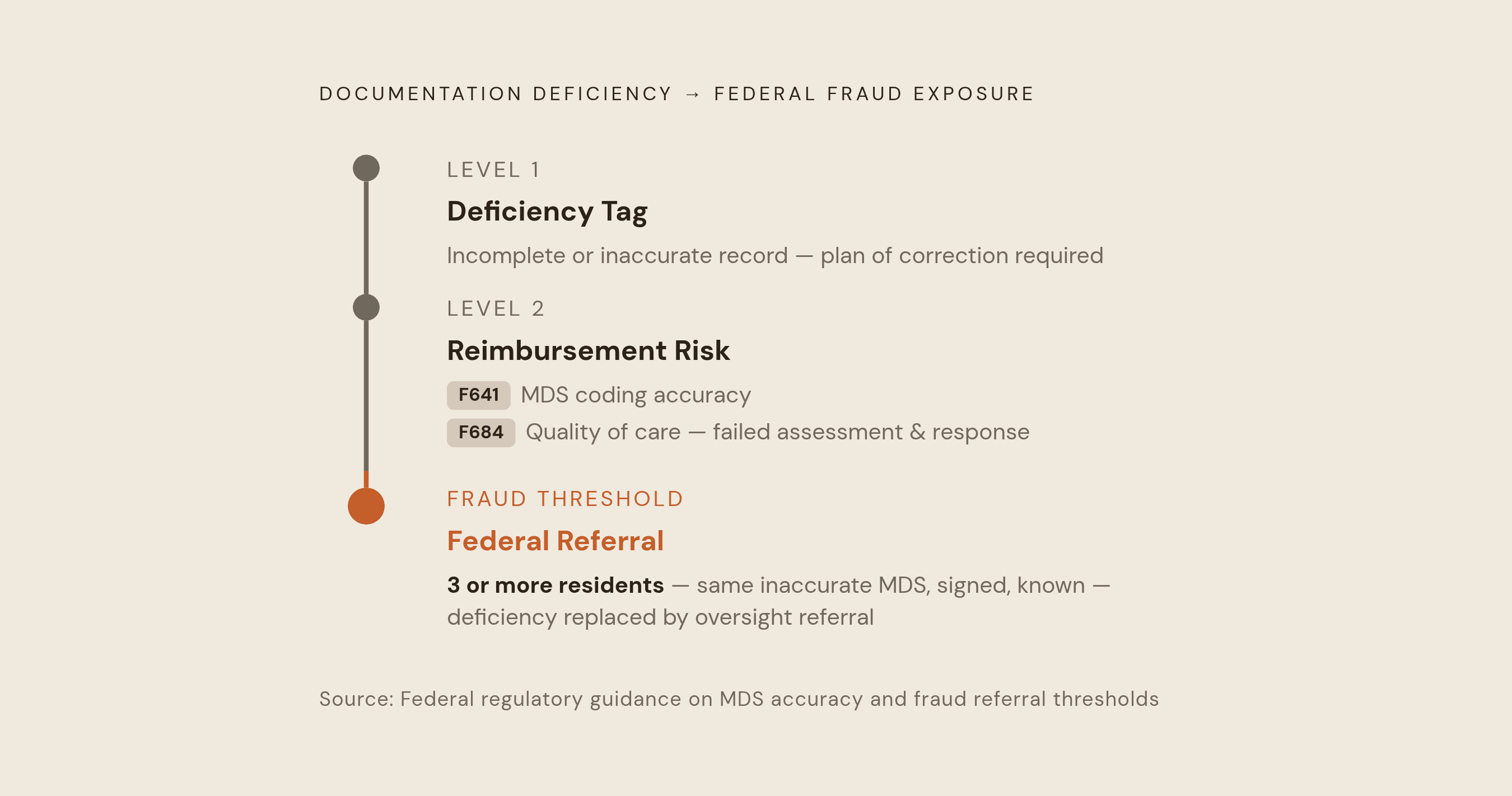
Federal regulatory changes effective April 28, 2025, combined with MDS audit activity that intensified in January and February 2026, moved documentation gaps out of the category of deficiency risk and into the category of financial and fraud exposure, for facilities and for the nurses whose notes underpin MDS coding. The 2025 Long-Term Care Survey Process revision, developed since late 2024 and fully in effect by April 28, 2025, changed how surveyors evaluate MDS accuracy, psychotropic medication documentation, and care planning, placing considerably greater weight on assessment accuracy and real-time care planning than prior survey cycles did, as The Bedside Standard reports.
Two federal tags sit at the center of that shift. F641 covers assessment accuracy, including MDS coding review, and when a resident's MDS coding does not align with what the clinical record actually shows, a facility faces reimbursement risk layered on top of the deficiency tag itself. F684 covers quality of care, and it gets cited when the record fails to demonstrate that a care team identified, assessed, and responded to a resident's condition. A documentation gap alone, even where no actual lapse in care occurred, can generate real regulatory exposure under current survey guidance.
The MDS audit wave that began in January and February 2026 turned these tags from theoretical risk into operational consequence. Those audits check whether the MDS coding on file for a resident matches what the underlying clinical record documents, and that check draws a direct line from a single nurse's chart entry to a facility's Medicare and Medicaid reimbursement. Regulatory guidance now defines a fraud pattern specifically: three or more residents coded with the same inaccurate MDS assessment, signed and certified by staff, where indications exist that staff knew the coding was inaccurate. A pattern meeting that definition is treated as a fraud signal rather than a quality miss, and gets referred to a federal oversight body for investigation. That distinction carries real weight for how facilities and nurses need to think about documentation now. A documentation gap that would once have earned a facility a deficiency tag and a plan of correction can now open a fraud inquiry naming the staff who signed the assessment, and those are different conversations with different stakes. CMS has also signaled continued pressure through monetary penalties, pushing facilities to demonstrate corrective action that is substantive rather than procedural.
The Highland Pines case, designated CR6922, anchors what this exposure looks like when it is not abstract. Required foot and skin assessments were not performed, or were not accurately documented, and that gap delayed the recognition of spreading gangrene in a resident under that facility's care. The documentation failure and the patient harm in that case are not separable events. One produced the other, and the regulatory environment that took shape across 2025 and 2026 now treats that kind of gap as exactly the sort of signal it is built to catch.