Cognitive Load and Charting Error Rates in Skilled Nursing Facilities
Depleted brainpower, not poor discipline, explains why charting accuracy drops by end of shift.
Cognitive load is the mental effort it takes to process information through working memory, and working memory only holds material for roughly 15 to 30 seconds before it gets bumped or lost. Dr. Michael Privitera of the University of Rochester Medical Center made that point on an AHA Safety Speaks podcast, and it reaches far past the hospital setting he was describing. In skilled nursing facilities, that same 15-to-30-second limit decides whether a nurse's charting at the end of a twelve-hour shift is accurate, complete, and specific enough to survive an audit. Documentation quality is what happens when a finite mental budget runs out hours before the shift does, not a training problem or a discipline problem. It's what happens when a finite mental budget runs out hours before the shift does.
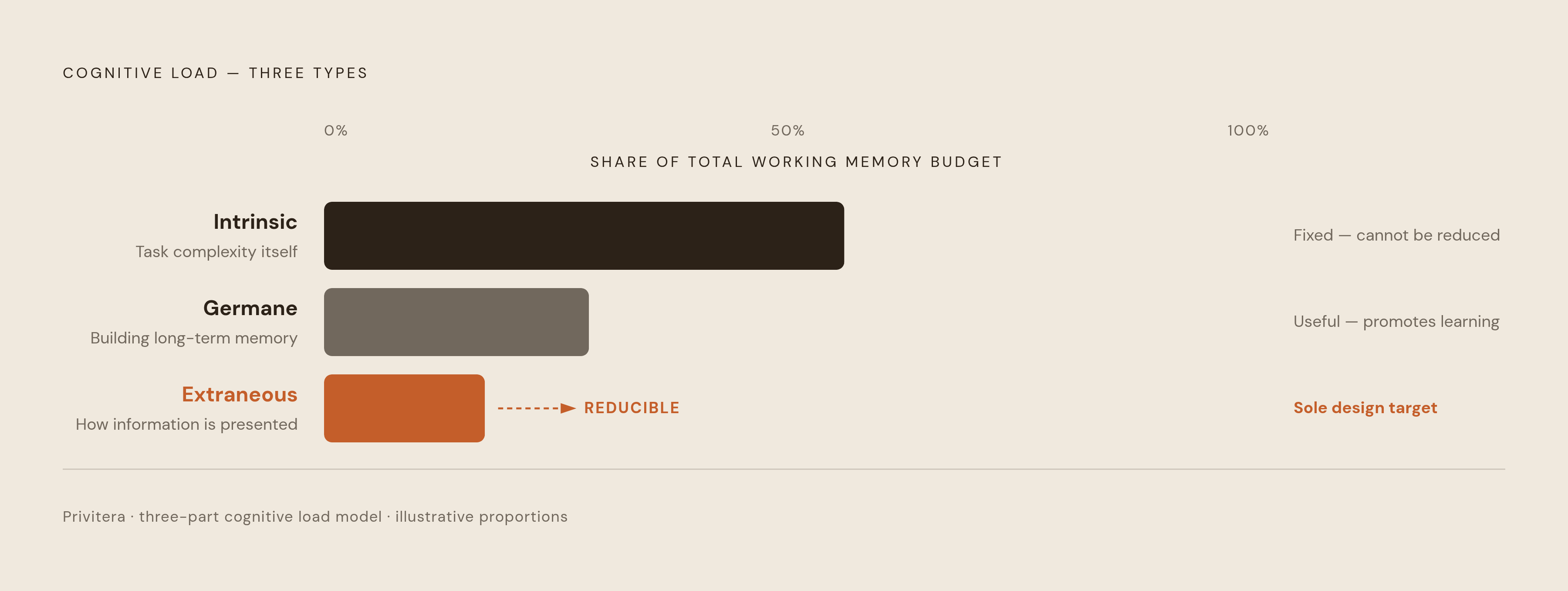
Privitera treats brainpower like a budget rather than a tap you turn on when you need more. "Brainpower is a finite resource," he said, "we have to budget the expertise like we would money and allocate it in the right places." He splits cognitive load into three parts: intrinsic load, how hard a task is on its own; germane load, the effort spent building a working model of a situation and moving it into long-term memory; and extraneous load, the load added purely by how information gets presented or how a system is built. Intrinsic load is fixed by the nature of the work. Extraneous load is a choice, usually made by whoever built the workflow or the screen the nurse stares at, and it's the only one of the three anyone can design away.
Skilled nursing facilities stack several load sources before a nurse even opens a chart. Patients carry high acuity and a tangled mix of comorbidities. Staffing ratios stretch one nurse's attention across many residents with competing, simultaneous needs. Regulatory documentation sits on top of the clinical work, not instead of it, and none of that paperwork is optional. The electronic health record systems built to help with all this often add to the burden instead, a pattern documented as a contributor to clinician burnout.
How Sustained Cognitive Demand Degrades Documentation Quality by End of Shift
The Surgeon General's Advisory on Building a Thriving Health Workforce, cited by AACN, reports that nurses spend, on average, about 40% of a shift on documentation. That figure says documentation is a major cognitive task in its own right, on par with the clinical work it describes, not some quick administrative chore tacked onto the end of the day.
Cognitive resources get spent all shift on direct care decisions, handoffs, and real-time problem-solving, the kind that can't wait. By the time a nurse sits down to chart, most of that mental budget is already gone. Notes written at the end of a long shift are not a sign of a nurse cutting corners or slacking on professional standards. They are the predictable output of a brain running on a depleted account since hour three, and blaming the nurse for that blames the wrong link in the chain.
What degrades is specific and fairly consistent. Recall of details observed hours earlier becomes less reliable as cognitive resources deplete, and the subtle stuff, a behavioral shift, a slow decline in mobility, a small trend in vital signs, is among the first things dropped when memory stretches thin. Specificity fades too, as the mental effort required for precise clinical language competes with an already depleted cognitive budget.
The specific documentation failures that accumulate when nurses are cognitively taxed
MDS coding tops the list, mostly on sheer volume. A comprehensive MDS assessment carries roughly 510 answers or choices, and around 530 when CAA investigation is included in a full comprehensive assessment. Getting that right while cognitively fatigued is structural. It's structural. Under PDPM, coding accuracy drives case-mix classification, so errors in MDS items can have direct and compounding reimbursement consequences. Missing documentation on restorative nursing program frequency and duration is a specific, common, and entirely avoidable error, and it hits the Nursing component score directly.
Narrative notes fail in a related way. Vague language slides past an internal review just fine, but it falls apart under external audit scrutiny. Surveyors and Medicare Administrative Contractors scrutinize documentation closely, and vague or incomplete notes are more likely to fail external review.
Care plans drift too. When the plan on paper stops matching what's actually happening at the bedside, that gap is visible to state surveyors and to Recovery Audit Contractors doing retrospective reviews. The subtle clinical signals, a slight change in respiratory pattern, a slow mobility decline, small behavioral shifts, are what predictive risk models depend on, and cognitive fatigue erases them first. The same mechanism works against a facility twice: once in the chart, once in the model built on top of it.
The Compliance and Financial Exposure Created by Charting Gaps
Start with who's looking. Medicare Administrative Contractors, Recovery Audit Contractors, and Unified Program Integrity Contractors review SNF documentation constantly, not occasionally. The SNF 5-Claim Probe & Educate initiative, launched in 2023, remains one of the main tools for surfacing documentation deficiencies across the industry.
The 2024 CERT report found an improper payment rate of 17.2%, roughly $5.9 billion in projected improper payments across Medicare. In one regional Medicare contractor's jurisdiction, covering a group of three states, the error rate for July through September of 2024 hit 27%. Those numbers are the direct financial residue of documentation gaps that started as a nurse's depleted working memory at 7pm.
Survey exposure runs on a separate but parallel track. CMS surveys follow a periodic schedule, but complaint surveys can land any time, so facilities can't treat readiness as a once-a-year event. CMS issued revised Long-Term Care Surveyor Guidance on November 18, 2024, and the updated LTC Survey Process and Appendix PP took effect April 28, 2025. Two new tags, F627 for Inappropriate Transfers and Discharges and F628 for the Transfer and Discharge Process, replaced the deleted F622 through F626 and F660 through F661 tags. Transfer and discharge documentation is now its own codified risk category, distinct from where it used to sit in the survey framework. Surveyors lean more on objective data and consistent documentation practice than ever, and even a minor charting gap can move the needle on both survey outcomes and reimbursement.
A newer wrinkle adds an incentive layer on top. The risk-based survey, announced July 16, 2026 and rolled out nationwide September 8, 2026, lets facilities with strong track records (fewer citations, higher staffing levels, fewer hospitalizations) qualify for a shorter, less burdensome survey process. CMS estimates around 12% of nursing homes will qualify. That qualification runs entirely on documentation history, so facilities with chronic charting gaps lock themselves out of the benefit before the survey ever happens. The policy isn't settled: the Center for Medicare Advocacy called the risk-based survey dangerous for residents. That disagreement is live, and both sides argue from a real concern rather than a strawman, but neither side disputes that documentation history is now the gatekeeper.
The staffing spiral: how documentation burden feeds turnover and then worsens the next nurse's cognitive load
Documentation burden is a retention risk as much as a compliance risk, and the two feed each other in a loop that's hard to break from either end. Among registered nurses who left the profession between 2018 and 2021, 26% named burnout as the primary reason for leaving. The national RN vacancy rate is 9.8%, and each nurse who leaves costs a hospital roughly $61,000 to replace. In skilled nursing, where margins are already thin, that cost lands harder and faster than it does in a hospital system with more financial cushion to absorb it.
The cycle runs in a fixed sequence, and it's worth tracing the whole thing rather than treating any single link as the cause. Heavy documentation burden pushes burnout, and burnout pushes nurses out the door. Every departure raises the patient-to-nurse ratio for whoever's left, and higher ratios raise cognitive load. Higher cognitive load produces more documentation errors, which raise audit exposure and survey risk, which generates more administrative work, which raises cognitive load again. None of that is theoretical: a CIN study found that patient-nurse ratios directly affected perceived cognitive load during handoffs, the exact moment where documentation errors most often start.
Removing the Documentation Burden Without Removing the Documentation
Most proposed fixes fail before they start, because they add something. A new data-entry step, a new workflow, a new screen for a nurse to click through: all of that is extraneous load, the exact category Privitera flags as the category most amenable to design-level intervention. A new interface makes the underlying problem worse while giving everyone the impression it's been solved.
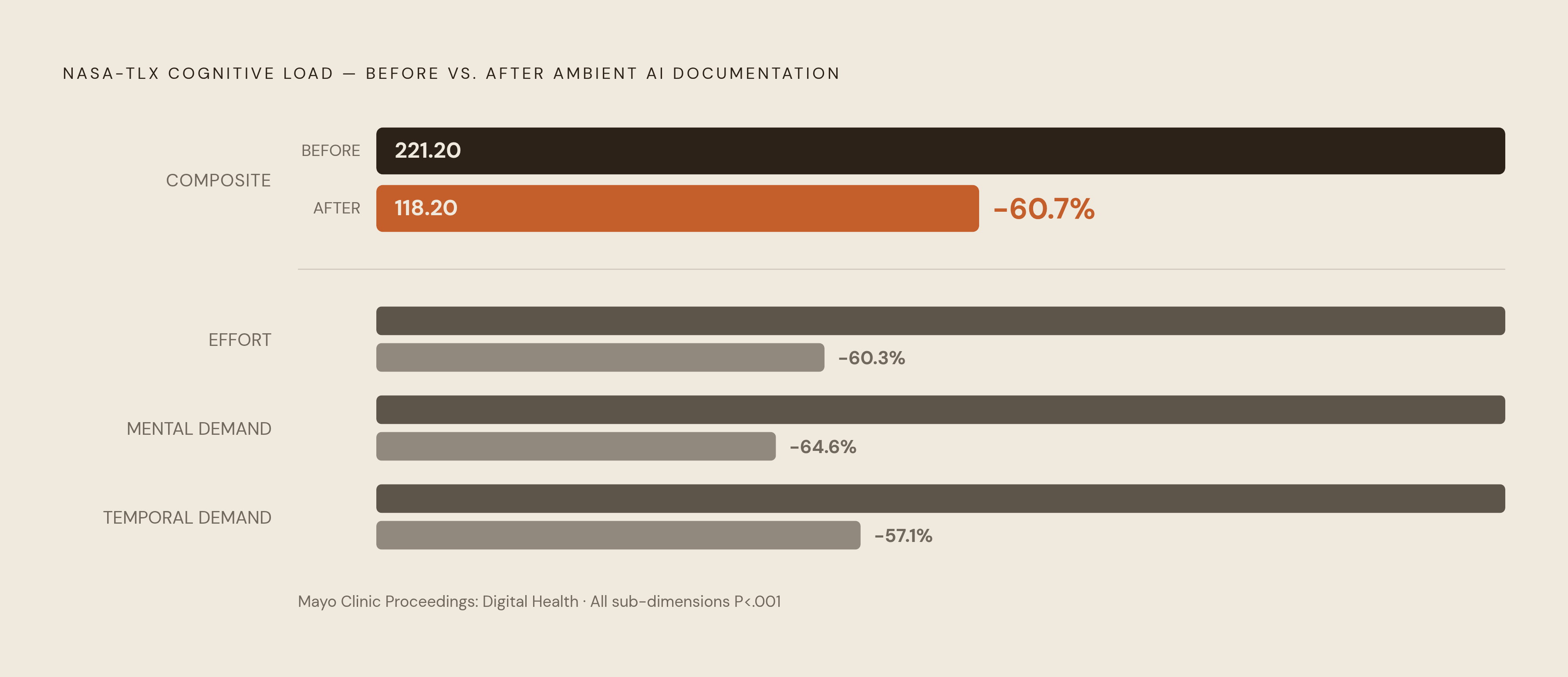
The evidence points toward ambient, passive capture instead. A prospective interventional study published in Mayo Clinic Proceedings: Digital Health found that ambient AI documentation cut the composite NASA-TLX cognitive load score by 60.7%, from 221.20 down to 118.20. Broken down, effort dropped 60.3%, mental demand dropped 64.6%, and temporal demand dropped 57.1%, all statistically significant at P<.001. The system captures and organizes clinical information without forcing the clinician to shift context or type the same thing twice, so the note gets built from what already happened in the room instead of reconstructed from memory three hours later.
Applied to skilled nursing, the same principle points toward working from documentation nurses are already producing inside their existing EHR. The raw clinical signal already sits in those notes. The failure is that it's unstructured, buried in free text, and invisible at the level of a whole building's risk picture. A tool that reads existing notes and displays compliance gaps, resident-level risk scores, and trend alerts inside the chart adds zero documentation burden. It makes visible what the chart already contains, rather than asking the nurse to produce something new.
Anyone evaluating a tool in this space should press on a few points rather than take a sales pitch at face value. It should work with what nurses are already writing, rather than require entering data into some new system on top of the EHR. Does it flag risk at the individual resident level, or only spit out aggregate quality metrics after the fact, once it's too late to act? Does it track the incident categories that actually drive regulatory exposure (falls, medication errors, hydration, skin integrity, behavioral changes), or only some of them? And does it catch a gap before a surveyor or auditor finds it, or does it just document the damage afterward? A tool that fails that last question is a record of what already went wrong. It's a record of what already went wrong.
Continuous Compliance Readiness Without Manual Review Burden
Compliance readiness, done right, is the running quality of everyday documentation, made visible continuously rather than reconstructed under deadline pressure. Facilities that treat it that way are structurally different from the ones scrambling three days before a surveyor walks in, and that difference is visible in audits and inspections long before any audit itself happens.
Operationally, that shift changes what a nursing manager's day looks like. Instead of auditing charts after the fact, the manager prioritizes risk before an incident happens, knowing which residents need eyes on them today rather than reviewing who needed eyes on them last week. Compliance gaps get caught inside the building, by the facility's own systems, instead of getting caught by a surveyor standing in the hallway. MDS accuracy improves for a fairly simple reason: the notes feeding the assessment are richer and more consistent, because someone captured them close to the moment they happened rather than pulling them from a depleted memory at the end of a twelve-hour shift.
Sources
- What is Cognitive Load and How to Manage It for Clinicians? | AHA
- Impact of Ambient Artificial Intelligence Documentation on Cognitive Load
- JMIR Medical Informatics - Impact of Electronic Health Record Use on Cognitive Load and Burnout Among Clinicians: Narrative Review
- nursingoutlook.org
- aacn.org
- medicareadvocacy.org