Why Nursing Managers Miss Resident Deterioration Signals in LTC
Subtle signals and thin staffing make early detection structurally difficult.
A nursing manager who misses the early signs of a resident's decline is, in the overwhelming majority of cases, not failing at the job. The care environment itself, structured around subtle clinical presentations, thin staffing, and documentation systems that hide what staff already wrote down, produces conditions that make early detection genuinely hard to achieve. This piece sets that structure out layer by layer: the biology of deterioration in older adults, the workforce conditions that prevent sustained observation, the architecture of the electronic health record, the regulatory consequences now attached to all of it, and why the common fix, threshold alerts, doesn't reach the actual problem. Each layer compounds the one before it, and understanding how they fit together is the starting point for closing the gap before a hospitalization or a survey citation does it first.
Why deterioration so often goes unnoticed in long-term care
Older adults in long-term care don't deteriorate the way clinical training prepares staff to catch, with acute, visible episodes. Signs are often subtle or absent, and the trajectory a resident follows once decline starts can be genuinely unpredictable from one day to the next. Many residents also under-report symptoms to the people caring for them, so a nurse or aide may have no verbal complaint to go on. A condition that starts out entirely treatable, mild dehydration, a low-grade infection, a small shift in behavior, can turn into sepsis, a hospital admission, or death once the window for early intervention closes. A 2025 multicenter qualitative study in the Journal of Nursing Scholarship ties delayed detection of acute deterioration in care home residents directly to avoidable hospitalizations and adverse outcomes, including premature death.
How the clinical signals themselves resist detection
Early deterioration in older adults rarely looks like a single dramatic event. It appears as a slight change in behavior, a small shift in how a resident walks or gets out of a chair, a respiratory pattern that's drifted just a little from baseline, or a vital sign trend that's heading in the wrong direction without yet crossing any defined threshold. None of this resembles the sharp, discrete presentations that most clinical training is built to recognize. The skills nurses bring to the bedside are tuned for a different kind of event than the one actually unfolding. Compounding this, older residents often don't report what they're feeling, whether from cognitive decline, stoicism, or simply not recognizing the change themselves. A qualitative study across 14 long-term care facilities found that nurses lean heavily on direct care workers for this reason: these workers spend the most concentrated time with any given resident and carry day-to-day responsibility for their care, which puts them in the best position to notice something's off even when no one can say what. The widest gap between how clinically significant a sign is and how visible it actually becomes occurs in the conditions that drive the most regulatory exposure: falls, dehydration, skin wounds, behavioral change, and low-grade infection. Even a fully attentive, well-trained nurse runs into a real obstacle at the level of biology and presentation alone, and that's before staffing or documentation enter the picture.
Staffing ratios and role overload in the detection gap
The staffing structure common to skilled nursing facilities spreads the burden of detection across a workforce that doesn't have the time, continuity, or consistency that surveillance of this kind requires. One workforce report puts typical direct care worker-to-resident ratios at a level that leaves each direct care worker responsible for enough residents that systematic, individualized observation becomes structurally out of reach during any single shift. The constraint is math: there simply isn't enough time in a shift to observe every resident closely enough, often enough, to catch a trend before it becomes a crisis.
Nursing managers face a version of the same problem, but at a different level. The role carries simultaneous responsibility for organizational change, staff management, regulatory compliance, and daily operations, all of which pull directly against the time needed to sit down and actually study resident trend data. High turnover makes this worse in a specific way: a staff member who has never met a resident before has no baseline for what "normal" looks like for that person, and without a baseline, deviation from it is invisible. Long-term care work is defined by heavy workloads, long hours, and compensation that drives people out of the field, and that attrition cycle keeps resetting the clock on institutional knowledge of individual residents. The 2025 Journal of Nursing Scholarship study names gaps in workforce knowledge, experience, and confidence as significant barriers to catching acute deterioration early, and it notes that the mix of staff roles found in care homes makes it even harder to recognize consistently.
There is evidence that targeted support can move the needle. One hospital avoidance program, piloted by a university and later expanded through another institution, paired nursing staff with decision-support tools and structured clinical review, and admissions to the hospital fell as a result. That result shows the detection gap can narrow with the right support in place, but it also shows the gap is a structural default, not something that closes on its own. The combined effect of thin staffing and fragmented management time is intermittent, manual observation carried out by rotating staff who may not know the resident, overseen by a manager whose attention is split across responsibilities that have nothing to do with clinical trend-watching.
The clinical record's concealment of staff observations
The electronic health record functions day to day in long-term care in a way that makes the richest clinical information the hardest to find. Most of what goes into an EHR is unstructured, free-text notes written by nurses and aides in their own words, yet most monitoring and reporting tools work exclusively from structured fields: vital signs, lab values, demographics, diagnostic codes. A clinician's progress note might contain exactly the detail that matters most, a subtle change in mental status, a behavioral observation, a worry about where a resident's condition seems to be heading, but none of that language exists in a form any dashboard is built to read. It never reaches a nursing manager's screen.
An aide who notices that a resident "seemed off" this morning may well write that down, but a manager scanning structured data has no way to see it, because the observation never took a form the reporting system recognizes, leaving both the observation and its absence invisible. The qualitative study of 14 long-term care facilities found that informal information sharing between nurses and care workers, not the clinical record, is the primary mechanism nurses actually rely on to detect deterioration, which tells you the record isn't doing the job it's supposed to do. The National Institute on Aging-funded Long-Term Care Data Cooperative demonstrates just how much value sits unused in these notes: when SNF EHR data was linked with hospital transfer records, phrases like "labored breathing and confusion" or "dyspnea and hypotension" reliably predicted sepsis diagnoses. The signals were written down. They were structurally invisible to the care team at the moment they mattered most. What looks at first like a problem of attentive nurses missing things turns out to be a problem of a documentation system that buries what those nurses already caught, and that invisibility carries consequences well beyond the bedside, into the regulatory record itself.
What regulators now expect facilities to catch (and document)
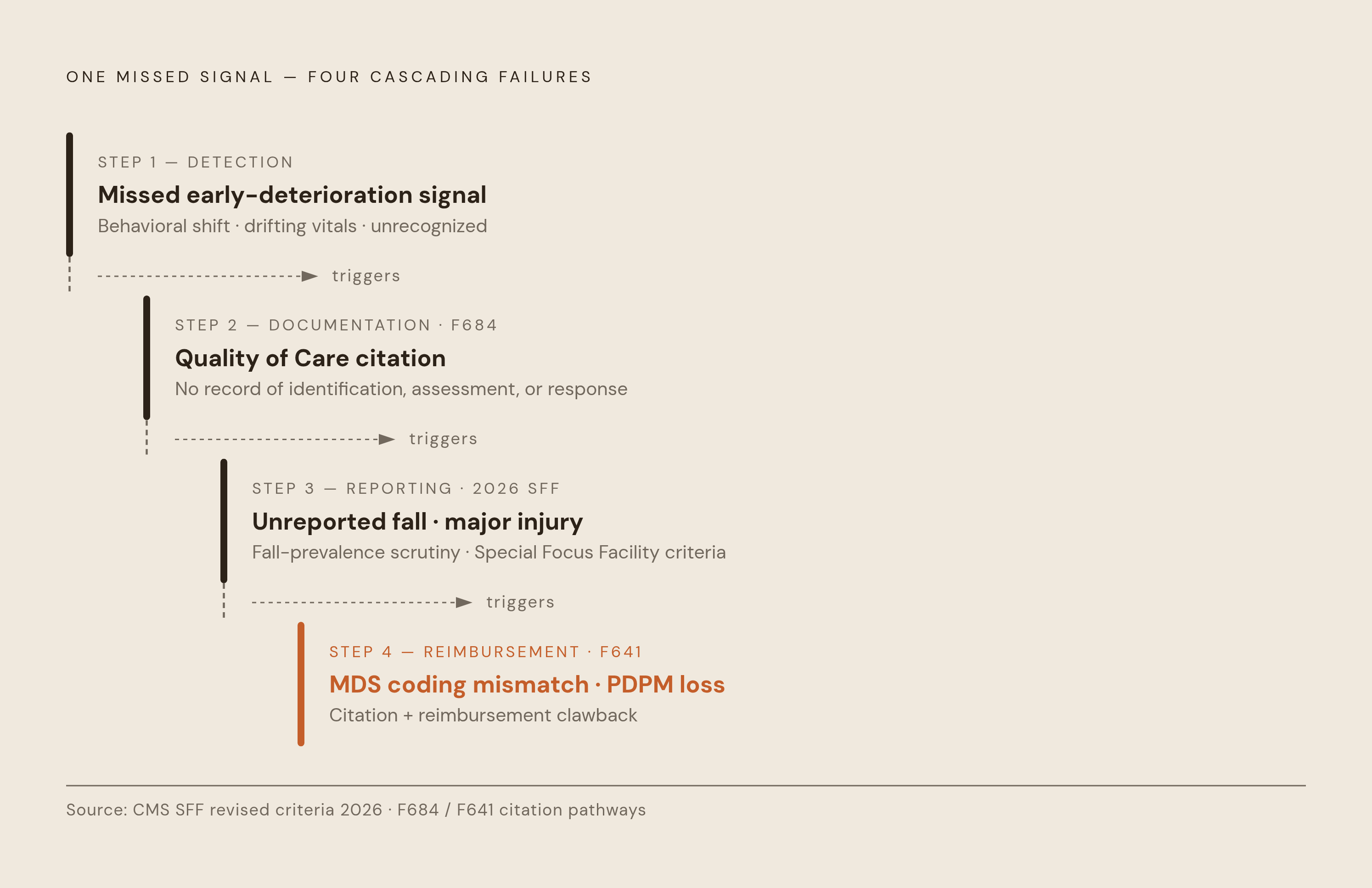
Federal regulators now treat the failure to detect and document early deterioration as a specific, named compliance risk, and recent rule changes have sharpened that exposure. F684, the Quality of Care tag, is cited when the record doesn't show that the care team identified, assessed, and responded to a resident's changing condition. The detection failure and the documentation failure are, for survey purposes, treated as one and the same event. F689, covering freedom from accident hazards and adequate supervision, remains among the most frequently cited tags nationally, and deficiencies arise whenever documentation of fall risk assessments, supervision plans, or care interventions is incomplete or out of date.
The stakes have grown sharper on two fronts recently. A federal oversight report found that nursing homes failed to report a large share of falls involving major injury and hospitalization among Medicare-enrolled residents. In early 2026, CMS revised its Special Focus Facility program to include falls prevalence as a selection criterion, so deterioration-related outcomes now help decide which facilities get this most consequential regulatory designation. Separately, CMS updated its Long-Term Care Survey Process guidelines with revised F641 guidance, effective April 28, 2025, that explicitly requires surveyors to check MDS coding accuracy against the clinical record. When the two don't match, facilities face both a compliance citation and reimbursement consequences under PDPM. The same 2025 LTCSP guidance names falls, weight loss, dehydration, pressure ulcers, elopement, and resident altercations as examples that can indicate insufficient staffing, tying deterioration detection directly to staffing citations as well. Detection failures no longer sit in isolation. They cascade into fall reporting, staffing adequacy findings, and reimbursement accuracy all at once.
Why single-trigger monitoring does not close the structural gap
The most common early-warning approach in long-term care relies on single triggers: a fever that crosses a set point, a blood pressure reading outside a defined range, a fall that's already happened. Each of these events is only measurable once a clinical process has already moved past its earliest, most treatable stage. By the time a threshold trips, the resident has typically already crossed from "trending" to "acute," and the chance for low-cost intervention has usually passed with it.
What threshold systems miss by design is precisely the material covered earlier: the subtle behavioral change, the gradual shift in mobility, the respiratory pattern that's drifting rather than breaching, the vital sign that's trending in a troubling direction without crossing any line. That language exists in nursing notes constantly. Structured monitoring never surfaces it. One might argue that threshold systems earn their keep through simplicity and actionability, but the regulatory record argues otherwise: falls, sepsis, and pressure ulcers, the very outcomes driving F684 citations and SFF designations, are exactly the conditions that threshold-based monitoring consistently catches too late to prevent.
Evidence suggests the earlier signal is there to find. A JAMDA study describes a predictive model built to identify SNF residents at risk of hospitalization or death within a seven-day window, and it performed with significant accuracy, so you can detect trend-based risk signals well before a threshold event occurs, if you use the right data. The Long-Term Care Data Cooperative's work makes the same point from a different angle: SNF EHRs capture clinical detail unavailable from any other source, and that detail is already being written down during routine care. The failure sits in how that data gets read and surfaced afterward, not in whether it exists.
Turning existing documentation into trend intelligence
Nursing managers don't need more data collected. They need the intelligence already sitting in the notes their staff write every shift, made visible, continuous, and ranked by priority, before a surveyor or a hospitalization finds it first. Every structural barrier covered so far, subtle clinical presentation, thin staffing, an EHR that hides what nurses already recorded, points to the same underlying fact: nurses and aides are already observing and writing down early deterioration signals. The failure is one of extraction. No dashboard reads those notes, no alert references them, and no risk score accounts for them.
Tools that read unstructured clinical notes straight from existing EHR documentation, without asking staff to enter anything new, fix that barrier at its source. They work from documentation that already exists, so an already-stretched care team doesn't have to take on new workflow. A continuous, resident-level risk score built from that existing documentation gives a nursing manager a ranked view across an entire resident population, showing where deterioration trends are forming, continuously updated as new notes come in. Predictive analytics that draw on EHR data, clinical indicators, and trend patterns to flag high-risk residents can support exactly this kind of proactive intervention, the same type of approach that the hospital avoidance program at Yaralla Aged Care Facility used to meaningfully reduce hospital admissions and length of stay when nursing staff had decision-support tools and guided clinical review behind them.
The compliance benefit follows directly from the clinical one. Continuous, documentation-grounded risk monitoring produces an audit trail that speaks straight to the F684 and F689 exposure described earlier: the same record that flags a resident trending toward decline is the record that shows a surveyor the team identified the change, assessed it, and responded. Detection and documentation stop working against each other and start working as one function, built from the words nursing staff were already writing down.
Sources
- Nursing Practice for Early Detection of Long‐Term Care Resident Deterioration: A Qualitative Study - PMC
- Detection of Acute Deterioration in Care Home Residents: A Multicenter Qualitative Exploration of Barriers and Enablers - MacAndrew - 2025 - Journal of Nursing Scholarship - Wiley Online Library
- The effectiveness and cost effectiveness of a hospital avoidance program in a residential aged care facility
- Detecting Acute Deterioration in Older Adults Living in Residential Aged Care: A Scoping Review - Journal of the American Medical Directors Association
- Characteristics of the Long-Term Care Data Cooperative: A New Resource for Research on Outcomes in Long-Term Care - PMC