Near-Miss Reporting Culture in Long-Term Care Facilities
Staffing shortages and weak safety culture keep nursing homes from learning from near misses.
A near miss (or "good catch," in the language nursing staff actually use) is an event that could have hurt a resident but didn't, either because someone caught it in time or because luck intervened before the error finished playing out. A wrong dose gets prepared but a second nurse catches it before it's given. A resident starts to slide out of a chair and a caregiver grabs them. A loose rug gets spotted before anyone walks over it. None of these count as adverse events because no harm reached the resident, but all of them expose the same cracks in the system that produce actual injuries. That's what makes near misses more useful than the incidents that make it into a lawsuit file: they happen far more often, they show the same failure points, and they appear while there's still time to fix something. The trouble in long-term care specifically is that these signals barely make it onto paper. Research published in PMC notes that facilities don't even know how many falls go unreported to nursing staff by residents themselves, and near misses that staff actually witness still go undocumented at a troubling rate. Nobody has a hard number for how big that gap is. What follows is an attempt to explain why it exists and what closing it would take.
The scale of preventable harm that near-miss signals are meant to prevent
MedCity News reporting puts the headline number at roughly 1 in 10 patients experiencing harm somewhere in their care journey, with more than half of that harm preventable. That's the baseline across healthcare generally. Now apply it to a nursing home population that's older, carries more chronic conditions, and is less able to speak up when something goes wrong, and the exposure only compounds.
The bigger issue is posture. That same MedCity News reporting found that most healthcare organizations spend their energy responding after harm has already happened rather than building the capacity to deal with precursor events before they turn into something worse. Near misses sit right at that precursor stage, and the piece calls them out directly as one of the most valuable, and most underused, sources of safety data available. Every one that goes undocumented is a system failure waiting to repeat itself. The fact that no one got hurt this time is a warning that nobody acted on. It's a warning that nobody acted on.
Getting at why that data goes uncaptured means looking first at the culture long-term care facilities actually operate in, because it's measurably behind the rest of healthcare on this front.
Safety Culture in Long-Term Care Versus Other Healthcare Settings
Safety culture in a lot of nursing homes is weaker than what you'd find in hospitals or outpatient clinics, a pattern that patient safety researchers have noted consistently. AHRQ's own Nursing Home Survey on Patient Safety Culture shows some improvement over time, but respondents have consistently flagged discomfort speaking up about safety concerns and staffing that doesn't feel adequate to the work as persistent gaps.
Leadership matters enormously here. Research points to nurse managers as the people who set the tone for whether a unit's safety culture holds up or falls apart. The culture swings wildly from one facility, even one floor, to the next depending on who's running it.
What does a weak safety culture look like on the ground? Staff don't report because they have no idea what happens to a report once it's filed. Some worry that flagging a close call reflects on them personally rather than on a broken process. And when nothing visibly changes after someone does report something, the whole exercise starts to feel pointless, so people stop bothering. None of this happens in a vacuum. Research identifies staffing shortages, how nursing homes are structured and financed, and a regulatory climate that often feels adversarial as the conditions that limit how much quality improvement can take hold. Culture initiatives don't succeed against that backdrop on good intentions alone.
The specific barriers that keep near misses out of the incident log
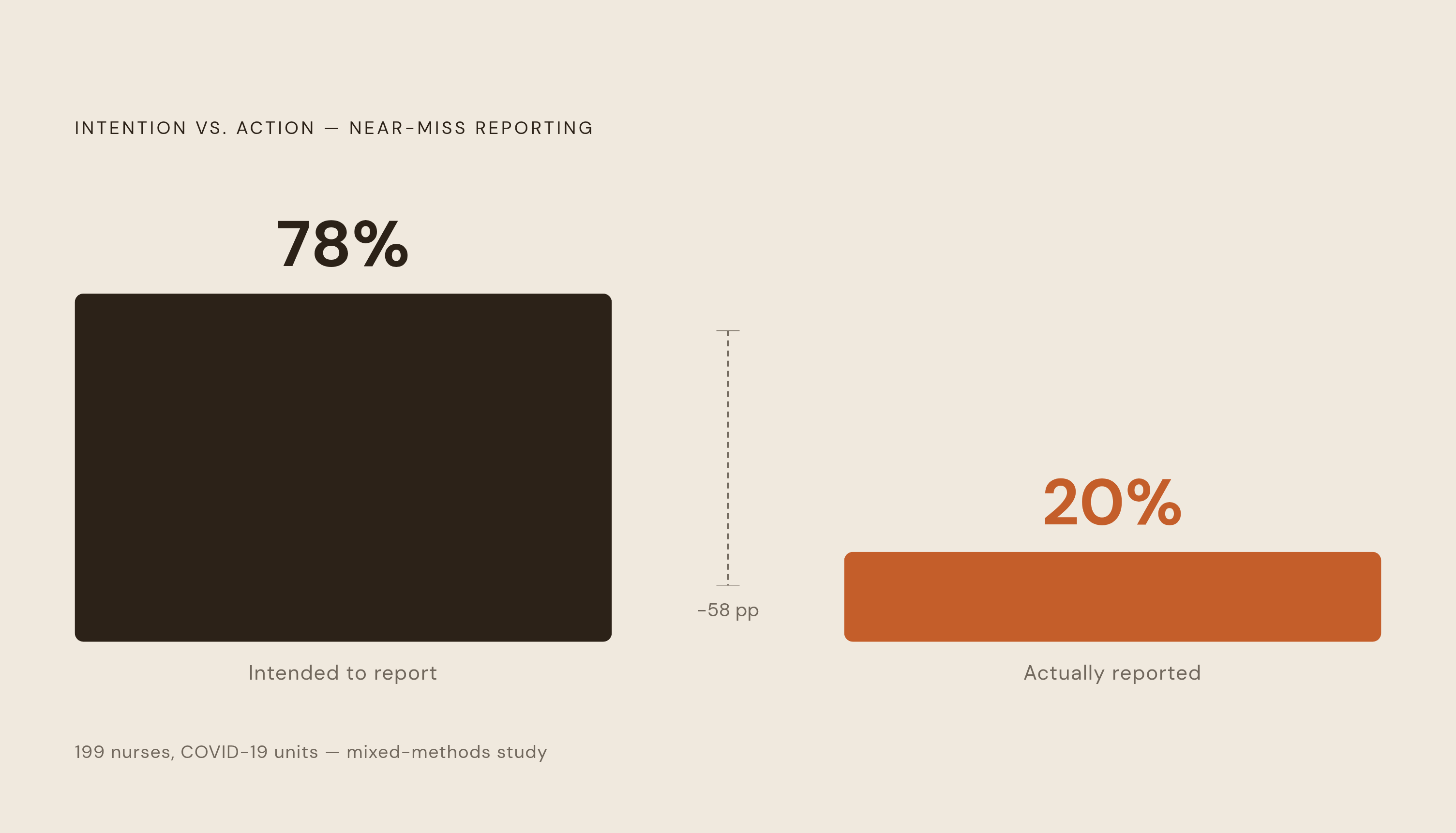
The clearest evidence of the problem comes from a mixed-methods study of 199 nurses working in COVID-19 units, cited by AHRQ PSNet: 78% said they intended to report near misses, but only 20% actually followed through. That gap tells you something important. This isn't a knowledge problem. Nurses already know a close call should be written up. What breaks down is everything between the intention and the act.
A qualitative study built on 13 semi-structured interviews with nursing home nurses, reported in ScienceDirect, lays out what actually gets in the way:
Fear is the top of the list, specifically fear of being blamed or dragged into conflict, since reporting can feel like confessing to a mistake or pointing a finger at a coworker. Unclear outcomes come next: if nothing visibly changes after a report goes in, the motivation to file another one erodes fast. Layer onto that a lack of organizational backing for the act of reporting itself, confusion about which form to use or who to send it to, discomfort with whatever electronic system is supposed to capture it, and the plain fact that in an understaffed shift, the window to document something closes before anyone gets back to it. There's also a judgment call buried in all of this: staff have to decide whether something even counts as worth reporting, and near misses often fall under whatever informal threshold they've set for themselves.
The 199-nurse study backs this up from another angle, pointing to personnel shortages and physical and mental overload as direct drivers of underreporting. The same staffing crisis appears twice, once in the care itself and again in the ability to document it.
The systems in place don't help. A PRISMA systematic review covering 106 studies, all from high-income countries, found a consistent lack of standardized reporting systems and processes across care homes. And the method most facilities still rely on adds its own drag: a policy review by Steer and colleagues looked at 25 policies from 23 organizations and found 19 referred to paper-based reporting, with only 2 built exclusively around electronic systems. Paper is still the default, and paper is friction.
Incident Misclassification and Buried Near-Miss Information
Sometimes the report gets filed and the signal still disappears, buried in how the incident gets described. A fall gets logged as an "unwitnessed event," full stop, with no note about why the resident was alone in the first place, which erases the actual near-miss: what supervision gap let this happen? A resident-to-resident assault gets written up as a "behavioral episode," with no mention of the injury the other resident sustained, which erases the safety signal entirely, and both patterns appear in reporting on nursing home incident documentation. A fall gets logged as an "unwitnessed event," full stop, with no note about why the resident was alone in the first place, which erases the real question: what supervision gap let this happen? A resident-to-resident assault gets written up as a "behavioral episode," with no mention of the injury the other resident sustained, and this erases the safety signal.
The Steer et al. The Steer et al. review finds a related gap on the governance side: of the 25 policies examined, only one built resident accounts and perspectives into the incident report. The person who was actually there, closest to the moment things nearly went wrong, gets left out of the record almost every time.
None of this needs to be deliberate. It can just as easily come from time pressure, habit, or genuine uncertainty about what belongs in the note. The effect is identical either way: the information that would let anyone spot a pattern simply isn't there. That should worry any facility leadership team looking at a clean-seeming incident log. A short log doesn't mean a safe building. It might just mean the documentation culture isn't catching what's actually happening.
Current Regulatory Demands and Penalties for Missed Near-Miss Signals
CMS has continued to update the State Operations Manual, changing how surveyors investigate and how facilities have to respond to deficiencies once they're cited. Civil Monetary Penalties are getting sharper teeth to go with it: the FY 2025 final rule expanded both per-instance and per-day CMPs, giving CMS more room to push for sustained correction rather than a one-time fix.
F-Tags covering accuracy of documentation and the MDS are among the citations that create direct regulatory exposure for facilities. Incomplete or inaccurate incident documentation feeds straight into that exposure.
There's a new incentive running the other direction, too. CMS launched a Risk-Based Survey process on September 8, 2026, and facilities with a strong track record can qualify for a shorter, more focused recertification survey, expected to be shorter and more focused than the traditional Long-Term Care Survey Process. CMS estimates about 12% of nursing homes will qualify at the outset. Eligibility runs on overall quality ratings, staffing performance, accurate data reporting, and survey history, all of which line up with what a facility with a working near-miss program tends to do well.
Quality reporting has direct financial teeth attached now, too. On staffing, the federal minimum staffing rule was formally rescinded through an interim final rule published in December 2025, effective February 2, 2026; the Federal Register recorded this. States now set their own numerical floors, but the facility staffing assessment requirement is still fully in force and still a live survey target. Wisconsin's DHS survey readiness guidance tells facilities outright to review QA committee minutes, grievance logs, and incident logs for trends to act on, tying near-miss logging directly to how ready a facility is when the surveyor shows up.
The Steer et al. review lands on the point that matters most here: incident reporting is a matter of governance as much as it is a matter of practice, and current policy likely leaves a lot of learning on the table that facilities could otherwise capture.
Near-Miss Data as a Predictive Signal
Skilled nursing facilities aren't short on data. Skilled nursing facilities are drowning in data, spread across systems, shifts, and disciplines, and without context attached, none of it actually drives a decision. Near-miss data changes that equation when it's captured systematically, because it becomes an input for risk stratification, a way to flag who's most likely to get hurt next before it happens. A close call is a leading indicator. An adverse event is a lagging one, and by the time you're looking at it, the damage is already done.
Risk stratification itself isn't a new idea in long-term care. Residents get sorted into high, medium, or low-risk groups, and that sorting is meant to shape individualized care plan decisions; a USPTO patent record cited in the research documents this. What's changed is how that sorting happens. AI and machine learning tools can scan patterns across residents, time windows, and conditions to raise risk before it's obvious to a nurse working a packed shift, which in practice means those tools help point staff toward the residents who need the closest look right now, not just the ones flagged on a chart from last week.
PointRight RADAR is one confirmed example of this in the field: a care management tool offering resident-level descriptive and predictive analytics, built to help care teams choose the right course of action for both short-stay patients and long-stay residents using data close to real time; NetHealth's coverage describes this. A near-miss fall gets documented, gets categorized, and gets fed into an analytics system, and as a result that resident's risk score moves up before the next fall ever happens. If the documentation step gets skipped, the signal vanishes. The risk score stays artificially low, and nobody's watching that resident any more closely than before. Cloud-based software and data analytics exist to close exactly that gap, improving operational efficiency and supporting earlier identification of risk; the SNF Metrics blog makes this case. Near-miss reporting, seen this way, is a data supply problem every bit as much as it's a culture problem.
Requirements for Systematic Near-Miss Reporting: Governance, Workflow, and Documentation
Research on near-miss reporting lands on a conclusion that's straightforward enough to act on: building a structured, supportive reporting culture, running real educational initiatives, and simplifying the reporting mechanism itself all improve near-miss reporting in practice, and tackling the barriers directly leads to safer environments and better outcomes for residents.
Governance has to come first, though, and the Steer et al. review from April 2026 shows what that floor looks like today. Of the 25 policies reviewed, 88% referenced other policy or legislative documents relevant to safety incident reporting, establishing a baseline of cross-referencing accountability structures. That's a starting point, not a finish line: accountability has to be spelled out, not implied. Nineteen of those 25 policies still leaned on paper-based systems, which builds friction into the exact moment someone is deciding whether a report is worth the trouble. And as already noted, the Steer et al. review found that only one of the 25 policies built resident perspectives into the incident report, a structural gap facilities can close simply by rewriting the policy to require it.
England's experience with a national patient safety reporting framework offers a useful caution here. A 2025 co-production study found strong agreement that PSIRF standards, built with hospitals in mind, don't map well onto care homes, and flagged specific fixes needed: less NHS-centric language, different training approaches, more resource provision, clearer oversight, and real implementation support; the Journal of Long-Term Care reported this. The lesson translates directly: a framework built for acute hospital care rarely fits a nursing home without real adaptation, and assuming otherwise sets a program up to fail.
Workflow is where all of this either works or doesn't. Any reporting process that adds a brand-new documentation task on top of an already-stretched shift is going to lose to the staffing and time pressures already described. The mechanism has to run off documentation that already exists, or it has to be close to frictionless at the point of care, because "close enough" isn't good enough when a nurse has six more residents to see before the shift ends. Clinical notes already contain the language of near misses, buried in free text: a resident "almost fell," a medication "nearly given in error," a wound "caught early." That signal sits in unstructured notes today, and the systems built to read that language and surface it turn documentation that already exists into near-miss data, without asking anyone to file one more form.
Sources
- From Close Calls to Safer Systems: Rethinking Near Miss Reporting in Healthcare - MedCity News
- Review of residential and nursing care home policies on safety incident reporting in England
- The relationship between patient safety culture and the intentions of the nursing staff to report a near-miss event during the COVID-19 crisis. | PSNet
- image-ppubs.uspto.gov
- snfmetrics.com
- sciencedirect.com
- federalregister.gov