
F-Tag Deficiency Citations That Name Nursing Staff in SNF Surveys
How F-tag citations name nursing staff and what surveyors document about their care.
F-tag citations function as more than regulatory paperwork, and the mechanism by which they implicate nursing staff is built into the structure of the citation itself. The CMS-2567 statement of deficiencies records what a surveyor saw, written out as narrative, and that narrative routinely names staff conduct, staff role, and the shift when an event happened. An F-tag citation contains four parts: the tag number, the regulatory text drawn from 42 CFR Part 483, a scope-and-severity letter running from A through L, and the surveyor's written account of what was seen or found in the record. The narrative portion is where staff conduct surfaces, because a surveyor does not simply mark a box. The surveyor describes what happened, who was involved, and what the documentation did or did not show.
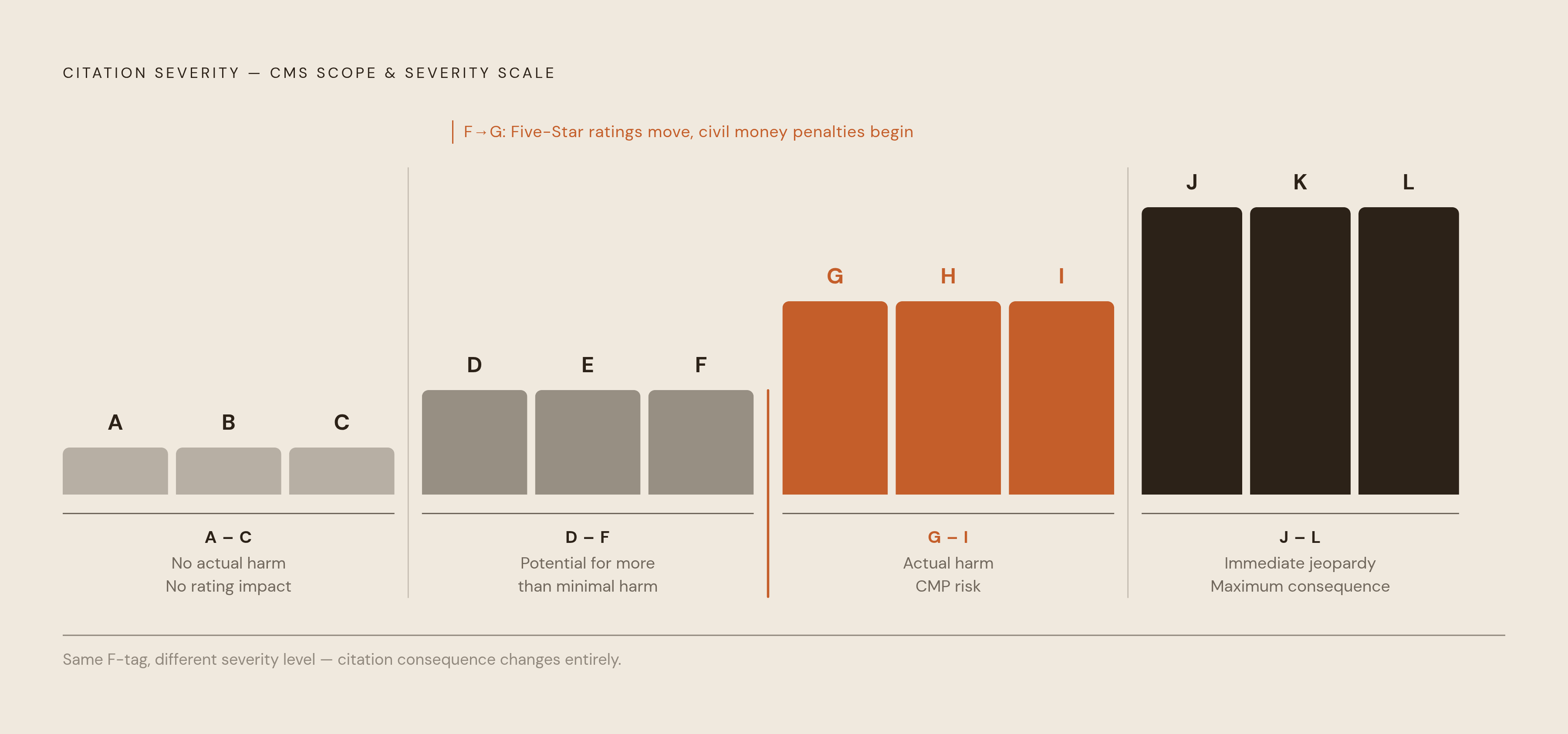
A citation's weight against a facility's Five-Star rating depends on where it falls on the scope-and-severity grid. Findings graded A through C, at the lower end of harm, carry zero rating points, but if a finding reaches actual harm (G through I) or immediate jeopardy (J through L), it carries substantial points. The same tag, cited at a different severity level, produces a very different consequence for the facility and for the staff named in the narrative. This is why two citations under the identical F-tag can mean almost nothing in one survey and a civil money penalty in another.
Surveyors build their findings from the record, not from intent or effort. A nurse who verbally informed a charge nurse of a change in condition, without documenting it, has left no trace a surveyor can credit. A documented assessment, timestamped and signed, carries full weight. This asymmetry, between what staff did and what the record shows they did, runs through every nursing-implicating citation this piece addresses. CMS policy limits the identification of individual residents in these narratives: the State Operations Manual instructs surveyors to use a resident identifier rather than a name, and prohibits discussing results in ways that would reveal a resident's identity. No equivalent protection applies to staff. Role, shift, and conduct stay fair game in the written narrative, and surveyors name them there constantly.
The deficiency landscape nursing staff face in 2026
Deficiency citations have grown across the roughly 14,700 nursing homes operating nationwide. KFF's analysis traces this trajectory and finds that the share of facilities receiving serious deficiencies rose meaningfully between 2015 and 2025. This is not a story about a handful of outlier facilities drawing scrutiny. It describes a sector-wide shift in how often surveys turn up findings that matter.
The tags driving this volume cluster tightly around the daily work of nursing staff: assessing residents, responding to falls, controlling infection, and keeping documentation current. Only a small share of all citations reach actual harm or immediate jeopardy, but those are the citations that move Five-Star ratings, trigger civil money penalties, and produce the surveyor narratives most damaging to a facility's standing. They sit in the care-quality tags, because nursing staff control assessment, documentation, and response directly. The sections that follow work through those tags individually, starting with the two that most directly capture how a nurse's documentation habits become a citation narrative.
F684 and F656: where nursing assessment and care-planning failures become citation narratives
F684, the Quality of Care tag, is where a surveyor's narrative most often names a specific care failure that traces back to nursing conduct. The standard requires that each resident receive care intended to help them attain or maintain their highest practicable physical, mental, and psychosocial well-being. Surveyors cite F684 when staff failed to notify a physician of a change in condition, or when a failure to provide appropriate care produced a decline that the record should have caught earlier. The surveyor is not grading the nurse's judgment in the moment. The surveyor is reading backward from the resident's outcome to the documentation trail that should explain it.
F656, which governs the development and implementation of a comprehensive care plan, covers the infrastructure that supports that care. Missed signatures, late progress notes, unsigned physician orders, and care plans that no longer reflect a resident's current status all appear under this tag. Clinical assessment is supposed to be a continuous process rather than a periodic event. Compliance guidance says staff must complete ongoing assessments and catch changes in condition as they happen, so if a care plan sits unrevised for weeks, that alone is a citation risk, whether or not any harm resulted from the lapse.
Closing that gap takes more than a one-time policy update. A performance improvement approach to F684 and F656 requires an active communication link between the staff observing a resident and the staff responsible for updating the plan, paired with ongoing documentation monitoring that catches gaps before a surveyor does. The operative risk lies in the space between the care actually delivered at the bedside and what the written record is able to show happened. Two related tags extend the same logic into adjacent corners of the record: F657 governs the timeliness of care plan revisions, and F842 governs the completeness of clinical records generally. Each missed update, each incomplete entry, is a finding waiting for a surveyor to find it.
F689: why fall prevention is the tag most likely to produce actual-harm citations against nursing conduct
F689, which covers freedom from accident hazards, supervision, and the appropriate use of assistive devices, produces a higher proportion of serious findings than any other frequently cited tag. Senior Care Report Card's 2026 analysis found 7,378 citations under this tag that reached actual harm or immediate jeopardy, and that volume is why F689 is the tag most likely to produce a damaging surveyor narrative tied directly to nursing conduct. The tag's scope extends well beyond falls: wandering and elopement, altercations between residents, hazards from assistive devices, and physical plant hazards all fall within it. Falls remain the dominant driver of citations under this tag, and they draw the clearest line from a surveyor's finding to the nursing staff responsible for supervision and response.
Compliance guidance built around F689 points to four nursing-driven practices that reduce citation risk, and each one describes what the record must show, not general safety advice. Environmental rounding by an interdisciplinary team identifies hazards before a surveyor arrives to find them independently. If a fall huddle convenes immediately after any fall, while the staff involved are still assembled, it documents the contributing factors and the preventive interventions put in place, instead of leaving that reconstruction to memory days later. Individualized care plan review confirms that the interventions currently in place are documented as either effective or revised in response to new information. QAPI committee trend analysis, covering the time of day, day of week, unit, shift, and equipment involved in falls across the facility, builds the pattern that a surveyor looks for the moment a second fall occurs on the same unit or shift. The regulatory standard does not require that falls never happen. It requires that the facility identified the resident's risks, assessed them, and responded, and surveyors cite F689 precisely when the record cannot produce that chain of evidence.
F580: the notification tag that catches the gap between a clinical observation and a documented response
F580 requires that a facility notify the resident's physician, along with the resident or the resident's representative, of specific changes in condition, accidents, or decisions that affect the resident. The citation occurs when nursing staff observe a change in condition but the record cannot show that notification happened on time. The underlying failure is the absence of a documented response to the clinical event, not the clinical event itself. F580 has frequently been cited when facilities transferred or discharged residents without documenting the reason communicated to the resident and their representative, which illustrates how a notification failure can produce a citation even when the underlying care decision was sound. A surveyor's test under this tag is direct: does a note show who was notified, when, and of what. A verbal notification that was never written down is invisible to the surveyor and carries the same weight as no notification.
F725, F726, and F727: how staffing tags name nursing roles directly in the deficiency record
Three staffing F-tags name nursing roles directly in the deficiency record, and all three remain fully in force in 2026. F725, the Sufficient Nurse Staffing tag, requires enough nursing staff, both licensed and non-licensed, to meet every resident's basic and individualized needs. That means you need licensed nurse coverage around the clock, every day of the week, and a designated licensed charge nurse on each shift. F726 looks at the competency of the nursing staff providing care, and F727 looks at whether a registered nurse is present for the hours federal rule requires.
The Biden administration's minimum staffing hours-per-resident-day rule was repealed effective February 2, 2026, but that repeal does not touch F725, F726, or F727 as operative federal standards. These three tags still govern staffing adequacy on their own, apart from the hours-per-resident-day framework that was rescinded. Revised guidance for F727 took effect April 28, 2025: if no RN hours appear in the Payroll-Based Journal Staffing Data Report and the facility cannot produce acceptable evidence of RN coverage, such as timecards or payroll records, F727 is cited at a minimum scope and severity of F, meaning widespread. If a surveyor can link resident harm to the absence of required RN services, the citation escalates further to actual harm, a domino effect that pulls the related clinical care tag into the same finding.
Surveyors now arrive at a facility already carrying PBJ data. CMS guidance requires that the PBJ Staffing Data Report be used on every recertification survey at a minimum, and citations under F725, F727, and F851, which governs PBJ reporting itself, can be identified from that data before the survey team sets foot in the building. File review during the survey is where contract and agency coverage most often fails. A surveyor pulling a clinician's credential file is confirming that this specific person held the license required to provide this specific care, in this building, on this date. A single gap in one file can support both an F726 citation and an F727 citation simultaneously.
Why staffing citations rarely reach serious severity
Insufficient nurse staffing has historically been cited at low severity far more often than at high severity, and the pattern extends further than that. The Center for Medicare Advocacy documents cases in which facilities cited at immediate jeopardy, the most serious staffing finding available, were not sanctioned for the noncompliance. That record raises an obvious question: if staffing citations so rarely produce serious consequences, why should a facility treat F725, F726, and F727 as high-priority risks?
The answer lies in the domino mechanism built into the citation structure. If a surveyor links a resident harm event to the absence of required RN coverage, a low-severity F727 citation will not stay low-severity. At that point the staffing tag and the clinical care tag it touches escalate together. KFF's 2026 analysis found that facilities with lower staffing levels were more likely to receive serious deficiencies overall, but that shows the staffing gap does not generate the serious finding on its own. It sets up the conditions, and a clinical care tag, such as F684 or F689, does the rest. Managing risk under F725, F726, and F727 means preventing the clinical harm event that turns a routine staffing finding into something considerably more damaging to the facility's record, not just avoiding the staffing citation in isolation.
Using MDS accuracy and real-time documentation to escalate citation severity
Minimum Data Set accuracy has become a parallel track of scrutiny that runs alongside the standard survey process, not in place of it. CMS introduced MDS Validation Audits so it can check that the MDS items supporting the Quality Reporting Program and Value-Based Purchasing reflect what actually happened in a resident's care. Because these audits operate continuously rather than at a single point in time, a facility's MDS accuracy stays under ongoing examination well beyond the window of any single survey.
Outdated or incomplete documentation stands out as the biggest risk factor behind survey findings, especially around decisions on patient discharges, transfers, and antipsychotic medication use. These are areas where the MDS record, the care plan, and the real-time clinical note need to agree, and where any divergence among them gives a surveyor the opening to escalate a finding from a lower severity level to a higher one. The throughline connecting F684, F656, F689, F580, and the staffing tags is the same one introduced at the outset: surveyors build their findings from what the record shows, not from what staff intended or attempted. MDS accuracy and real-time documentation are the mechanism by which that record either holds up under scrutiny or gives a surveyor the evidence needed to raise a citation's severity.