When Verbal Orders Must Be Documented in Long-Term Care Nursing
Nurses must document verbal orders immediately and prescribers must authenticate them promptly.
Verbal orders remain a routine part of long-term care nursing, used specifically when the preferred channel for submitting orders, computerized provider order entry, isn't available to the licensed practitioner in the moment.
Why verbal orders exist in long-term care
Long-term care facilities depend on verbal orders because clinical need doesn't wait for a nurse to reach a terminal, and a physician managing a resident's condition by phone or in a hallway conversation needs a way to issue direction that counts as a real medical order, not a suggestion. Guidance from the Nebraska Board of Nursing and the Washington State Board of Nursing, both drawing on CMS guidance from 2017, treats the verbal order as a backup channel rather than a preferred one: CPOE comes first, and a verbal order is acceptable only when a CPOE or written order can't be submitted by the licensed practitioner at that time. The exchange itself is defined narrowly, as real-time oral communication between a licensed practitioner acting as the prescriber and a licensed nurse with the authority to receive and record that order in the resident's medical record. That structure is deliberately simple: one prescriber, one nurse, speaking in real time, with no intermediary and no buffer. The simplicity is also the vulnerability. Because the transaction runs through a single link, any breakdown in that link, a missed word, a misheard dosage, a nurse who steps away before finishing the entry, becomes a gap in the record with nothing else to catch it.
The risk factors are well understood and none of them are exotic. Telephonic and other audio-only connections make this worse because they strip away the nonverbal cues, like a prescriber's hesitation or a nurse's confused expression, that would otherwise flag a misunderstanding before it becomes an order. The channels available for this kind of communication have actually narrowed over time rather than expanded. The Joint Commission and CMS now allow secure text messaging for patient care orders, but only through a HIPAA-compliant platform and only when the order is promptly entered into the medical record, which tightens rather than loosens the standard a facility has to meet. None of this argues against using verbal orders. It argues for treating the documentation that follows as load-bearing, not administrative.
What the nurse must capture in the medical record
The duty to document a verbal order begins the instant the nurse hears it, not at the next scheduled charting window and not whenever the unit quiets down enough to catch up on paperwork. The Long-Term Care Pocket Guide to Nursing Documentation sets this as the baseline standard: verbal and telephone orders must be recorded on the resident's clinical record immediately by the person who received them, and that entry has to be signed and dated by that same person. What has to appear in that entry is specific rather than general. Arkansas's Table 11 on verbal orders lays out the same elements in policy form: who is authorized to receive these orders, the requirement to repeat the order back for accuracy, identification of the ordering doctor, identification of the receiving nurse by name and title, and entry of the order followed by the receiving nurse's signature. Different states phrase it differently, but the content required is the same across sources, because the content is doing the same job everywhere: reconstructing, after the fact, what was said, by whom, to whom, and when.
Read-back is built into that same immediate act of documentation rather than sitting beside it as an extra step. Every verbal order has to be stated clearly by the prescriber, repeated back in its entirety by the nurse receiving it, and confirmed, a sequence that applies whether the order comes from the physician directly or from a delegate authorized under 42 CFR 483.30(e). The Nebraska Board of Nursing goes further and recommends that prescribers give the nurse time to get in front of a computer with the resident's record open, so the order can be entered directly rather than relayed from memory a few minutes later. None of this shifts where responsibility sits. An order also has to be complete enough that no further medical judgment is required to carry it out. The nurse has to confirm it fits the resident's plan of care and ask for clarification immediately if it doesn't, rather than guessing and documenting the guess as fact.
The authentication deadline: the federal floor and state ceilings
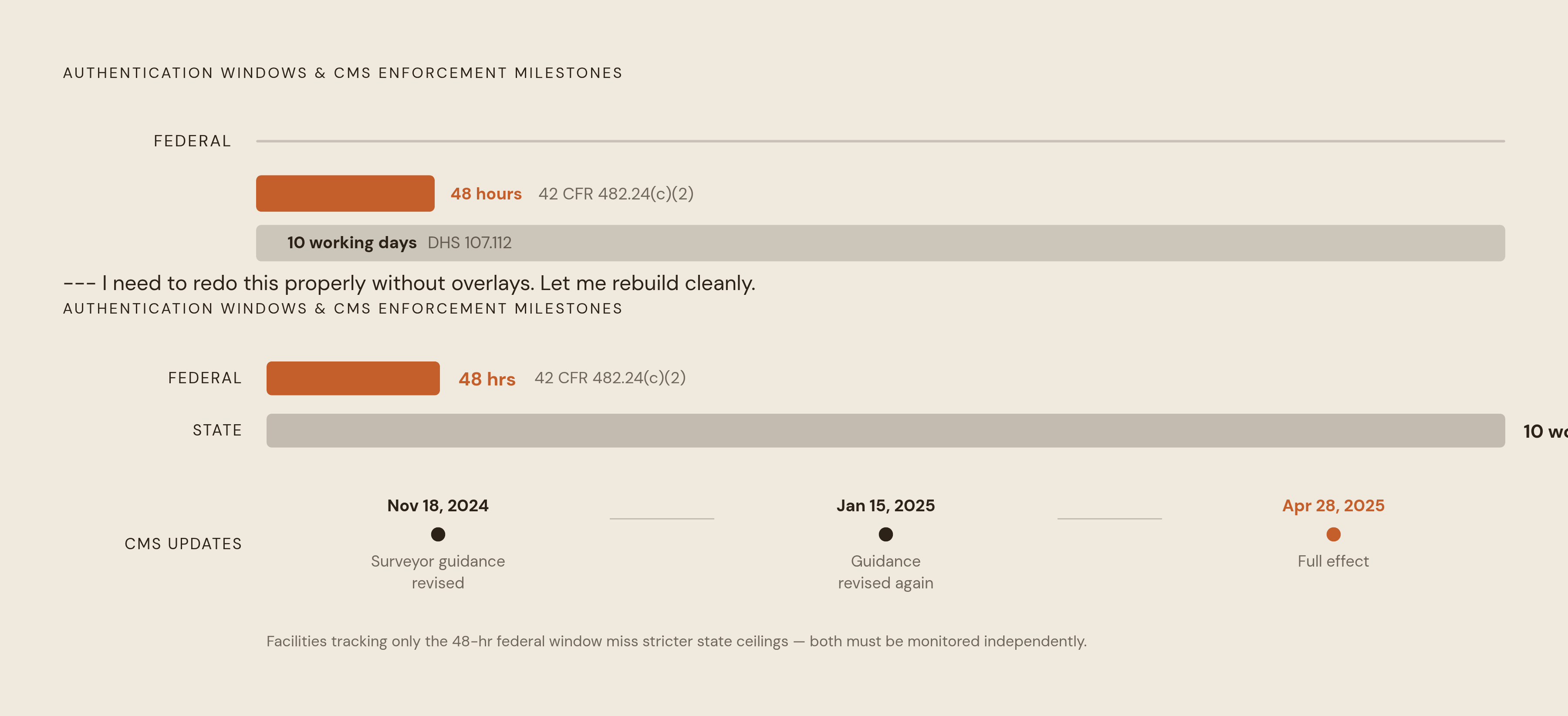
Once the order is documented, a second clock starts, and this one belongs to the prescriber rather than the nurse: the authentication deadline. Under 42 CFR 482.24(c)(2), every order, including verbal orders, has to be dated, timed, and authenticated promptly, and CMS defines "promptly" as 48 hours unless state law sets a different timeframe. Authentication itself is a distinct act from the nurse's initial entry: it's the point where the ordering practitioner reviews the transcribed order and signs it to confirm that what was written down matches what was actually said.
State requirements vary enough that a facility operating across state lines, or even just assuming the federal number applies everywhere, can end up out of compliance without anyone having done anything obviously wrong. Code DHS 107.112, requiring the ordering provider's signature within 10 working days of the order being given. A facility has to know its own state's deadline and treat it as controlling whenever it's stricter than the federal floor, instead of defaulting to the 48-hour figure as if it applied uniformly.
Who is permitted to sign off on the order isn't always a settled question either. Tasks like verifying and signing orders in a nursing facility can be delegated to a PA, NP, or clinical nurse specialist who isn't a facility employee but who works in collaboration with a physician. Whether that non-physician practitioner is employed by the facility or works independently in collaboration with one changes what co-signature requirements apply, and that distinction is one of the more common sources of confusion facilities run into. A facility that doesn't track which category its collaborating NPPs fall into risks building its authentication process around the wrong assumption.
EHR Integration and the Enforcement Bar on Authentication Timing
The rules on authentication timing haven't changed in substance, but the way surveyors enforce them has changed considerably, and that shift traces directly to the spread of electronic medical records. Once electronic signatures and timestamped systems became the norm, that slack disappeared, because the exact moment an order was entered and the exact moment it was authenticated are now both recorded automatically and visible to anyone reviewing the chart. A surveyor no longer has to take a facility's word for when something happened. Late or corrected entries used to support orders for inpatient admission or outpatient observation services are now rejected outright on medical review, treated as though they were never made. A gap in the timestamp is functionally treated as a gap in the care itself. That has reimbursement consequences as well as survey consequences: failing to authenticate an order properly and on time can affect whether a claim tied to that order gets paid, independent of whether the care delivered was appropriate.
This enforcement shift is current, a present risk facilities must address now. CMS released revised surveyor guidance in Appendix PP of the State Operations Manual on November 18, 2024, and state survey agencies are required to follow it. CMS then revised that guidance again on January 15, 2025, pushing the effective implementation date, with the updated guidance taking full effect on April 28, 2025. The March 2025 effective date allowed time for surveyors and nursing home providers to be trained, meaning facilities surveyed after that date are being assessed under the updated framework. Facilities that haven't adjusted their internal authentication tracking to match this reality are operating under rules that no longer apply.
What a documentation gap costs: survey deficiencies, denied claims, and legal exposure
A missing or incomplete verbal order entry doesn't create one kind of problem. Getting the documentation wrong can trigger a formal survey deficiency, put a facility's certification at risk, and lead to denied payment for services that were, in fact, delivered to the resident. CMS enforcement includes civil monetary penalties that can be charged per day until the problem is fixed, or per instance for a one-off deficiency. A documentation pattern that looks minor in any single case can add up fast once it's treated as a repeated failure rather than an isolated one. A facility with incomplete records can end up in a weaker position on both the survey and legal fronts even when the underlying care was entirely appropriate, simply because the record can't prove what happened.
The litigation side carries its own weight. Verbal order failures sit directly inside both categories at once. An order that was given correctly but never properly recorded can later look, in a lawsuit, exactly like an order that was never given in the first place, or like an order that was given and then ignored. The documentation is the only evidence that separates a facility that acted appropriately from one that appears, on paper, not to have acted.
Why documentation gaps also degrade the clinical data that protects residents
The damage from an undocumented or late-entered verbal order doesn't stop with the individual resident or the individual survey cycle. It extends into every system a facility uses to watch for patterns across its resident population, because those systems can only analyze what's actually in the record. When a verbal order never gets entered, or gets entered late, the clinical event behind it becomes invisible to any tool built to catch early signs of declining health, since risk stratification and predictive monitoring tools depend on a record that's both complete and current. Nursing homes already struggle with data fragmentation, since EHRs, claims systems, and other data sources often sit in separate silos that don't talk to each other well, and a verbal order that doesn't get documented promptly adds to that fragmentation from inside the EHR itself, not just across systems. A medication change ordered verbally and never properly logged is invisible when that analysis runs, no matter how sound the analysis is.
The same logic applies to the newer predictive tools built to flag problems before they become emergencies. Tools for fall prevention, behavioral change monitoring, and hydration tracking work by detecting patterns across documented clinical events, and a verbal order for a fall-risk medication adjustment that never makes it into the record removes exactly the kind of signal those tools are built to catch. This is the direct mechanism by which a documentation failure at the point of a phone call turns into a missed intervention weeks later, because the system meant to catch the warning sign never had the information it needed.
Where the documentation burden falls on nursing managers
Verbal order documentation sits at a genuinely difficult intersection: real-time clinical urgency on one side, and a precise, after-the-fact documentation obligation on the other, and that collision produces structural gaps even in facilities that run tight, well-trained nursing operations. The broader burden of clinical documentation has already eaten into the time nurses can spend on direct resident care, and a verbal order is one of the sharpest points of that tension, because the nurse has to do two demanding things at the exact same moment. One is clinical judgment: is this order appropriate, does it fit the resident's existing plan of care, does something about it warrant a question before proceeding. The other is precise transcription: the exact drug, dose, route, frequency, the time the order came in, and the full name of the practitioner who gave it. Both have to happen in the same few seconds, under whatever conditions the unit happens to be in at that moment. None of that responsibility shifts onto the EHR system or onto the prescriber afterward. Guidance from the Washington NCQAC is explicit that accountability for following a verbal order correctly stays with the nurse, not with the record-keeping system that stores the entry.
Technology is starting to offer some support for the mechanical side of this problem, though not for the judgment side. Automatic speech recognition and note summarization are already common in hospitals and clinics during patient consultations, and extracting medical orders directly from conversation transcripts to populate the EHR is a natural extension of that same technology. The MEDIQA-OE 2025 shared task was the first research challenge built specifically around extracting medical orders from doctor-patient conversations, and it drew six participating teams, a sign that researchers are now working directly on the kind of nurse-dictation-to-order pipeline that skilled nursing facilities rely on every day. Tools like this may eventually reduce the mechanical burden of transcription. They won't change who is responsible for confirming that the order makes sense for the resident in front of them, and the documentation obligation begins the moment the order is spoken.
Sources
- Long-Term Care Long-Term Care Pocket Guide to Nursing Documentation Nursing
- eCFR :: 42 CFR Part 483 Subpart B -- Requirements for Long Term Care Facilities
- NCQAC Advisory Opinion 6.0 Standing Orders and Verbal Orders Page 1 of 4
- Verbal Orders page 1 Nebraska Board of Nursing Advisory opinion
- TABLE 11 VERBAL ORDERS Basic Premise: Verbal orders may be
- Overview of the MEDIQA-OE 2025 Shared Task on Medical Order Extraction from Doctor-Patient Consultations
- Evaluating Prompting Strategies with MedGemma for Medical Order Extraction