
Skin Injury Incident Reporting vs. Pressure Injury Staging in SNF Charts
Misclassifying wounds as pressure injuries inflates facility rates and triggers survey citations.
A skin tear and a pressure injury look similar enough on a dressing change that a rushed nurse can chart one as the other without realizing it. That single substitution, repeated across a facility's census, distorts MDS Section M data, skews the pressure-injury rate CMS publishes for that building, and hands surveyors a documentation inconsistency they are trained to catch. The two wound types trigger entirely separate documentation pathways: pressure injuries flow into Section M and public quality measures, while skin tears get captured as incident documentation tied to a specific event. Most of these errors rest on a simple, rarely stated assumption: a wound is a wound, so close enough is good enough. It isn't, and the gap between those two ideas is where coding accuracy, survey findings, and reimbursement all take their hits. What follows is an accounting of how these two tasks differ, where they legitimately cross paths, and what correct separation looks like at the point of charting.
What separates a pressure injury from a skin tear and its look-alikes
Mechanism decides the classification, not appearance. A pressure injury is a perfusion problem: sustained loading over a bony prominence cuts off blood flow, and the tissue dies from the inside out, often before the skin surface shows much of anything. A skin tear is mechanical, full stop. Acute shear or friction peels the epidermis away from the layer underneath it, and the damage starts at the surface and stays there. Treatment logic follows straight from that distinction. Offloading a body part does nothing for a skin tear, and trauma protection does nothing for a pressure injury, so a misclassification isn't just a paperwork problem. It sends the care plan in the wrong direction.
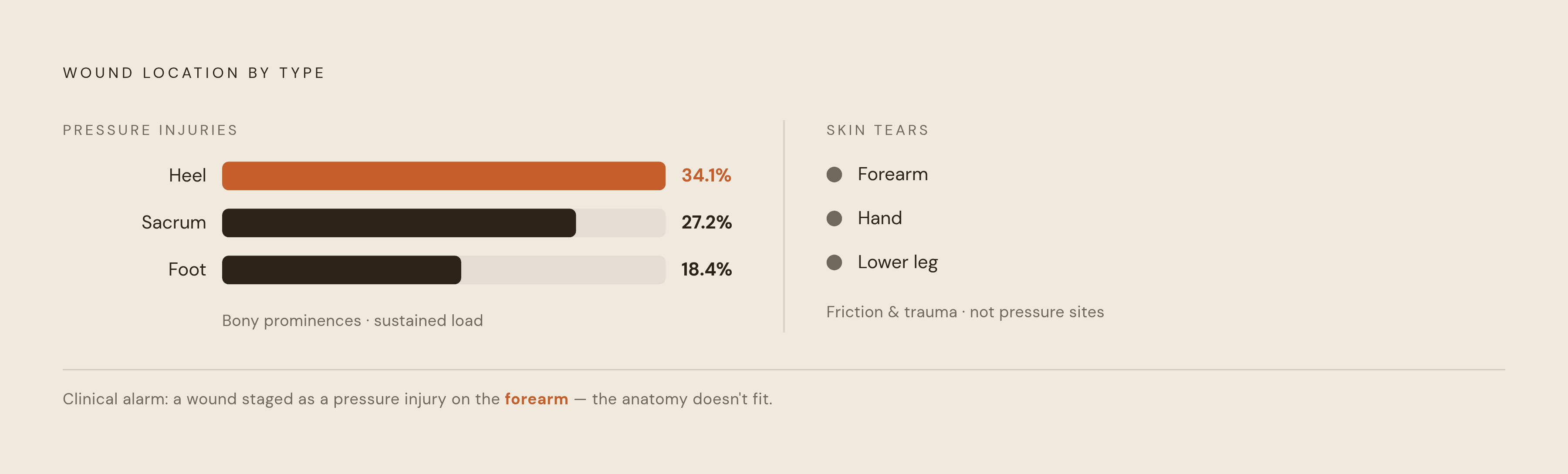
Location offers a useful bedside signal, though it's a signal, not a verdict. Pressure injuries cluster at the heel (34.1%), the sacrum (27.2%), and the foot (18.4%), the classic weight-bearing bony prominences. Skin tears appear on forearms, hands, and lower legs, sites where friction and trauma occur, not sustained pressure. A wound staged as a pressure injury but sitting on the forearm should trigger an immediate second look, because the anatomy doesn't fit the story.
The harder problem is the look-alikes, particularly moisture-associated skin damage and incontinence-associated dermatitis. IAD shows up in the perineum and inner thighs, nowhere near a bony prominence, and its cause is moisture and chemical irritation from urine or stool, not pressure. IAD prevalence in nursing homes can reach 30%, according to Medline, making it one of the highest-frequency misclassification risks in the building. This failure mode, clinicians documenting IAD as a Stage 1 or Stage 2 pressure injury, quietly inflates the pressure-injury count while making MASD look rarer than it actually is. The Wolters Kluwer Pressure Injury Pocket Card, updated February 2026, draws the exclusion list explicitly. Incontinence-associated dermatitis, intertriginous dermatitis, medical adhesive-related skin injury, and traumatic wounds like skin tears, burns, and abrasions are not pressure injuries, and none of them get staged using the NPIAP system.
Then there's the edge case nobody has fully solved. Skin failure is a condition gaining recognition without a validated diagnostic framework or a biomarker behind it: there's no bedside test that reliably separates it from a pressure injury. Some wounds develop despite genuinely optimal prevention, particularly in residents carrying multiple comorbidities or limited physiological reserve, and a growing body of evidence suggests not every wound is proof of a care failure. Skin failure lesions can look like pressure injuries and appear in the same places, which makes the boundary genuinely ambiguous at the clinical level. In that gray zone, the job is to document the reasoning, the risk factors, and the clinical judgment that led to whatever classification gets chosen. It's to document the reasoning, the risk factors, and the clinical judgment that led to whatever classification gets chosen. The distinction is causal first and locational second, and documentation has to capture the "why," not just describe the "what."
How the NPIAP staging system works and its limits
The NPIAP system runs on six categories, and each one is defined by depth and tissue involvement, not by size or how bad the wound looks to an untrained eye. Intact skin with non-blanchable erythema defines Stage 1, and it can present very differently on darker skin tones, a detection challenge more than a staging ambiguity. Stage 2 is partial-thickness loss with exposed dermis, a viable pink or red wound bed, or a blister that's intact or ruptured; there's no adipose tissue visible, and critically, no granulation tissue, slough, or eschar. Stage 3 is full-thickness loss with visible adipose, often with granulation tissue and epibole present, but no fascia, muscle, tendon, or bone exposed. Stage 4 is full-thickness loss with exposed fascia, muscle, tendon, ligament, cartilage, or bone. Unstageable means the wound base is obscured by slough or eschar, so no stage can be assigned until that base becomes visible. Deep Tissue Pressure Injury is intact skin over deep maroon or purple discoloration, and it is a distinct category from the purple or maroon changes that sometimes get folded, incorrectly, into a Stage 1 assessment.
Stage 2 is where most of the trouble lives. It gets misapplied more than any other category, and the Wolters Kluwer Pocket Card (February 2026), states the rule without hedging: Stage 2 must never be used for MASD, IAD, ITD, MARSI, or traumatic wounds. Not as a judgment call. As a hard exclusion.
A Stage 3 pressure injury that starts granulating and closing does not become a Stage 2 as it heals, because the intuition that it should runs the wrong way. A Stage 3 pressure injury that starts granulating and closing does not become a Stage 2 as it heals. It stays a Stage 3, documented going forward as a Stage 3 healing wound, because staging tracks the deepest tissue damage the wound ever reached, not its current depth. Downgrading a healing Stage 3 to a Stage 2 is a documentation error, and a high-stakes one, since it understates the wound's history in the chart.
On terminology: the CMS RAI Version 3.0 Manual, in the MDS v1.20.1 update from October 2025, confirms that "pressure ulcer," "pressure injury," "pressure sore," "decubitus ulcer," and "bed sore" are all acceptable terms in the clinical record. The label matters less than getting two things right: the primary cause has to be pressure, and the stage has to be coded consistently across the chart. Staging is the foundation for treatment decisions, MDS coding, and survey defense. It's the foundation for treatment decisions, MDS coding, and survey defense, and a mis-staged wound corrupts all three at once.
What MDS Section M captures and how misclassification distorts it
Section M is the data collection point where pressure injuries enter the federal reporting stream. M0300 captures current, unhealed pressure injuries by stage within a seven-day look-back window, and that entry requires supportive documentation across the clinical record to be defensible. The MDS entry is only as defensible as the paper trail supporting it. Section M also distinguishes injuries present on admission from those that developed in the facility, a distinction that matters enormously for separating what the facility caused from what walked in the door.
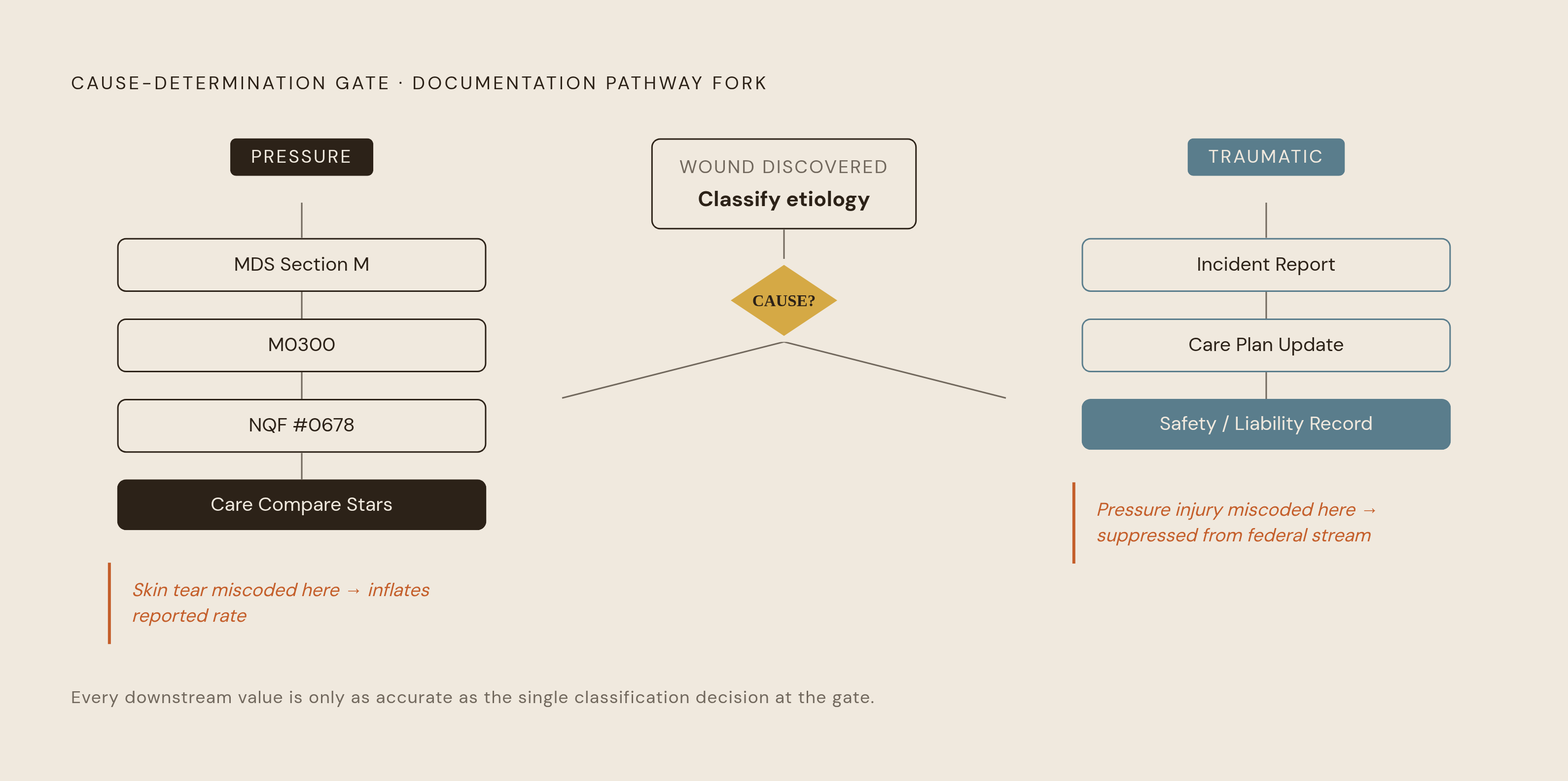
From there, the data travels. Section M feeds the quality measure "Percent of Residents or Patients with Pressure Ulcers That Are New or Worsened" (NQF #0678), which flows directly into Care Compare star ratings. Misclassification distorts that pipeline in two opposite directions. Coding a skin tear or an IAD lesion as a Stage 2 pressure injury adds a wound to M0300 that has no business being there, artificially inflating the facility's reported rate. Documenting an actual pressure injury as a skin tear or a moisture lesion does the reverse: it keeps a real injury out of Section M, which looks like under-reporting the moment a surveyor lays the chart next to the wound itself.
The RAI manual update adjusted guidance on coding pressure injuries present on admission that later heal and then reopen, and it added new guidance on advanced wound care dressings, skin substitutes, and adhesive bandages. Documentation teams need to check current procedures against that update rather than assuming last year's workflow still applies. Separately, the CMS QM User's Manual v18.0, effective January 1, 2026, reinforces a point that's easy to lose in the daily grind of charting: SNF performance is tied increasingly to documentation accuracy. The numbers in the chart are the numbers that score the building, whether or not they reflect what happened at the bedside.
The consequences aren't hypothetical. An Indiana SNF survey finding from January 2025, documented in the Indiana QAMIS report, cited a facility for an MDS assessment that inaccurately staged deep tissue damage on a resident's left heel. One miscoded wound, on one assessment, became a formal survey finding.
The regulatory exposure when these two documentation tasks are conflated
F-tag F686, under 42 CFR 483.25(b)(1), is the primary regulatory anchor for pressure injury care, and it sets a two-part standard: a resident who arrives without a pressure injury shouldn't develop one unless it's clinically unavoidable, and a resident who already has one has to receive care aimed at healing it, preventing infection, and preventing new injuries. Surveyors combine observation, interviews, and record review, and documentation inconsistency feeds directly into that process as evidence. F686 citations typically reflect system breakdowns rather than isolated clinical events: failure to identify risk, failure to implement preventive measures, failure to revise interventions when something isn't working, and inaccurate or inconsistent documentation on top of all of it.
There's a coding layer to this exposure too. The diagnosis code has to align with the documented clinical findings. An auditor reviewing a claim against a clinical note can deny that claim on a staging inconsistency alone. It doesn't matter how good the actual care was. Pressure injury diagnosis codes must precisely reflect the documented wound characteristics, and a mismatch anywhere in that chain is a denial waiting to happen.
State-level penalties add a financial layer on top of the federal one. That's documentation error converted directly into a state financial penalty, no hypothetical required.
The scale of pressure injury prevalence makes the stakes concrete. Pooled prevalence is 11.6% for any-stage pressure injuries across the SNF population, with facility-acquired rates around 8.5%, and individual facility rates ranging anywhere from 2.2% to 23.9%. A facility already near the high end of that range, carrying documentation inconsistencies on top of it, is compounding its own exposure. And underreporting isn't a hypothetical risk sitting off in the future. Research on nursing home ratings in one country's long-term care system. Dermacareseniorsolutions.com cites research on nursing home ratings in one country's long-term care system that found pressure ulcer events aren't always captured accurately in quality data to begin with. Detection and documentation vary by staff, by tool, and by timing. Surveyors know this going in, which is exactly why they cross-check the written record against the wound itself rather than taking the chart at face value.
The incident reporting pathway for skin injuries and its differences from MDS staging
MDS staging and incident reporting serve two different purposes and run on two different clocks. Section M staging is a structured clinical assessment completed on a schedule tied to defined assessment windows, and it feeds directly into population-level quality measures. Skin injury incident reporting is event-based. A skin tear, a bruise, an abrasion, or another traumatic injury triggers the report the moment it's discovered, not on a calendar.
The two documents capture different information for a reason. An incident report records the circumstances of discovery, the clinical response, and relevant notifications, safety and liability documentation built for a different audience than a quality-measure code.
The confusion tends to arise at a very specific moment. A nurse finds an open area on a resident's forearm during morning care, and that finding might get entered as a wound note, an incident report, and a care plan update, all at once. Whether it also belongs in Section M is a separate clinical judgment, one that depends on determining cause rather than simply describing what the wound looks like. Skin tears aren't rare in this population. A study of 23,453 nursing home resident records found skin tears made up roughly 9.41% of documented wounds, common enough that floor staff run into them routinely, so a clean incident-reporting habit directly affects how accurately those wounds get classified and reported.
The correct workflow keeps cause-determination as the gate everything else passes through: assess the wound, determine the mechanism, document the clinical reasoning in the note, then route it. Traumatic wounds go to incident reporting. Pressure-etiology wounds go to Section M. A wound that presents ambiguously, like one sitting over a bony prominence in an incontinent resident, where pressure and IAD are both plausible, might need both pathways, or it might need a clinical documentation integrity query before anyone commits to a stage. That query, sent to the attending or a wound care specialist, is the right escalation. A floor nurse making a unilateral call on an ambiguous wound is not.
How unstructured nursing notes create the documentation gap that misclassification lives in
The clinical intelligence needed to classify a wound correctly usually already exists somewhere in the chart. It's sitting in nursing notes, wound care progress notes, and shift documentation, scattered across entries that rarely get reviewed together as a single narrative between formal assessments. That scattering is the gap misclassification lives in.
Structured MDS fields are only as good as the process that feeds them. If the nurse completing Section M is working from memory, or from one brief wound note, rather than a longitudinal record connecting cause, treatment, and trajectory over time, staging errors aren't a surprise. They're the predictable output of an input problem.
Inconsistency across staff and shifts makes it worse. Dermacareseniorsolutions.com reports that different staff members, using different tools at different times, produce different counts for what should be the same wound in the same resident. That's a documented accuracy problem in SNF pressure injury data, not a hypothetical one. The gap between what a nurse actually writes at 6 a.m. and what eventually gets coded into Section M days later is where both inflation and suppression happen. A skin tear charted in a narrative note as "open area, right forearm, reddened edges" carries no explicit statement of cause, and without that statement, the wound is left to be interpreted by whoever reads the note next, at whatever distance from the original event they happen to be reading it.
Sources
- assets.contenthub.wolterskluwer.com
- Example Items with Proposed NPUAP Terminology Changes for the Quality Measure Percent of Residents or Patients with Pressure Ulcers That Are New or Worsened (Short Stay) (NQF #0678)
- The State of Pressure Injuries in U.S. Skilled Nursing Facilities
- Pressure Injury vs. Skin Tear: How to Tell the Difference
- aapacn.org
- The Pathophysiology of Skin Failure vs. Pressure Injury: Conditions That Cause Integument Destruction and Their Associated Implications - PubMed
- medline.com
- in.gov