What Happens to a Nursing Note After a Resident Fall
Nursing notes on falls determine care plans, billing codes, and legal liability for years.
A resident falls in a nursing home. A nurse writes a note. That note is not the end of an event; it's the start of a paper trail that runs through care planning, MDS coding, state survey, Medicare billing, and, if things go badly, a courtroom. The quality of that single note determines how each of those systems treats the fall, and most facilities do not track the note far enough to know where it breaks down.
AHRQ's definition counts a fall as any episode where a resident lost balance and would have hit the floor without staff catching them. Injury has nothing to do with it. A resident caught mid-fall by an aide is a reportable fall in the same way a resident who lands hard on a hip is. That distinction matters because it sets the floor for what has to be documented, and it's a floor a lot of charting quietly ignores.
The immediate clinical note has to cover vital signs, apical and radial pulses, a cranial nerve check, a skin inspection for pallor, trauma, circulation changes, abrasion, bruising, and sensation, plus a CNS assessment of movement and sensation in the lower extremities. Level of consciousness matters too, along with any loss of consciousness, subtle cognitive shifts, pupil response, and orientation. The note also needs physician notification, family notification, any new orders, and a documented decision on whether the resident needed an ER visit.
One rule sits above all the clinical detail: never mention the incident report inside the nursing note. The incident report is an internal document. Reference it in the chart, and a plaintiff's attorney gets a door into a document that was never meant to leave the building. The allnurses LTC charting guide flags this as one of the more common mistakes new nurses make.
None of this is paperwork for its own sake. It's the raw material every downstream system will pull from, and what's missing here cannot be rebuilt later by anyone, no matter how good their memory is.
The 72-hour monitoring obligation
AHRQ's Falls Management Program requires stepped-up monitoring for 72 hours after a fall. Every shift during that window, a nurse has to log a review of systems, noting improvement or worsening of symptoms and the treatment given. The fall itself has to appear clearly in every one of those shift notes, not just the first one.
Investigating the fall has to happen close to the moment it occurs. Wait a day, and reconstructing what actually happened gets hard fast, since the resident's memory fades, physical details and witness recollections become harder to recover.
AHRQ is blunt about one thing: "unknown" should almost never be the final answer during a fall investigation. Even in an unwitnessed fall, staff know the resident well enough to make an educated read of the scene, the position of the body, the resident's gait history, medication timing, and use that knowledge to fill in gaps instead of shrugging.
That only works if staff aren't afraid to say what they saw, or what they suspect. The investigative record depends on staff feeling able to report freely what they saw, and that record thins out exactly where it needs to be thickest when that openness is missing. What comes out of this 72-hour window becomes the evidentiary record for the care plan revision, for MDS coding, and, if it ever comes to that, for legal defense.
The physician notification requirement and the note's standing as a legal document
F580 does not require a call to the physician after every fall. CMS ties the requirement to the resident's condition and the circumstances of the event. Most facilities, though, write policy that requires notification for every fall regardless, because from a survey-readiness standpoint, that's the safer bar to hold.
AHRQ trains staff to use SBAR, Situation, Background, Assessment, Recommendation, to structure that call. It gives the nurse a way to organize what to say before dialing, and it produces a clear, documented exchange. The note then records what the physician said back and what, if anything, changed as a result.
A delayed notification is not automatically Immediate Jeopardy. It becomes that when the delay pushes back an evaluation the resident needed, and that gap in time leads to, or could plausibly lead to, serious injury, harm, or death.
Nursing notes are legal documents, full stop. They can be pulled into a legal case any time questions surface about the care a resident received, nursingcecentral.com notes. The note written during a busy shift is the exact same document an attorney might read five years later, word for word. That's why a line like "resident found on floor, no acute distress" carries weight far beyond a neutral shorthand. It's a gap, and three different audiences, clinical, regulatory, legal, will each read that gap against the facility.
How the note feeds MDS coding and the October 2025 definition changes
The MDS 3.0 RAI User's Manual, Version 1.20.1, came out August 29, 2025, and took effect October 1, 2025. Section J's definitions changed in ways that widen what counts. "Fall" now covers incidents involving an external force. "Injury (except major)" now folds in skin tears, bruises, sprains, and pain. "Major Injury" AAPACN and getpowerback.com report that the definition expanded to include fractures, dislocations, and organ injuries.
The updated manual also asks for a tighter, more specific description of the injury tied to the fall, and any hospital or ER report from that fall has to get added to the resident's chart.
The coding math runs through a single field: a resident lands in the Falls with Major Injury quality measure numerator if any look-back scan assessment codes J1900C as 1 or 2. That code traces back, directly, to whatever language and detail made it into the original nursing note. If the note is vague, the coder is guessing, and the guess becomes a federal quality metric.
The Nursing Home Quality Initiative and Five-Star Quality Rating System, the SNF Quality Reporting Program, and SNF Value-Based Purchasing all ride on that metric. MDS data collected from October 1, 2025 through September 30, 2026 feeds into the FY 2028 performance period for Falls with Major Injury and Discharge Function Score. A note written this month has a shadow that stretches out years, which is a strange thing to say about a shift note but is true all the same.
Given the stakes, the director of nursing services has reason to be personally involved in fall-related MDS coding decisions, rather than leaving MDS coordinators to code from notes that were never built to answer the questions the manual now asks.
The underreporting crisis the OIG found
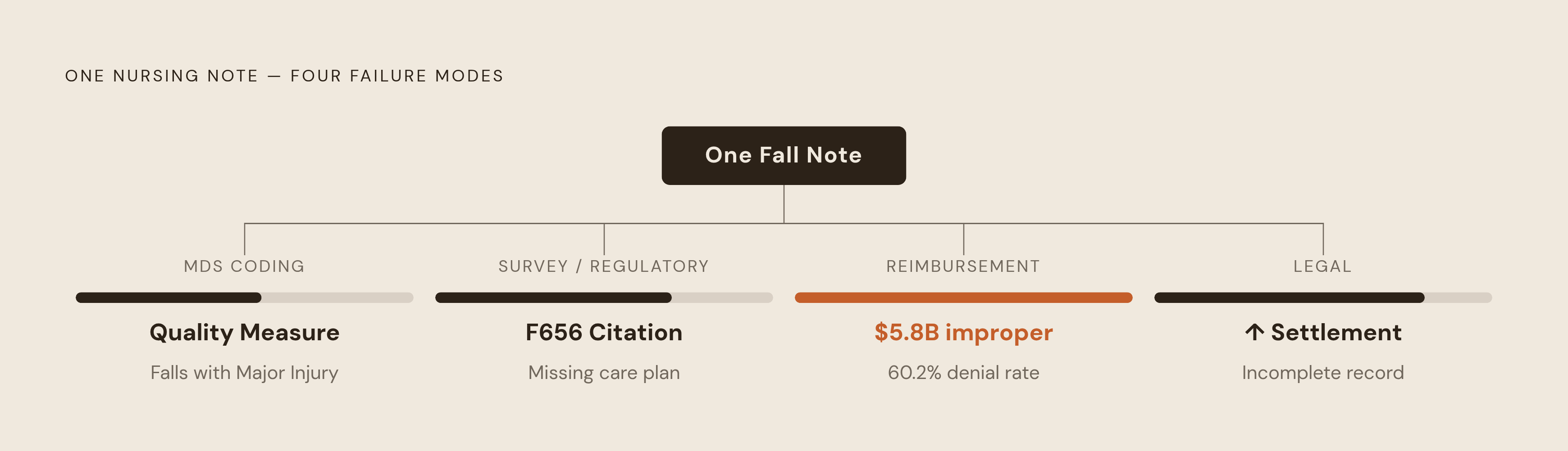
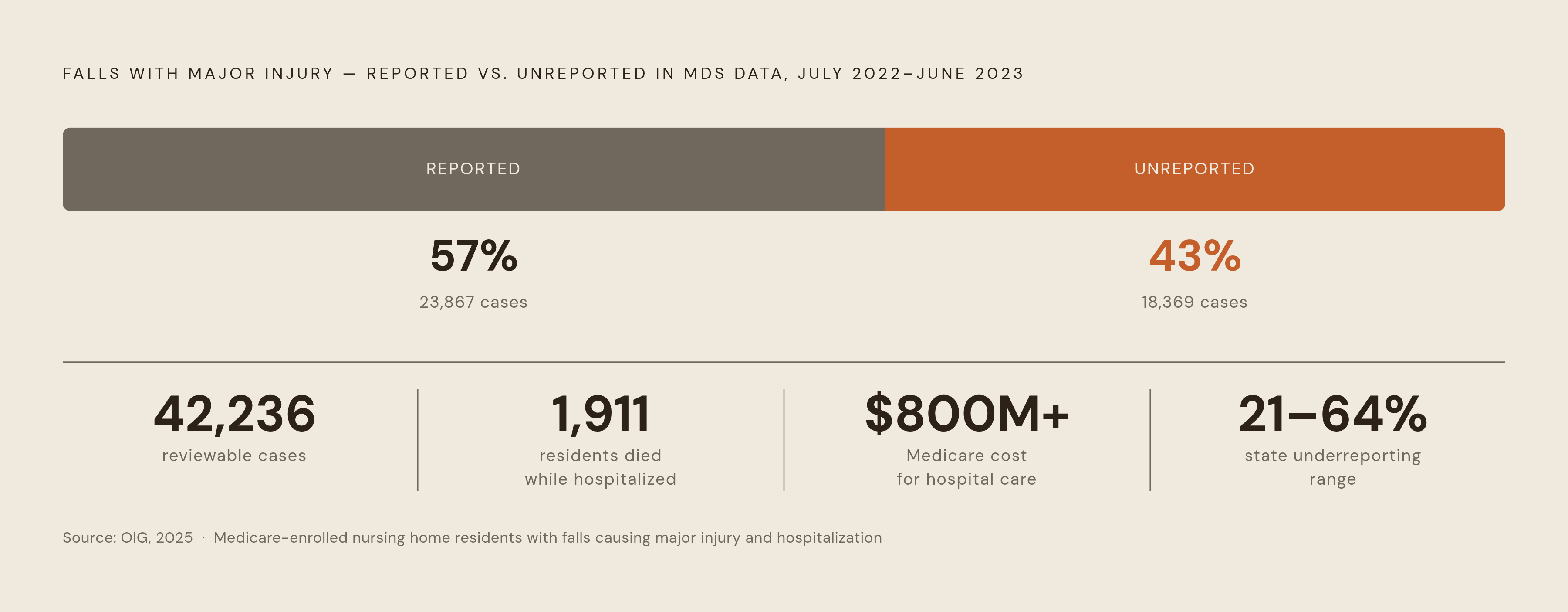
An OIG review published in 2025 found that nursing homes failed to report 43% of falls with major injury and hospitalization among Medicare-enrolled residents in the assessments CMS requires, which is nearly half. That is not a rounding error. That is nearly half.
Over the July 2022 to June 2023 review period, Medicare-enrolled residents experienced 42,864 falls with major injury and hospitalization. 1,911 residents died while hospitalized from those falls. Medicare and enrollees together paid more than $800 million for the resulting hospital care. Of the 42,236 cases OIG could review, 18,369 were never reported in MDS data.
Underreporting rates varied meaningfully across facility types and sizes. State-level variation was wide: South Dakota underreported 21% of cases, one jurisdiction underreported 64%. Falls were least likely to get reported for younger residents, for men, for short-stay residents, and for residents with Medicare-only coverage.
The pattern OIG identified points to a structural tension: quality measure scores are affected by reported serious falls, which creates pressure on disclosure. That makes CMS's Care Compare website, which families use to pick a nursing home, considerably less reliable than it looks.
AHCA, the country's largest association for long-term and post-acute care providers, has argued that more clarity is needed on what information actually flows from hospitals back to nursing facilities after an injurious fall. That's a fair question to raise. But whether the gap comes from documentation failure, coding failure, or a hospital-to-facility information gap, the underlying problem is the same: the trip from clinical note to MDS code isn't reliable, and almost nobody is watching it closely enough to know when it breaks.
Fall documentation surveyors check under the updated 2025 survey process
CMS issued QSO-25-07-NH, revising the Long-Term Care Survey Process. Surveyors started working from that guidance on February 24, 2025, and the updated process was fully in effect by April 2025, MEHCA and voize.ai report.
The trigger is simple: a resident falls, and the record doesn't show a current risk assessment paired with an updated care plan. That gap alone draws closer scrutiny, apart from the actual quality of care given.
F656, Comprehensive Care Plans, sits among the most commonly cited F-tags nationally. The deficiency usually is a care plan that doesn't match where the resident actually is right now. It's a care plan that doesn't match where the resident actually is right now. A post-fall update that got written after the first fall but never touched again after a second fall is still a citation waiting to happen.
CMS's risk-based survey approach lets facilities with strong compliance histories, solid staffing, and low hospitalization rates qualify for a more focused, lighter-touch survey. Only a portion of nursing homes will qualify for that track, and those that do not face the full standard survey, where fall documentation sits near the top of what gets pulled.
Surveyors read these notes as auditors, not as a clinician weighing whether the care made sense. They're reading as auditors, checking whether the paper trail proves the regulatory boxes got checked, in the right order, on time.
The reimbursement and liability consequences that trace back to a single note
Available figures show insufficient documentation drove 60.2% of Medicare reimbursement denials for SNF services in one measured year. Medicare made an estimated $5.8 billion in improper payments for SNF services in one measured year.
Fall-related documentation gaps create denial risk in more than one place at once, including a missing order, a level-of-care billing code the chart doesn't support, and an incomplete certification or recertification. Each of those threads runs back to a clinical event around the fall that should have been captured and wasn't.
Legal exposure follows the same pattern. When the record can't reliably show what care was actually given, settlement costs climb even when the care itself was appropriate, because the note is the only proof anyone has of what happened in that room. Juries don't get to interview the nurse's memory. They get the chart.
A single bad note can trigger a QM coding error that dents Five-Star and SNF VBP scores, a surveyor citation that comes with a fine, a reimbursement denial that claws back revenue for care already delivered, and a weaker legal position that raises settlement costs, all at once. These are one documentation failure, surfacing in four different systems that don't talk to each other. They are one documentation failure, surfacing in four different systems that don't talk to each other.
Why the note's full journey requires continuous oversight of documentation quality
The consequences of one note play out over weeks, months, and, in the case of VBP baseline periods, years. The window to catch a problem in that note and fix it is nowhere near that long. It closes fast, usually within days of the event, and after that, the gap is baked in.
The information isn't missing from the building. Nurses are already writing these notes, shift after shift. What's missing is any structure that reads them closely before a survey, an audit, or a lawsuit forces someone to. Right now, a gap in a 72-hour monitoring note, or a care plan that never got touched after a second fall, or a coding mismatch between the nurse's language and the MDS field, tends to become visible only when it's already too late to fix cheaply.
Tools that read unstructured clinical notes directly out of existing EHR systems, without asking nurses to double-enter anything or learn a new workflow, can flag those gaps while there's still time to act on them. Catching a missed monitoring note ahead of a surveyor doing so. Catching a stale care plan before it becomes an F656 citation. Catching a coding discrepancy before the MDS submission window shuts.
A facility already knows nurses need to document falls more thoroughly in some abstract sense; that is not the real question it faces. They're already documenting. Whether anyone in the building has a way to follow that note through its whole journey, from the bedside to the survey report to the reimbursement claim, and catch exactly where it breaks, is the real question.