Real-Time Resident Risk Reporting Between Nurses and Charge Staff
Closing the gap between bedside observation and rapid clinical action.
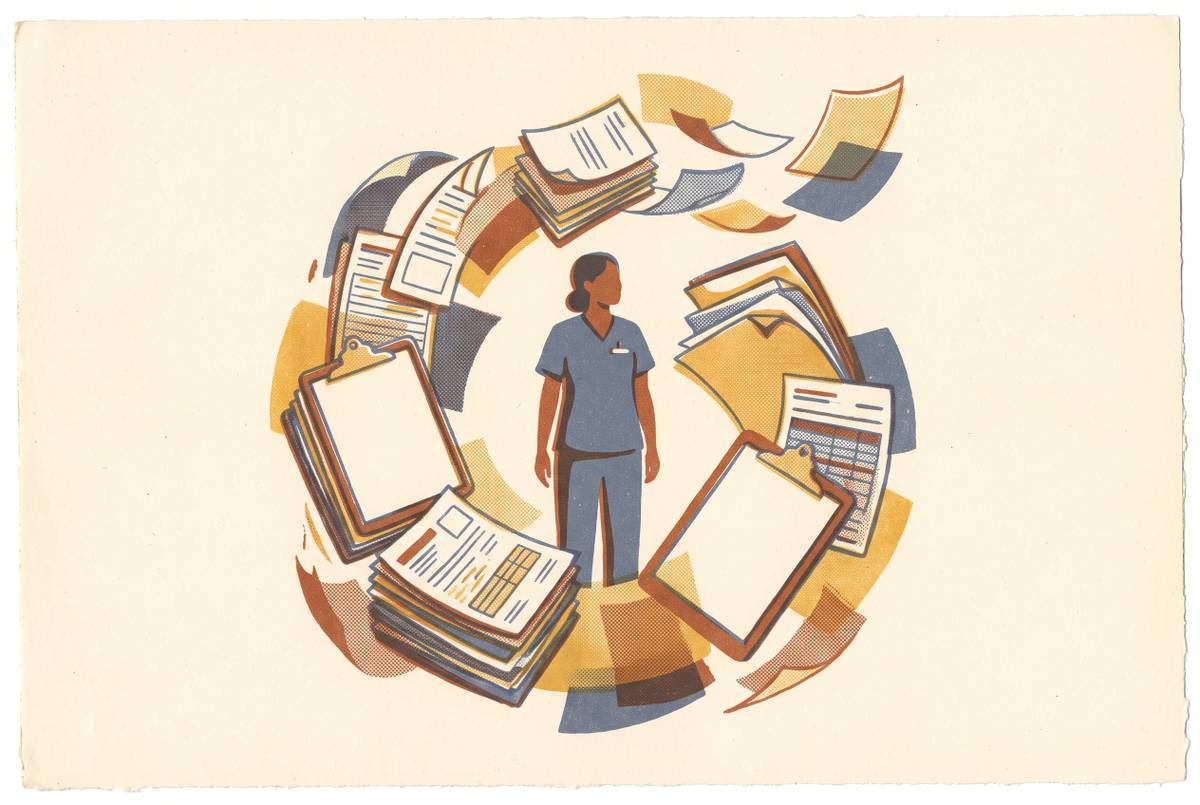
Somewhere in that pile sits the detail that predicts a fall, a hospital transfer, or a wound that's about to turn septic. The information a resident needs is already there. It just hasn't reached the person who can act on it, and that gap, not any shortage of clinical observation, is the real failure point in skilled nursing facility risk reporting.
The nurse-to-charge-staff information gap in skilled nursing facilities
Bedside nurses watch residents all day, every day. They notice when someone's thinking gets foggier, when skin starts to break down, when fluid intake drops off, when a gait changes just enough to matter. Those observations get written down. The trouble is where they get written down: unstructured notes buried inside an EHR that charge staff, moving fast between rooms and residents, rarely get time to read start to finish during a shiftc2.
So the information travels the old way instead. A verbal report at shift change. A paper log. A charge nurse skimming an EHR screen between calls. Each of those channels compresses what actually happened into what can be said in the time available, and each introduces its own kind of loss (delay, compression, or the risk that a significant detail gets dropped).
None of this points to nurses failing to notice things or charge staff failing to care. It points to an architecture that was never built to move observation into action at the speed a clinical situation demands. Fragmented task coordination and manual handoffs raise cognitive load and open the door to avoidable error, and the result, even in facilities that run tight, disciplined shifts, is a team that reacts to deterioration instead of getting ahead of it. That's a structural condition, not a performance problem, and it sets up everything the rest of this piece has to work through.
The regulatory demands on that information flow
That structural condition used to be mostly a clinical concern. It isn't anymore. Recent CMS changes have turned the speed and accuracy of clinical documentation into a line item on the balance sheet.
Start with staffing. The Biden-era mandate got repealed in December 2025, with an interim final rule taking effect February 2, 2026, and on paper that reads like a loosening of pressure. It isn't. CMS moved the pressure instead of removing it, and scrutiny now arrives through workforce cost and hours transparency, flowing to regulators, researchers, and the public through Payroll-Based Journal reporting and the new CMS 2540-24 cost report. Every SNF still has to keep a documented, data-driven assessment tying staff level and mix to resident acuity. The staffing conversation and the clinical documentation conversation are now the same conversation.
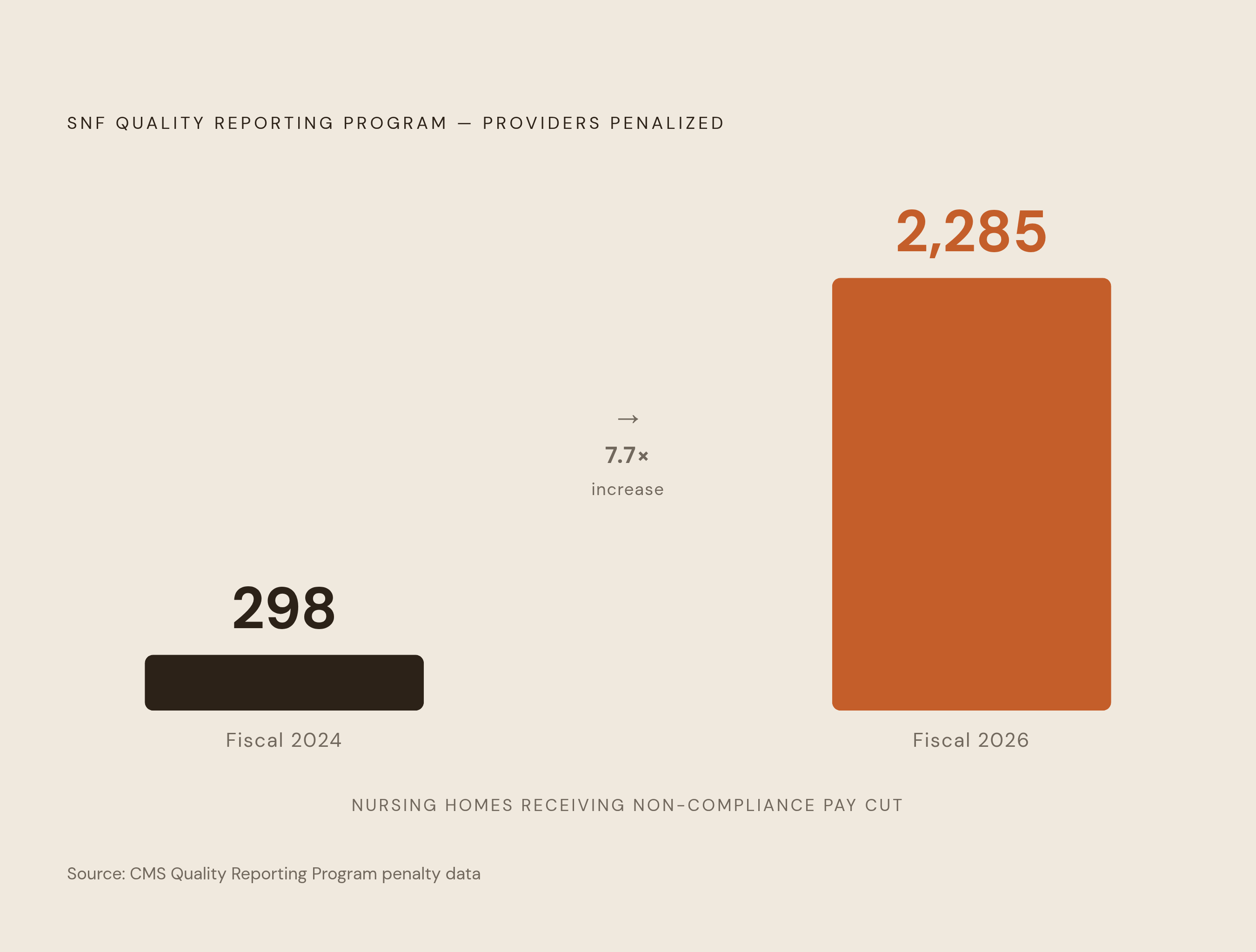
The financial consequences of getting this wrong have moved fast. The number of SNF providers hit by the QRP non-compliance pay cut jumped from 298 nursing homes in fiscal 2024 to 2,285 in fiscal 2026, an increase that shows how quickly a documentation gap turns into a penalty. Meanwhile the documentation obligation itself keeps expanding: CMS finalized a rule on July 29, 2026 requiring MDS data for all SNF residents receiving covered skilled care, regardless of payer, which pulls a whole population of residents into the reporting requirement that used to sit outside Medicare Part A.
And CMS has started rewarding facilities that get this right. The Risk-Based Survey process goes nationwide on September 8, 2026, giving high-performing facilities a shorter, more focused recertification survey, but only if they can sustain strong quality metrics quarter after quarter. Sustaining a metric like that isn't something a facility can pull off with a burst of activity before an audit. It requires the underlying data to be right every day, which is what a broken nurse-to-charge-staff information flow can't deliver.
Stalls in Clinical Information Moving from Nurse to Charge Staff
The EHR holds nearly everything a nurse has observed, but the observations bedside nurses generate about changes in cognition, skin condition, hydration, behavior, and gait live in unstructured EHR notes that charge staff rarely have time to read in full during a shift. Nurses put information in. Charge staff rarely take priorities back out.
Modern EHR platforms actually have the features that should fix this: watchlists, alerts, dashboards that can be tailored to a resident or a unit. They just don't get configured, and even when they do, they don't get used consistently. The tool exists. The workflow around it doesn't.
The richest material sits in the free-text notes, including behavioral shifts, a skin finding that doesn't look like much yet, and a symptom a resident mentioned once and nobody flagged. Reviewing all of that by hand takes time nobody has, costs money to try, and still risks missing the one detail that mattered, according to research summarized in a recent scoping review of the field. That's not a hypothetical cost. CMS data show that nearly one in five SNF residents admitted for post-acute rehab ends up back in the hospital within a month, a number that reflects conditions crossing a line well past the point where anyone could have stepped in.
Facilities that have tried bolting alerts onto this system without fixing the underlying workflow run into a different problem: fatigue. When every alert looks the same and charge staff can't tell why a resident got flagged, they start overriding or ignoring the alerts altogether, and the very gap the alerts were supposed to close reopens in a new shape. Most SNF teams still juggle fragmented data, manual intake steps, and disconnected communication, and each handoff introduces potential for delay, data loss, or missed intervention.
What real-time resident risk reporting requires to work
Speed alone doesn't solve this. A system that fires off notifications faster but still buries the reason behind them just moves the same problem to a different screen. Real risk reporting has to extract the information, sort it by urgency, and hand it over with enough context that charge staff can act without going back to dig through the original chart.
Extraction comes first, and it has to be continuous, not a batch job run once a shift or once a day, because a resident's condition doesn't wait for the reporting schedule to catch up. That means pulling from structured fields and from the free-text notes at the same time, since so much of what matters lives in the prose a nurse wrote, not the checkbox she clicked.
Triage comes next. The system has to rank residents by acuity so the person picking up the dashboard sees the resident who needs attention right now, rather than a flood of raw data or a uniform wall of flags that all look equally urgent.
Then there's context. Most early systems fall down here. An alert that says "resident at risk" tells charge staff nothing they can use. An alert that says what the risk is and what the evidence-based response looks like, delivered while there's still time to intervene, is a different thing entirely, and it's the difference that makes the tool worth trusting.
That trust depends on interpretability. Charge staff need to see what's driving a risk score, not just the number itself. If that support is taken away, clinical staff start second-guessing the system, override rates climb, and the whole investment stops paying off.
None of it works if it adds work. Any system that asks nurses to document twice, once in the EHR and once somewhere else for the reporting tool, will not survive contact with a real shift; the information has to come from documentation nurses are already producing, or adoption collapses under existing time and staffing pressure. Natural language processing applied to those free-text notes handles extraction and triage in the same motion, and a recent scoping review found that risk detection from unstructured notes was the primary focus of most of the studies it covered, which says something about how central this approach has become to post-acute clinical intelligence.
How leading platforms are closing the gap in practice
These aren't abstract requirements. Several platforms now demonstrate that real-time EHR-driven risk reporting can measurably change clinical outcomes when the extraction-triage-context chain is functioning correctly.
Real Time Medical Systems, based in Maryland, pulls structured and unstructured EHR data continuously and runs it through proprietary algorithms built to spot what it calls "interventional moments," moments when a clinical response still has a chance to change the outcome, and delivers alerts alongside recommended, evidence-based protocols straight to nursing home staff. A longitudinal study in the American Journal of Managed Care, covering CMS readmissions data from 2017 through 2022, found that Lancaster General Hospital SNFs using the platform had substantially lower estimated readmission rates than both LGH SNFs without it and the national cohort in the most recent 12 months ending Q4 2022, with all pairwise comparisons showing P <.0001. The platform's team was scheduled to present its approach at the LifeSpan Network 2026 Annual Conference & Expo in Ocean City, Maryland, this past September.
A different approach comes from Clinical Advanced Insights, introduced in October 2021 and built to analyze millions of patient and resident data points, flagging where resources are needed most, with particular attention to fall prevention, depression indicators, and respiratory risk. Clinicians work from dashboards that narrow down to a single facility area or a single resident, giving them a way to weigh risk and adjust care or staffing before a situation escalates.
For facilities running on established EHR platforms, the pattern holds regardless of vendor: tools that read straight from existing documentation can surface intelligence that's already sitting in the chart, without asking nurses to enter anything twice. A study in npj Health Systems described a system that uses generative language models to distill admission history and physical notes into task-relevant categories, then compress those into a short narrative summary. Tested across nine different language models, the approach built on those summaries turned out to be the strongest predictor of SNF discharge outcomes among the unstructured-data methods tested.
Different vendors, different techniques, but the underlying shape repeats: pull from documentation that already exists, rank it so the highest-priority resident surfaces first, and attach enough clinical context that nobody has to go back and re-read the whole chart to understand what the alert means.
Where real-time reporting systems still fall short
None of this is a finished product that a facility can install and forget. Left unmanaged, these systems can recreate the exact information gap they were built to close, just in a costlier, more technical form.
Data fragmentation is the first wall most facilities hit. EHRs, claims data, and social determinants of health information tend to live in separate silos, and without real interoperability between them, automation stalls out and HIPAA exposure grows, since resident information ends up scattered across more systems than any single extraction layer can reliably reach.
Alert fatigue is the second, and it's well documented in any high-volume notification environment: flag every resident and charge staff will, sooner or later, start treating every alert as noise. Getting the triage logic and the alert thresholds right is a core requirement for the system to function. It's the entire difference between a tool people rely on and one they've learned to click past.
Interpretability keeps mattering even after go-live. Clinicians need to see what's behind a score, not just the score, and a black-box number with no explanation attached burns through clinical trust faster than almost anything else a vendor can do wrong.
Regulatory timing raises the stakes further. Looking further out, the QRP data expansion proposed for 2031 is projected by CMS to add roughly 964,000 additional hours of data collection across the sector each year, which puts real pressure on facilities to get extraction automated well before that burden lands. Tools not yet built to handle all-payer MDS workflows will leave a gap right where the compliance exposure is highest.
Requirements for a Sustainable Real-Time Reporting Practice
Three things have to hold together at once for real-time risk reporting to survive past its pilot phase: extraction running off documentation that already exists, output charge staff can act on without returning to the source chart, and an implementation built to track a regulatory environment that keeps moving.
Compliance readiness has to be constant, not something a facility switches on before a survey. The Risk-Based Survey process, live nationwide as of September 8, 2026, only rewards facilities that hold consistently high quality metrics quarter over quarter. The underlying data infrastructure has to be running on every single shift, not activated in the weeks before an inspection.
Workflow integration is the most underestimated part of implementations. A dashboard only changes behavior if it's set up to show the right priorities the moment a shift begins, and a system becomes implemented only once staff behavior around it changes, not at go-live. It's implemented the day charge staff stop checking the tool out of obligation and start relying on it out of habit.
The efficiency gain for nursing managers depends on the system taking work off their plate rather than adding to it. Automation models built around event-driven task coordination, timely clinical alerts, and tight EHR integration have been linked to shorter task times, fewer breaks in the workflow, and less non-clinical busywork overall. The payoff appears in time recovered for actual clinical decisions, not as another report to file.
That matters even more as CMS moves toward all-payer MDS reporting, proposed for 2031 but already shaping decisions now. Facilities with EHR-integrated extraction already running will absorb that added volume far more easily than facilities still coordinating MDS submissions by hand, and industry observers have pointed out that AI already built into EHR platforms and third-party tools may take on a meaningful share of that coming compliance load. The direction across the sector is unmistakable: the facilities pulling ahead in 2026 treat analytics as part of how care actually gets delivered, using language processing on clinical notes to catch care gaps, predictive models to judge discharge readiness, and generative tools to give staff time back.
None of this requires nurses to observe more, document more, or work harder than they already do. The observations are already there, written down every shift, in every note. What's been missing is a way to get that information to the person standing at the nursing station in time to use it, and that, not some deficit in clinical attentiveness, has been the real problem all along.
Sources
- Nursing Home Payroll Compliance in 2026: What Changed After the Staffing Mandate Repeal
- Nursing homes brace for a million-hour quality reporting data surge
- Skilled Nursing Update: CMS Implements Nationwide Risk-Based Surveys For Higher-Performing Skilled Nursing Facilities | Hall Render
- Top Trends That Will Shape the Skilled Nursing Sector in 2026 - Skilled Nursing News
- Federal Register :: Medicare Program; Prospective Payment System and Consolidated Billing for Skilled Nursing Facilities; Updates to the Quality Reporting Program for Federal Fiscal Year 2027