
Nurse Retention Strategies That Address Administrative Burden in SNFs
Cutting EHR burden and improving daily work life retains more nurses than wage increases alone.
Nurse Retention Strategies That Address Administrative Burden in SNFs.
Why SNF nurses are leaving
Skilled nursing facilities keep losing nurses even in years when paychecks grow: per the HCS Nursing Home Salary & Benefits Report, CNA turnover declined slightly to 42.34%, RNs at 36.53%, and LPNs at 35.29%, while RN hourly wages rose only 2.38% year-over-year, down from 4.59% the prior year 2025–2026 Nursing Home Salary & Benefits Report / HCS 2025–2026 Nursing Home Salary & Benefits Report. Those numbers look almost encouraging until you widen the lens: the MissionCare Collective's Skilled Nursing Workforce Report puts average turnover across the industry's 1.7 million-employee workforce at 82% once healthcare support roles are counted, an industry replacing the better part of its staff every year Skilled Nursing Workforce 2025 Report / MissionCare Collective.
Wages have moved, but not fast enough to matter. Zooming out further, the picture gets worse: the 2024 National Nursing Workforce Survey found more than 138,000 nurses have left the profession since 2022, and projects that by 2029, 40% of RNs and 41% of LPNs intend to leave nursing altogether, a potential national loss of 1.6 million nurses Black Book Research 2025 national survey. Money did not cause that exodus, and money alone will not stop it.
So what's actually driving it? When nurses are asked directly, the answer skews toward culture, workload, and whether anyone notices their effort. The Harris Poll Survey found fewer than one in three healthcare employees feel very valued or very loyal to their employer, and only one in five believe their employer is invested in their long-term career success. Pay raises don't touch that feeling. Neither does a staffing memo.
What does touch it is the daily texture of the job, specifically how much of a nurse's shift gets swallowed by tasks that have nothing to do with resident care. When raises slow and departures don't, the useful thing to ask changes from how much staff are paid to what is actually consuming their time. That question points straight at administrative burden, and it deserves a closer look at what that burden costs, in dollars, before getting to what it costs in people.
What administrative burden costs a facility
Start with the plain arithmetic of replacing a nurse. The 2025 NSI National Health Care Retention & RN Staffing Report puts the average cost of replacing one bedside RN at $61,110, ranging from $49,500 to $72,700 depending on specialty and location, and the average vacancy sits open for 83 days before it's filled 2025 NSI National Health Care Retention & RN Staffing Report 2025 NSI National Health Care Retention & RN Staffing Report. Multiplied by a facility's annual churn, the number becomes a budget crisis rather than an HR line item. SNFs run leaner margins than hospitals do, which makes the same proportional hit sting more, not less.
Vacancies don't just sit empty while a facility waits 83 days for a replacement 2025 NSI National Health Care Retention & RN Staffing Report 2025 NSI National Health Care Retention & RN Staffing Report 2025 NSI National Health Care Retention & RN Staffing Report. They get covered, usually by overtime or agency staff, both of which cost well above what an employed nurse earns for the same shift. Every hour spent on premium coverage is an hour a facility's own retention failure is billing back to it.
The instability climbs the ladder, too. In the Texas Long-Term Care Nursing Supply and Staffing Survey, 36.6% of directors of nursing had held their current position for less than a year 2024 Texas Long-Term Care Nursing Supply and Staffing Survey. A DON who hasn't been in the seat long enough to know the building's quirks cannot stabilize the floor beneath her, and that instability cascades downward into exactly the kind of churn the facility is trying to stop.
Then there's the reimbursement angle, which changes the calculus from "nice to fix" to "financially unavoidable." MedPAC's report to Congress confirms that staff turnover rates are now one of the SNF value-based purchasing measures added in FY 2026. Turnover has stopped being a private HR headache and become a public reimbursement metric that CMS is watching. It's a recurring, measurable financial exposure, and reducing it belongs on the same spreadsheet as staffing costs and Medicare reimbursement, not filed under employee wellness https://med.uth.edu/mshbc/coding-compliance-overview/target-probe-and-educate-tpe/. At the facility level, the cumulative hit runs into the millions annually (per the American Hospital Association's Health Care Workforce Scan, hospitals spend $3.9 million to $5.7 million per year on RN turnover alone, according to the NSI National Health Care Retention & RN Staffing Report) 2025 NSI National Health Care Retention & RN Staffing Report. Every administrative inefficiency that accelerates a nurse's exit is a measurable, recurring financial exposure, framing admin burden reduction as ROI, not comfort.
The documentation load nurses are carrying in SNFs
Nurses aren't vague when they describe what's draining them, and the number one answer keeps coming back to the same source: the electronic health record. A national survey by Black Book Research found 92% of nurses believe EHR systems have negatively affected their job satisfaction, close to consensus among the profession Black Book Research 2025 national survey.
The volume behind that grievance is staggering once you break it into units. The U.S. Surgeon General's Advisory on health worker burnout separately found nurses spend around 40% of a shift on documentation 2024 National Nursing Workforce Survey Black Book Research 2025 national survey. Do the math on a 12-hour shift and that's close to five hours spent typing, clicking, and confirming fields instead of touching a resident 2024 National Nursing Workforce Survey Black Book Research 2025 national survey U.S. Surgeon General's Advisory on health worker burnout.
Skilled nursing adds a layer acute care doesn't carry in the same way. This isn't generic charting. It spans MDS accuracy, where F641 sits among the most frequently cited F-tags in the country, care plan currency under F656, incident tracking, medication administration records, and PBJ payroll data, each one carrying its own regulatory consequence if it's wrong. A nurse in an SNF isn't documenting for convenience. She's documenting under the threat of a citation.
And the documentation itself is often duplicated, badly standardized, or bloated with fields nobody needs. The KLAS Arch Collaborative's report, built from responses from 80,147 acute care nurses, found the three most common documentation complaints are duplicative flowsheets, a lack of standardization across tasks, and excessive required fields. Those complaints map onto SNF workflows just as cleanly. When the same report asked nurses what they wanted most from their EHR, streamlined or reduced charting came up twice as often as any other request.
The burden doesn't stop at the bedside. Research published in Nurse Leader in 2025 ties the rising complexity of the care environment to role misalignment and falling satisfaction among nurse managers, and separate 2025 survey data found 36.7% of nursing home leaders had considered quitting in the prior three months. Documentation load doesn't spare the people managing it. It just moves up a level.
How documentation burden connects directly to burnout and departure decisions
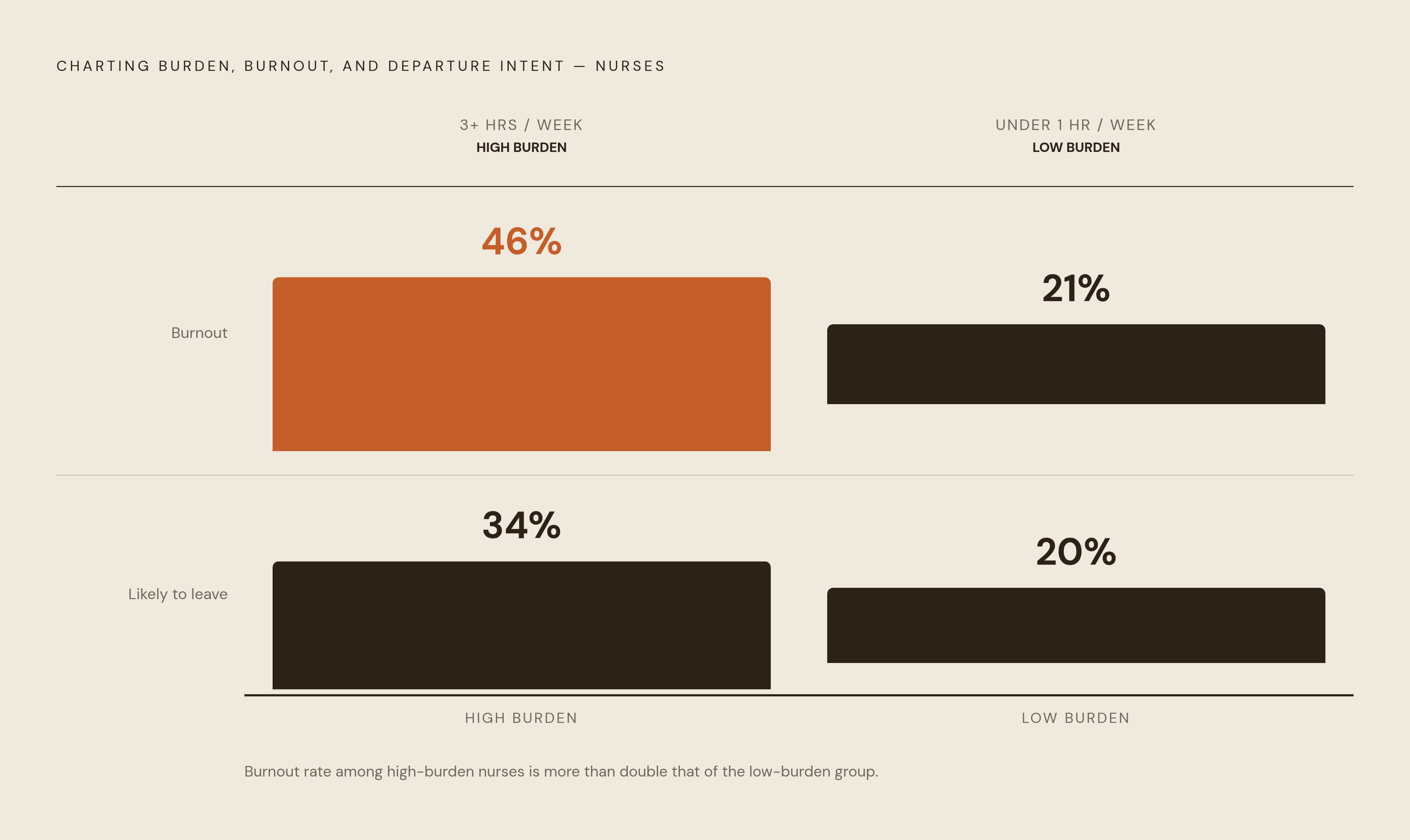
The KLAS report offers the clearest single number in this entire discussion. Among nurses spending three or more hours a week on unproductive charting, 46% report burnout and 34% say they're likely to leave their organization, compared to just 21% and 20% respectively among nurses spending under an hour on the same task. That's more than double the burnout rate and nearly double the departure intent, tied to a single variable: how much time gets wasted on documentation that doesn't serve care or compliance.
Black Book's 2025 survey backs this up from a different angle 2024 National Nursing Workforce Survey Black Book Research 2025 national survey. Roughly a third of nurses said they're considering leaving their current position within the next year because of EHR-related stress, and a meaningful share said they're contemplating leaving nursing entirely. That's a warning sign that has nothing to do with pay scales or staffing ratios. It's about the tool nurses are forced to fight all shift long.
The manager layer shows the same pattern, maybe more starkly. The documentation burden that senior nurses carry, often heavier than what floor staff carry, is directly implicated in the leadership churn that destabilizes entire facilities.
None of this is coincidence dressed up as correlation. Nurses are saying, in survey after survey, that charting eats the hours they came to the job to spend on people, and when that displacement becomes routine rather than occasional, walking away stops looking irrational and starts looking like the only sane option. Skilled nursing makes this worse than acute care does, because SNF compliance documentation never really pauses. It's dense, it's constant, and it's exposed to survey scrutiny in a way that leaves no room to shortcut it. That means the burden here runs structurally higher than in a hospital setting, and the fix has to be structural too. Exhaustion and burnout was the most selected reason (51.1%) for DON turnover in the Texas Long-Term Care survey, connecting the documentation burden senior nurses carry directly to the leadership instability SNFs suffer 2024 Texas Long-Term Care Nursing Supply and Staffing Survey.
The compliance environment that makes SNF documentation harder than it needs to be
Regulatory change is compounding the pressure right as facilities most need relief. Starting September 8, 2026, CMS rolls out its Risk-Based Survey process nationwide for qualifying nursing homes, under which high-performing facilities face a narrower, more focused recertification survey. That sounds like good news for well-run facilities, and it is, but it also raises the stakes on documentation quality, since the designation depends on sustained, provable compliance rather than a single clean inspection.
Those designations are expected to show up publicly on Care Compare by September 30, 2026. A facility's documentation history now carries a reputational weight that follows it into every prospective family's search results, not just its next survey cycle.
Meanwhile F641 for MDS accuracy and F656 for comprehensive care plans remain among the most frequently cited F-tags in the country. Skilled Nursing News reported that surveyors finding three or more MDS inaccuracies can automatically escalate a citation to a higher scope and severity level. There's very little room for error, and even less room for the kind of sloppy, rushed charting that chronic overwork produces.
Audit exposure adds another layer of consequence. An OIG audit of one nursing and rehabilitation center found an estimated $31.2 million overpayment tied directly to documentation that didn't support the billing behind it, the result of documentation quality slipping under sustained staff pressure NSI 2026 National Health Care Retention & RN Staffing Report. That's what happens when documentation quality slips under sustained staff pressure.
Layered on top of all this is a policy shift that changes the compliance math entirely. CMS's interim final rule repeals the Biden-era requirement for 24/7 on-site RN coverage and the specific minimum nurse staffing hours per resident day, though the facility assessment provision stays in place Skilled Nursing Workforce 2025 Report / MissionCare Collective. CMS estimates the repeal saves nursing home operators roughly $1.75 billion a year Skilled Nursing Workforce 2025 Report / MissionCare Collective. But the numerical authority now shifts to individual state statutes. Facilities operating across state lines face a patchwork of differing rules instead of one federal floor Skilled Nursing Workforce 2025 Report / MissionCare Collective. For floor nurses and nurse managers, none of this is abstract policy. It's daily documentation pressure, and facilities that treat compliance as something to scramble for right before a survey dump that pressure on staff in waves. Facilities that run compliance continuously spread that load out evenly, and, done right, automate a meaningful share of it away from nurses altogether.
Structural strategies that reduce documentation burden without adding new workflows
Any fix that asks a nurse to learn a new system, enter data twice, or duplicate what she's already charted fails before it starts. The burden grows instead of shrinking. The strategies that actually work extract value from documentation nurses are already producing, rather than asking for more of it.
The first move is workflow standardization inside the EHR itself Black Book Research 2025 national survey. This means going after the three complaints KLAS documented directly: duplicative flowsheets, inconsistent task standards across units, and required fields that exist for no clear clinical or compliance reason. An audit of existing flowsheets, done with the intent to cut rather than add, reveals fields that survive purely out of institutional habit. Consolidating or eliminating them takes real ownership beyond an IT ticket. The DON and the EHR administrator need to co-own this work, because neither clinical judgment nor technical access alone is enough to get it right.
The second move is putting automation to work on notes nurses have already written. Tools built to read those existing notes and generate structured outputs, compliance gap alerts, resident risk scores, incident trend reports, recover time without asking anyone to type a single extra word. Vendors positioning this kind of automation point to figures suggesting up to 20% of a nursing manager's time can come back through this approach, time that flows straight back into supervision, staff support, and actual resident care.
Third, compliance monitoring needs to run continuously instead of in bursts before a survey. A reactive posture, the last-minute chart audit before inspectors arrive, concentrates pressure into crisis cycles that stack on top of a nurse's normal workload. Continuous monitoring spreads that pressure evenly across the year, and where flagging is automated, moves a meaningful share of it off nurses entirely. F641 and F656 citations, the most frequently cited F-tags nationally, are largely preventable with intentional process design, according to AAPACN. Automation makes that process consistent across shifts and staff turnover instead of depending on whichever nurse happens to be sharpest that day.
Fourth, and easy to overlook: nurse manager roles need realigning around what a system can now handle. Nurse managers spend disproportionate hours compiling reports, tracking compliance manually, and chasing paperwork that automated tools can do faster and more consistently. The 2025 Nurse Leader research points toward aligning workload with actual skill and protecting well-being, which in practice means stripping out tasks a system can absorb so the manager spends her time on judgment calls only she can make. With 36.7% of nursing home leaders having considered quitting in the prior three months, this is a supervisory-layer retention problem. Monitoring categories that matter in SNFs (falls, medication errors, hydration, skin wounds, and behavioral changes) are all documentable through existing charting if the system is built to bring them into view. Under the CMS RBS framework, high-performing facilities earn lighter survey touch, and the compliance dividend of continuous readiness is both regulatory and operational.
Retention strategies that work alongside burden reduction, the full picture
Cutting administrative load recovers time and lowers burnout, but time recovered has to go somewhere, and nurses need a reason beyond relief to stay for years rather than months. These strategies don't compete with burden reduction. They compound on top of it.
Career advancement is one of the biggest levers available. The 2026 NSI report lists it among the top five reasons nurses voluntarily resign, trailing only personal issues and relocation, and landing ahead of retirement. A 2025 umbrella review in BMC Health Services Research found that having a clear clinical ladder in place reduced nurse turnover by roughly 11%. SNFs, compared to acute care, tend to run thin on this front, which leaves a visible gap that facilities willing to build real advancement tiers can close. That means defining actual levels, tying them to certifications and specialty skills, and funding the continuing education behind them. Guidance from HR for Health and America's Essential Hospitals also points to mentorship, pairing experienced nurses with newer staff, as a way to develop talent while giving senior nurses a meaningful role off the bedside.
Scheduling matters just as much, and it appears on the same NSI top-five list of resignation drivers. Float pools and flexible staffing arrangements protect core staff from the chronic overtime that KLAS data ties directly to both burnout and departure intent. Predictable schedule posting, giving nurses real advance notice of their shifts, costs almost nothing and signals respect for someone's life outside the building.
Onboarding deserves the same attention. First-year RN turnover runs high nationally, and NSI's 2026 data shows a meaningful share of all separations come from nurses with under a year on the job. A 2023 systematic review in MDPI identified onboarding and mentoring as among the most effective retention interventions available, with social support named as one of twelve broader intervention themes.
Recognition rounds this out, but only if it's specific and constant rather than a once-a-year gesture. The same Harris Poll data cited earlier shows fewer than a third of healthcare employees feel genuinely valued, and only a fifth believe their employer is invested in where their career goes. A BMC Nursing study linked transformational leadership and work-life balance directly to better retention, underscoring that the supervisor relationship, itself shaped by how overloaded that supervisor is, ends up being the proximate driver of how a nurse experiences every single shift. A nurse buried in redundant paperwork isn't going to feel appreciated by a pizza party in the break room. Burden reduction is what makes every other retention effort actually land. Extended onboarding (90 days with phased learning goals) and paired mentorship for at least six months are evidence-backed, and the SNF environment's compliance complexity makes structured onboarding more important, not less.
Sources
- Nurse Retention Strategies to Reduce Turnover Costs in 2026 | Prolink
- Building Workforce Stability: Nursing Retention Strategies for Acute-Care Hospitals - America's Essential Hospitals
- Proven Nurse Retention Strategies to Reduce Turnover Costs
- 2024 Long Term Care Nurse Staffing Study- Highlights and Recommendations
- March 2025 report to the Congress--Chapter 6: Skilled nursing facility services
- Nurse Burnout Survey 2026: The Systemic Drain on Nurses
- missioncare.com