Elopement Incident Documentation Requirements for LTC Nursing Staff
Proper documentation of elopement risk starts at admission and protects residents' lives.
Elopement documentation in long-term care is a chain of entries that starts at admission and doesn't end until the incident is closed. It's a chain of entries that starts at admission and doesn't end until the incident is closed, and a missing link anywhere in that chain is what turns a bad day into an F689 citation. Under federal guidance, elopement means a resident leaves the building, a courtyard, or any safe area without the facility knowing, or gets lost inside the facility itself, in a mechanical room or a stairwell, without staff supervision. That's a narrower and more specific event than wandering, which describes movement within a space the facility has deemed safe. The distinction matters because it decides which regulatory tag applies, which documentation pathway kicks in, and how a surveyor or a plaintiff's attorney will read the chart afterward.
The population most exposed to this risk is not a mystery to anyone who has worked a dementia unit. Roughly 6 out of 10 people living with Alzheimer's disease are expected to wander and become lost at some point, and cognitive impairment is the single biggest predictor of elopement risk in long-term care. That statistic alone should tell a facility how much documentation weight belongs on intake and reassessment, long before anyone is searching a parking lot.
What is at stake when an elopement is poorly documented
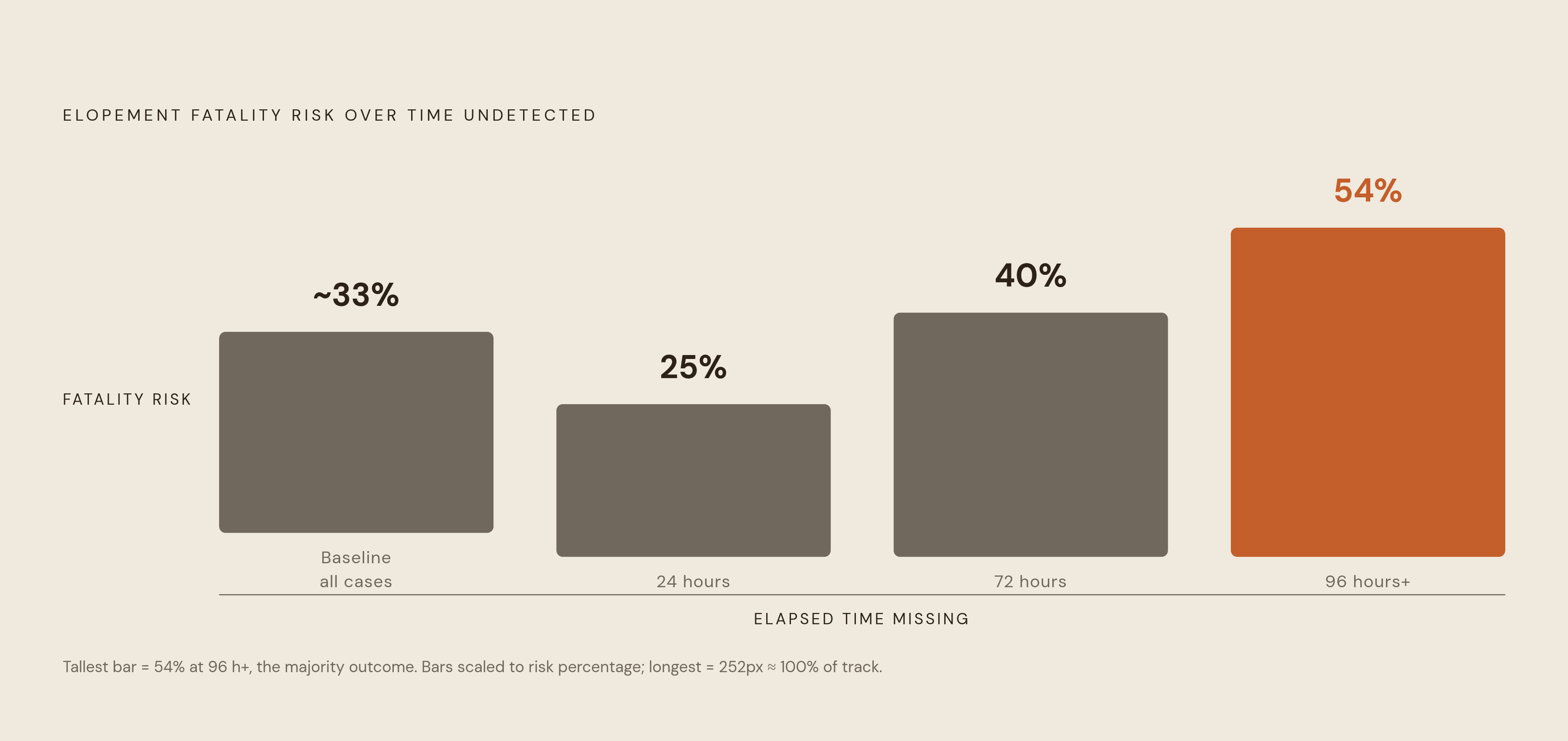
The numbers here are grim: roughly one-third of nursing home elopement cases end in a fatality. Roughly one-third of nursing home elopement cases end in a fatality. Time is the variable that decides the outcome: fatality risk climbs to 25% if the resident isn't found within 24 hours, to 40% after 72 hours, and to 54% at 96 hours or beyond. Every hour of delay in the search, and every gap in how that search gets logged, raises or lowers the odds that the resident comes home.
Litigation follows the same pattern. Elopement cases account for upwards of 10% of all lawsuits filed against nursing homes, and close to 80% of those suits involve a resident's death. The facility's own paperwork, more often than not, decides those cases. It's the facility's own paperwork. A care plan that flagged a resident as high risk for elopement but shows no specific intervention attached to that finding is not a neutral document in a courtroom, but an admission. So is an incident log that records three prior wandering attempts with the exact same response each time, no protocol update, no IDT meeting, no change in supervision level. Plaintiff's counsel doesn't need to prove negligence from scratch when the facility's own chart proves the facility knew and did nothing differently.
CMS penalty activity is trending in a direction that makes this less theoretical by the year. Penalties tied to documentation deficiencies rose 18% in 2024, and the average annual liability cost tied to elopement incidents reached into the hundreds of thousands for facilities that year. Compliance is not paperwork for its own sake. A defensible record costs far less than a six-figure exposure.
The federal and state regulatory framework nurses document against
Three provisions of a federal regulatory framework produce almost every elopement citation, since 42 CFR § 483.25(d) covers quality of care and accident hazards and is the provision CMS interpretive guidance uses to name elopement directly as an accident hazard facilities must supervise against. 42 CFR § 483.25(d) covers quality of care and accident hazards, and it's the provision CMS interpretive guidance uses to name elopement directly as an accident hazard facilities must supervise against. It's the section F689 is cited under, and it's the one surveyors reach for first.
42 CFR § 483.21 governs comprehensive, person-centered care planning. The rule requires measurable goals and specific timeframes tied to a resident's medical, nursing, and psychosocial needs, and it applies to every resident. The interdisciplinary team must produce that plan within 21 days of admission, following the completed comprehensive assessment, and it has to be revisited after every comprehensive and quarterly review, not left to sit until the next annual.
42 CFR § 483.12 rounds out the framework by governing freedom from abuse, neglect, and exploitation. Restraint use gets scrutinized under this provision. Any physical or chemical restraint used to manage elopement risk has to be the least restrictive option available, used for the shortest duration clinically justified, and documented continuously while it's in place. A locked door or a lap belt without that documentation trail is its own liability, separate from the elopement itself.
CMS didn't leave this framework static. QSO-25-07-NH, issued November 18, 2024, rewrote the surveyor guidance in a 902-page document that took effect February 24, 2025, and it changed how surveyors evaluate compliance across the board, not just for elopement. The LTCSP Mapping Document, updated in February 2026, now flags language surveyors look for directly, including "concerns regarding unsafe wandering: eloped in last 120 days" and instances of residents leaving secured areas or wandering without staff intervention. Facilities should assume surveyors are reading charts with that exact language in mind.
Structured data validation adds another layer of exposure in 2026. CMS is auditing roughly 10% of skilled nursing facilities, and any facility selected has to submit MDS assessments for direct medical record review. That's a full accuracy audit of the documentation underlying a facility's risk coding, not a spot check.
Pre-incident documentation: what must exist in the chart before elopement ever occurs
Everything starts, or should start, at admission. Staff are obligated to gather a wandering and elopement history from the resident, the family, and any transferring facility or hospital before or at the point of admission, and that intake conversation is the foundation everything downstream depends on. Families don't always volunteer the risk factors that matter most. A resident with a long history of evening walks, or a smoker used to stepping outside unsupervised, carries elevated elopement risk that families sometimes don't think to mention because it doesn't register to them as a safety issue. Good intake documentation asks about it directly instead of waiting for it to show up as an incident.
A federally mandated resident assessment tool carries specific items that translate this risk into the record. E0900 captures the presence and frequency of wandering behavior. E1000 captures the impact of that wandering, including whether it places the resident at significant risk of reaching a dangerous location, a stairwell, a parking lot, an unlocked exit. The Brief Interview for Mental Status, items C0200 through C0500, feeds directly into the cognitive risk profile that these wandering items depend on. None of this is optional charting; it's the data CMS uses to calculate risk-adjusted quality measures, and the Risk Adjustment Appendix File tied to the MDS 3.0 Quality Measures User's Manual, version 18.0, carries the regression coefficients behind those calculations effective January 1, 2026.
The timing on the comprehensive elopement risk assessment is set by federal rule, not left to facility discretion. It's due within 14 days of admission or readmission, again quarterly, again after any significant change of condition, and again after an elopement event or whenever clinical judgment calls for it. A resident who was assessed as low risk on admission and then develops delirium driven by an infection six weeks later needs that reassessment before the quarterly cycle would otherwise trigger it, not after.
Care plan documentation requirements before and after any elopement event
A baseline care plan has to exist for every new resident at admission, and for anyone with cognitive impairment, the plan needs to account for the fact that an unfamiliar building is itself a risk factor, independent of diagnosis. The comprehensive version follows from the interdisciplinary team within seven days of the completed comprehensive assessment, no later than 21 days after admission, and it has to be built around that specific resident rather than pulled from a template.
Vague goals don't hold up. "Resident will remain safe" satisfies no one, not a surveyor, not a plaintiff's attorney, not the nurse trying to figure out what intervention to apply on a Tuesday afternoon. Goals need to be SMART: specific, measurable, achievable, relevant, and time-bound. Interventions need to be just as concrete: alarmed exit doors, a wander management system tied to a specific device, enhanced staff presence during the late afternoon shift change when sundowning and elopement attempts tend to cluster, a safe walking path that gives a resident somewhere to go instead of somewhere to escape from. Triggers matter too. A resident who elopes because he believes he needs to pick up his kids from school needs a de-escalation approach built around that specific belief.
Person-centered activity planning belongs in this same document, because elopement attempts are frequently an unmet need expressed the only way a cognitively impaired resident has left to express it. Addressing boredom, restlessness, or a desire for purpose isn't a soft add-on to the care plan, it's an intervention with the same evidentiary weight as an alarm system.
Review isn't just quarterly. A significant change of condition triggers it, and so does any elopement event or near-miss, immediately, not whenever the next quarterly review happens to fall. If the interventions already in place failed to stop an attempt, the IDT has to reconvene, document that meeting actually happened, and record the reasoning behind whatever changes follow. A chart that shows the same intervention list before and after an elopement attempt is exactly the pattern plaintiff's counsel goes looking for.
Documentation nurses must complete in the first hours after an elopement is discovered
Everything from the moment of discovery forward needs a timestamp attached to it, and estimates don't count. The exact time staff noticed the resident missing has to go in the record, not "sometime around lunch."
The search itself needs the same precision. Building interior, adjacent grounds, roadways, any nearby body of water, all of it documented by area, by who searched it, and at what time. Notification follows the same standard, reaching staff on duty and facility leadership, the resident's authorized representative, and the resident's physician, each logged with the time, the method of contact, and, for the family notification, what was actually communicated. If the resident hasn't turned up, local law enforcement gets called, and that call, along with the agency contacted, has to be logged by time. Some states go further. Michigan's rule requires a 24-hour notification to the state health department, a deadline that runs independent of whether the resident has since been located.
The incident report itself has required fields that don't flex by facility policy. It needs the names of everyone involved, the date, hour, and location of the incident, and a narrative that lays out the facts and the cause if one is known. It needs to record the effect on the resident, whether there was an injury, whether medical treatment was sought, and it needs a written log of every notification made, with time and date attached to each one. It closes with the corrective measures the facility is taking to keep the same thing from happening again, and that section can't be boilerplate if it's going to hold up to scrutiny.
A few more pieces round out a defensible report. Behavioral cues staff noticed before the elopement belong in the record, since they often appear again in the care plan review afterward. The resident's descriptive information, name, age, physical description, clothing, and last known location, needs to go out to responding staff and law enforcement fast, along with a photograph and a brief history of prior wandering or elopement activity, because search coordination depends on it. Environmental conditions need documenting too: was the door alarm working, was a door left unlocked, was the wander management device transmitting correctly. These aren't optional details filled in if time allows, they're required fields, because they often separate an isolated incident from a systemic failure. Duration matters as well, tracked from the moment the resident was noted missing to the moment they were located.
None of this stands alone. Surveyors and attorneys read the incident report against the corroborating record: alarm data logs, video timestamps, law enforcement dispatch records, observation notes written close to the time of the event, and firsthand accounts from the staff who were on the floor. An incident report that says the door alarm sounded at 2:14 p.m. needs an alarm log that agrees with it. When those records don't line up, the inconsistency itself becomes the story, regardless of what actually happened to the resident.
Sources
- Evidence Based Best Practices - Elopement Prevention and Response
- Elopement in Nursing Home: Protocol, Policy & Reporting - Nursing Home Truth
- Preventing Wandering and Elopement in Nursing Homes: Legal Obligations and Remedies
- Patient Elopement Prevention: Protocols, Risks and Penalties
- RCFE Incident Reporting Checklist
- Elopement Prevention and Response: Four Essential Strategies
- ecfr.gov
- epeople.ai