How Manual Incident Report Handoffs Create Documentation Gaps
Nursing homes lose nearly half of serious falls because shift handoffs have no written record.
Skilled nursing facilities lose incident information at a predictable point: the shift handoff, where a chain of informal steps runs from a verbal report to a scrap of paper to a note that never quite makes it into the chart. Every link in that chain is a place where a fall, a skin tear, or a behavioral change can quietly disappear from the record. The fix starts with knowing exactly where the chain breaks.
Skilled nursing runs on 12-hour rotating shifts staffed to care for a population that's medically complex and largely non-ambulatory. Incident exposure never really stops, which makes every shift change a high-stakes moment by default. A hospital patient who gets discharged before a documentation gap surfaces takes that gap with them out the door. A long-term care resident doesn't leave. Undocumented incidents accumulate in place, quietly distorting the clinical picture of someone who's been there long enough that nobody remembers which version of events is the accurate one.
The handoff itself is a sequence: verbal bedside report, then paper or electronic shift notes, then care plan updates, then MDS coding, then supervisor logs. Each stage is a separate system, usually owned by a different person, and none of them talk to each other automatically. The Surgeon General's Advisory on Building a Thriving Health Workforce puts nurse documentation time at roughly 40% of a shift already. Against that load, handoff is one more task competing for attention from someone who's exhausted and treated by no one as a protected ritual worth protecting.
This is a story about staff who care but work within a chain with too many links, and every link is a place where something can fall through. It's a story about a chain with too many links, and every link is a place where something can fall through.
The specific moments in a shift transition where incident details fall out of the record
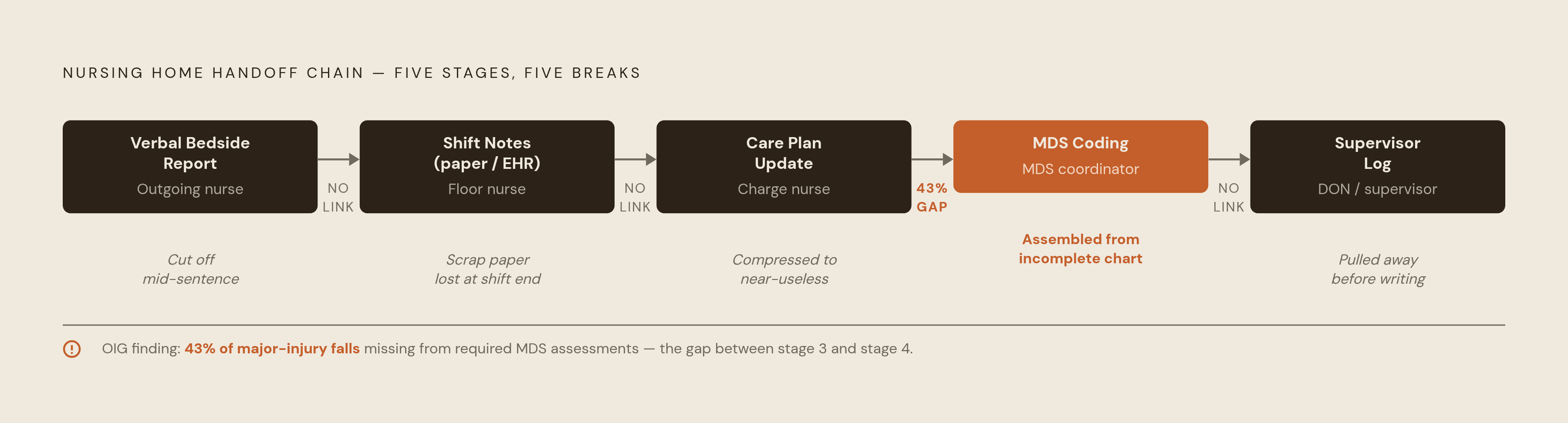
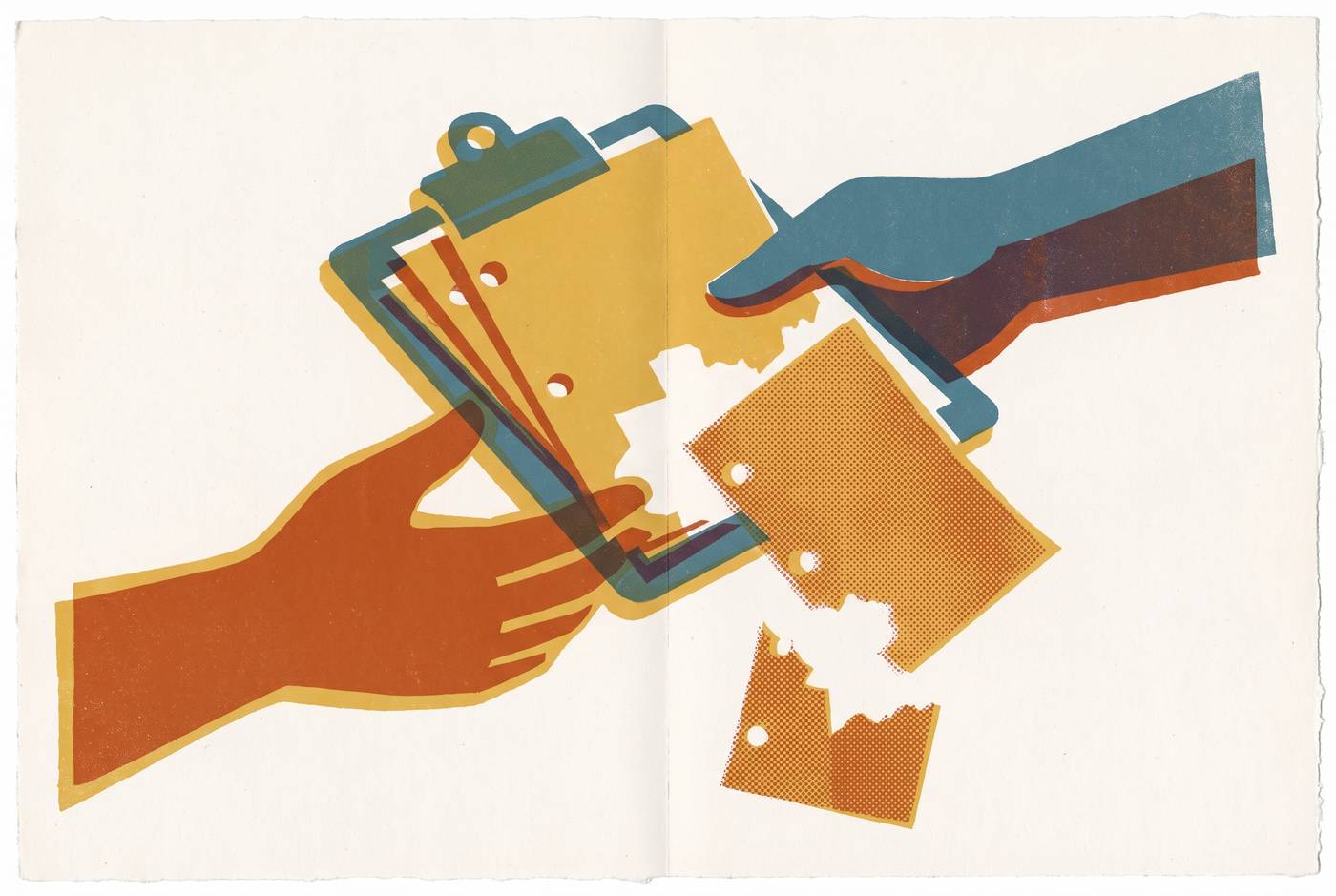
Picture the mechanics. The outgoing nurse talks through what happened during the shift; the oncoming nurse jots it down on whatever paper happens to be nearby. That scrap isn't part of the medical record, and most of the time it doesn't outlive the shift it was written during.
Handoffs also tend to happen in the worst physical setting imaginable for careful communication: hallways, nursing stations, shared spaces full of call bells and cross-talk. The outgoing nurse gets cut off mid-sentence, and whatever detail got interrupted rarely gets restated later. Nobody circles back to finish the thought.
There's a judgment problem baked into the process too. What gets said out loud is filtered through one nurse's private sense of what the next shift actually needs to know. An incident that seemed handled, or resolved, or simply minor in the moment, often doesn't make the cut. Nobody decides to hide it. It just doesn't seem worth the breath at 6:45 in the morning.
Even when a nurse writes something down on paper, getting it into the EHR after a full 12-hour shift competes with everything else demanding attention at the end of that shift. So the note stays on paper, or the digital entry gets compressed down to something nearly useless. And when something needs real escalation, a fall, a sudden behavior change, the usual path is still verbal: tell the supervisor, and hope the supervisor doesn't get pulled away before writing it down. No written confirmation means no proof the escalation ever happened, let alone that anyone reviewed it.
The Joint Commission has found that over 80% of serious medical errors involve miscommunication during handoffs, and skilled nursing's handoff moment is exactly where that statistic comes to life. A nurse can deliver flawless post-fall care and still be the same nurse whose verbal-only handoff means that fall never officially happened.
Staffing Shortages and Handoff Compression
According to PointClickCare, 87% of nursing homes face moderate to high staffing shortages, which is the operating environment most facilities live inside every single day. That's the operating environment most facilities live inside every single day.
When a floor is short-staffed, the outgoing nurse can't stop to give a careful, complete handoff. Call lights are still going off and medications still need to go out, so the handoff has to happen around all of that rather than instead of it. In the worst cases, there's no real overlap between shifts at all, just a few rushed minutes before one nurse walks out the door and the other stands alone on the floor.
Short staffing strips away the supervisory check that used to catch what slipped through. Supervisors who'd normally be free to formalize a verbal incident report are covering clinical duties themselves, because there's nobody else left to do it.
The paperwork burden doesn't shrink to match, either. That 40%-of-a-shift documentation figure assumes a floor staffed adequately. When it isn't, documentation gets squeezed against direct care demands, and incident reports are usually first to give. Handoff turns into triage: what absolutely must be said, versus what seemed handled and can wait. The things that seemed handled are precisely the things that vanish.
Federal Evidence on Records Lost to Handoff Failures
The scale here isn't theoretical. An OIG report (OEI-05-24-00180) found that nursing homes failed to report 43% of falls with major injury and hospitalization among Medicare-enrolled residents in their required MDS assessments. A NursingHome411 policy brief on that same report converted the percentage into raw numbers: facilities left out nearly 18,400 of roughly 42,000 such falls from the assessments federal rules require them to file.
The state-by-state variation is its own piece of evidence. Underreporting ranged from 21% in South Dakota to 64% in Washington, DC. A spread that wide doesn't look like random noise. It looks like facilities running fundamentally different internal processes, some that catch incidents reliably and some that don't catch much of anything.
Part of why this happens so easily: PointClickCare's analysis notes that 95% of falls in nursing homes go unwitnessed. The entire record of what happened rests on whatever the nurse who found the resident chooses to write down and pass along, with nothing else to check it against.
The OIG findings point to a specific mechanism behind the numbers: when a resident goes to the hospital after a fall, the MDS ends up coded from incomplete information passed between two systems that don't communicate automatically.
The stakes attached to this category aren't small. That same PointClickCare analysis found that falls account for 36% of all professional liability claims in skilled nursing. The category most exposed to handoff failure is also the category carrying the heaviest litigation risk. None of this proves anyone was negligent. It proves the chain between bedside nurse, chart, MDS coordinator, and hospital record has too many gaps in it to produce accurate federal reporting at scale.
MDS Coding as Regulatory and Financial Liability
The MDS doesn't get built in real time. An MDS coordinator assembles it periodically, working from whatever the clinical record happens to contain at that moment. If an incident never made it into the chart, it cannot make it into the MDS. There's no mechanism for recovering information that was never written down anywhere retrievable.
CMS's 2025 update to surveyor guidance on F641 now explicitly covers MDS coding accuracy. When the MDS doesn't line up with the clinical record, facilities are exposed on two fronts at once, compliance risk and reimbursement risk under PDPM. A related but distinct scenario arises where the care itself looks fine on the surface but the documentation never shows that staff identified a concern, assessed it, and responded to it. That's the fingerprint of a handoff gap: the care happened, but the paper trail stayed silent.
Under the updated survey process, surveyors in 2025 and beyond lean on objective data and consistency within the record to judge compliance, so small charting gaps now carry more survey weight than they used to. A regional Medicare claims reviewer recorded a 27% documentation error rate in SNF medical reviews for July through September 2024, a concrete figure showing how often what's actually in the chart falls short of what a claim requires.
The financial exposure isn't abstract either. PointClickCare put the average liability cost per occupied bed at $3,000 in 2024, and pegged the annual cost of undocumented falls alone at $380,000 per facility. Those figures are the downstream price of incidents that moved through a handoff chain and never landed anywhere permanent.
Documentation Gaps and Resident Risk Identification
Risk stratification depends entirely on a complete incident history existing somewhere. Falls, behavioral changes, skin integrity events, medication variances: the pattern across all of those drives how a facility scores risk and plans care for a given resident.
When incidents stay verbal and never make it into the chart, that pattern doesn't exist on paper. A resident who's fallen three times this month, but whose falls got handled informally each time, can show up in the system as low-risk, simply because the record shows nothing. PointClickCare's analysis on incident documentation identifies the mechanism: if a fall history isn't documented, other staff never get alerted to the danger, precautions never get put in place, and the resident who needs the most attention ends up receiving the least.
That gap matters even more as facilities adopt predictive tools that scan EHR data to flag high-risk residents shortly after admission by weighing clinical and demographic factors from the EHR. Those tools are only as good as what gets fed into them. A facility spending money on data-driven risk monitoring still depends on the same fragile handoff chain to populate the data that monitoring runs on. Break the handoff, and the analytics inherit the same blind spots the handoff created. Risk stratification only works when the history behind it can be trusted, which makes handoff integrity a prerequisite for any predictive safety effort, not a side project running alongside it.
The regulatory environment that makes continuous documentation integrity, not periodic cleanup, the only viable approach
Standard surveys happen at least once every 15 months, but complaint surveys can land at any time, with no warning. That rules out treating documentation as something to clean up before an expected visit, because there is no reliably expected visit to clean up before.
Pathway Health's recap states that CMS's updated Long-Term Care Survey Process and Appendix PP took full effect on April 28, 2025, and surveyors now work under guidance that sharpens scrutiny of MDS accuracy, care planning, and incident documentation specifically. On the enforcement side, The FY 2025 final rule expanded use of both per-instance and per-day Civil Monetary Penalties, so a documentation gap left to linger gets penalized progressively rather than written up once and forgotten.
CMS Memorandum QSO-26-14-NH confirms that CMS is also rolling out a Risk-Based Survey process nationwide starting September 8, 2026. Roughly 12% of qualifying higher-performing facilities will get shorter surveys with fewer surveyors on site, though those surveys still have to touch every required area of compliance. Critics have warned that this setup risks letting quality problems slip through simply because fewer eyes are on site for less time. For facilities that qualify for the lighter track, that actually raises the stakes on internal documentation integrity, since less external oversight remains to catch what internal processes miss.
A state health agency recently issued a revised Nursing Home Incident Reporting Manual, following a prior revision back in June 2012. LeadingAge New York states that the new manual clarifies what counts as reportable and how it should be reported. A regulator doesn't revise a manual on that timeline unless it believes existing reporting has been inconsistent for a while. Whether a facility faces a traditional survey or the streamlined version, waiting to fix documentation gaps until a surveyor is standing in the building doesn't work. The gaps form continuously at every shift change, regardless of whether anyone's watching.
Closing Handoff Documentation Gaps Before They Become Chart Deficiencies
Verbal handoffs aren't going away, and pretending otherwise wastes everyone's time. The realistic goal is making sure every incident raised verbally has a second, parallel path into the permanent record before the shift ends, so the verbal report becomes a starting point instead of the entire record.
Facilities that get this right standardize what counts as reportable in the first place, establishing clear, facility-wide criteria for what qualifies as an incident, a defined window for when it has to be documented, and someone specifically responsible for confirming it landed in the chart. The core requirements are the same three: defined reporting criteria, one consistent tool used building-wide, and timing expectations that don't shift depending on who's on shift.
Duplicate entry should be killed wherever it occurs. Every time staff type the same information into two different systems, quality drops on at least one of them. The lower-friction path draws on documentation already sitting in the EHR rather than bolting on a separate incident-reporting step for staff to remember on top of everything else they're already charting.
Supervisors need a real mechanism for verifying that anything flagged verbally during a shift actually made it into the record before sign-off, because a gap left unchecked for one 12-hour shift can sit there uncorrected for weeks. MDS coordinators need the equivalent on their end: a reliable signal that an incident happened during the coding period they're working from. The space between bedside charting and MDS assembly is exactly where the OIG's 43% underreporting figure comes from, and closing it means building an actual workflow connecting floor nurses to the MDS team rather than assuming the information will find its own way there.
Cross-setting handoffs need their own protocol as well. Amy Stewart's point in the McKnight's coverage of the OIG report was specific: SNF nurses should follow up with the hospital, even days later, to confirm the real extent of an injury. That's a gap between two separate organizations, and no amount of internal EHR improvement closes it by itself.
Most of what's needed already exists somewhere in nurses' own clinical notes. The real gap sits between those notes and the systems, MDS, incident logs, care plans, supervisor records, that are supposed to make the information visible and usable downstream. Closing that gap has less to do with changing how staff behave and more to do with extraction and routing: getting what's already written to where it actually needs to go. Tools built to read existing clinical documentation and surface incident patterns, without asking staff to enter anything new, are aimed at exactly that problem. They work with what's already being charted instead of adding another task to a documentation load already eating close to half of every shift.