How Redundant Data Entry Drives Nursing Turnover in Long-Term Care
Repetitive charting across disconnected systems burns out nurses and drives turnover.
Turnover in long-term care isn't a staffing problem that spikes and recedes. It behaves like a fixed cost, something facilities budget around rather than try to solve. A long-term services and supports scorecard put nursing home staff turnover at 53.9%. A Health Affairs study found mean annual turnover for total nursing staff running around 128%, with a median closer to 94%. Some buildings do better than others. None of them are doing well.
Pay, physical strain, and staffing ratios take most of the blame in these conversations, and they deserve some of it. But research into turnover intent has identified workplace culture and management support as significant predictors of a nurse's decision to leave, alongside task burden. That finding points somewhere less obvious than a wage gap: toward what the job actually feels like hour to hour, and how much of that hour is nursing versus paperwork maintenance. Administrative friction lives inside that gap. It doesn't show up next to wage data on a workforce dashboard. Administrative friction appears in exit interviews, assuming anyone asks the right question.
A national trade association reported the field added 40,700 jobs in 2025, with overall turnover falling. Read alone, that statistic sounds like the crisis is easing. Then notice that providers broadly still call recruitment difficult, nursing home employment remains strained, and the field is on pace for a shortage of more than 300,000 full-time LPN roles by the mid-2030s if nothing changes. Growth and decline happening in the same sector, at the same time, is a sign the actual causes haven't been touched. It's a sign the actual causes haven't been touched.
Redundant data entry in a nursing home shift
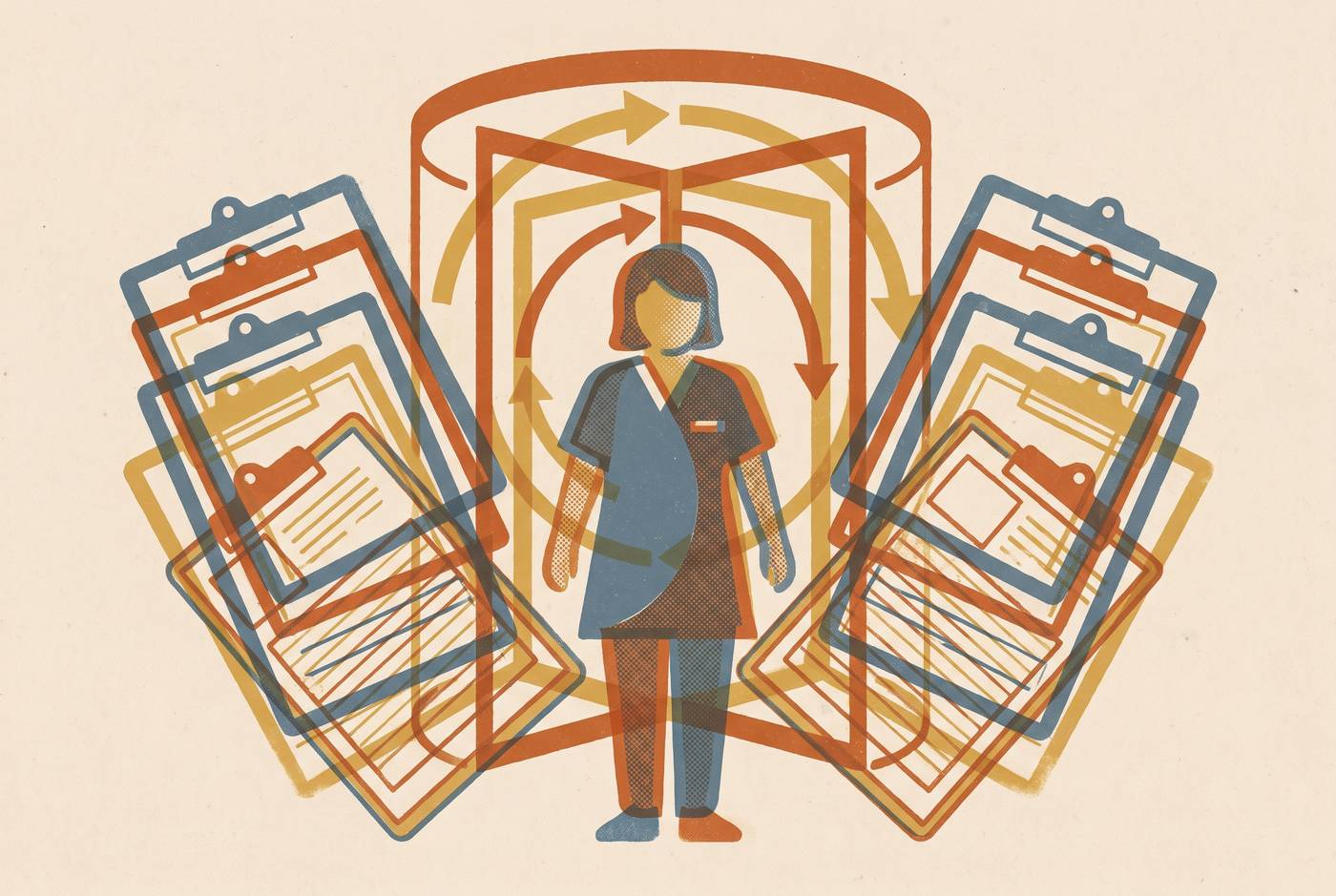
Documentation in a nursing home doesn't live in one place. It lives in at least three, and each one wants its own version of the same clinical observation typed in separately.
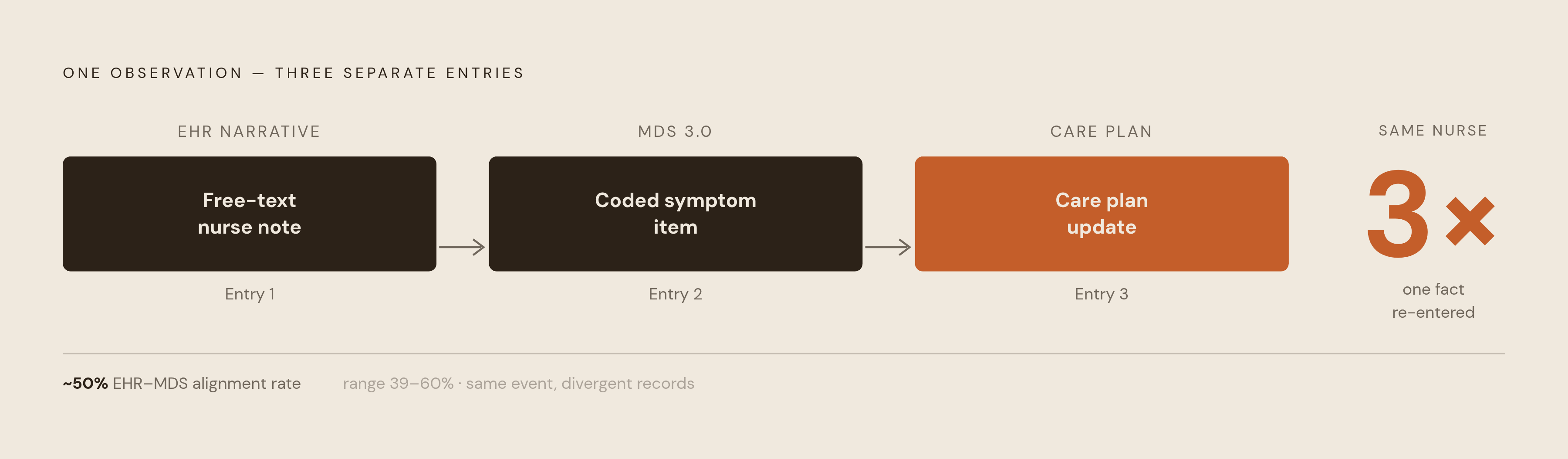
There's the EHR narrative note, where a nurse writes up the shift in free text. There's the MDS, the federally mandated structured assessment covering clinical, functional, and psychosocial status, completed on nearly every resident every three months or more often, entered separately from the EHR note and never auto-populated from it. And there's the care plan, updated on its own schedule, drawing on observations already written down twice elsewhere.
A study from the Post-Acute and Long-Term Care Medical Association measured alignment between direct staff care-partner reports and MDS 3.0 data. It ranged from 39% to 60%, averaging around 50%. Half the time, what a nurse actually observed and charted doesn't match what ends up in the regulatory record. That gap doesn't close on its own. Someone has to re-enter it, reconcile it, or correct it, and that someone is the same nurse who charted the fact the first time.
Take a resident with a new behavioral change. A nurse documents it in a shift note. Then codes the same observation into an MDS behavioral symptom item, using different structure and different terminology. Then updates the care plan to reflect it. One clinical fact, touched three times, by the same person, in three separate formats. Nurses now spend close to 40% of their shifts on documentation instead of direct patient care, and given the MDS/EHR misalignment numbers above, a real share of that time is just this: the same fact, retyped.
CMS released updated MDS 3.0 Item Sets under the FY 2026 SNF PPS Final Rule, with a revised version posted in fall 2025 and an October 1, 2025 effective date. The multi-system entry structure that produces the redundancy above remains in place. F641, the citation for inaccuracy in the Minimum Data Set, carries real regulatory weight during surveys. Every re-entry touchpoint carries regulatory risk stacked on top of the time cost.
Documentation burden, burnout, and the intent to leave
The EHR is already a major source of dissatisfaction among nurses, and the data on this isn't subtle. A Black Book Research survey of more than 9,000 nurses found 92% believe EHR systems have hurt their job satisfaction. Sixty-nine percent named documentation burden and poor usability as major reasons for wanting to leave. Thirty-four percent said they were considering leaving their current job within the year specifically because of EHR-related stress, and 19% said they were considering leaving nursing as a profession.
The complaint is about the redundant part specifically. It's about the redundant part specifically, and KLAS Research's Arch Collaborative report backs this up: streamlined or reduced charting was the single most-requested EHR improvement among nurses, named twice as often as any other request. The same report tied burnout and turnover risk to a specific pattern: nurses reporting high amounts of "unproductive" charting, work they experience as bureaucratic rather than clinically meaningful. That word, unproductive, carries the weight of the finding. Charting that serves the system instead of the resident is what wears a nurse down.
Two injuries stack on top of each other here. One is a time injury: every minute spent re-entering an observation is a minute not spent at a bedside, and nobody entered nursing to maintain documentation systems. The other is harder to measure and probably worse: a purpose injury. When a nurse recognizes that what she's typing already exists somewhere else in the chart, the act stops feeling like clinical contribution and starts feeling like clerical upkeep. The CDC has drawn a direct line from documentation burden to workload and clinical burnout, and from burnout to worse patient outcomes, reduced safety, and higher turnover. Each link in that chain has been documented on its own.
The EHR experience now shapes where nurses choose to work in the first place, and whether they stay once they're there. A large share of nurses rank the EHR experience among their top factors when evaluating a new employer, and 80% say they'd rather work somewhere with what they call a nurse-centered EHR. A facility that can't offer that is losing candidates before they ever apply, to competitors running a lighter documentation load.
The financial cost facilities absorb when a nurse walks out
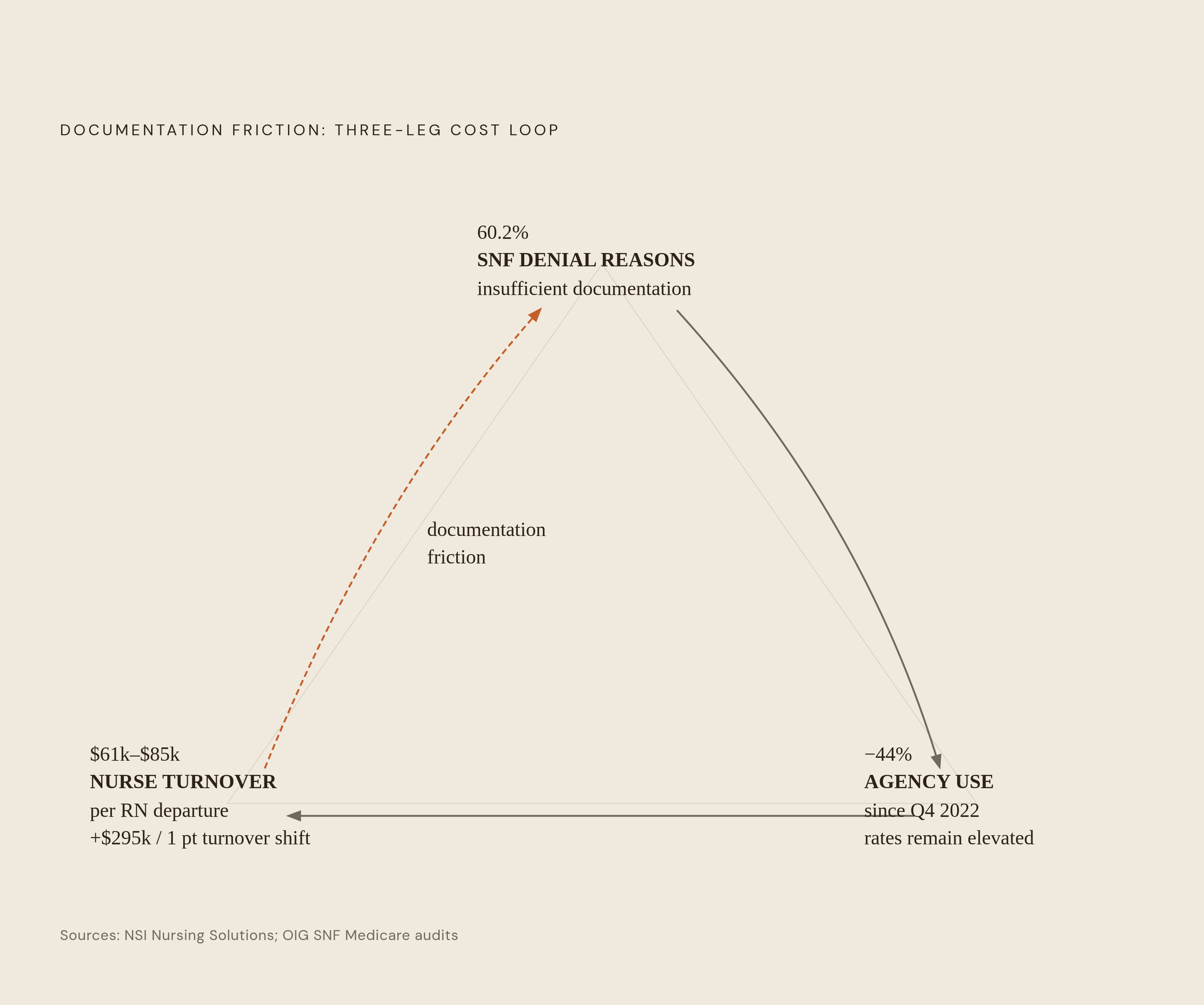
The average cost of turnover for a single staff RN reached $61,110 in 2024, up 8.6% from the year before. That number climbs further when a contract nurse fills the vacancy, up to $85,498 per nurse, contributing to a total annual system cost of $27.9 million across the multi-hospital systems studied under the RETAIN Framework. Each single percentage point of change in RN turnover can cost, or save, a facility around $295,000 a year. That's the figure that should reframe how a facility leader thinks about a documentation fix that shaves even a few points off attrition.
Long-term care carries extra pressure on top of direct replacement cost. Insufficient documentation caused 60.2% of SNF reimbursement denials, and that number only worsens when overloaded nurses, moving fast across multiple systems, make errors transferring information between them. The standard short-term patch for a staffing gap is agency labor, and agency rates run well above staff rates even as AHCA data shows agency use has fallen roughly 44% since the fourth quarter of 2022. Departures create documentation gaps. Gaps cause denials. Denials cut into revenue at the same moment agency costs rise to cover the vacancy. All three legs of that triangle trace back to the same documentation friction.
Why the standard response of adding a new tool or a new workflow makes things worse
When documentation errors become visible, the instinct in most facilities is to add more structure around them: one more mandatory field, another flowsheet, another checklist. Each addition is defensible in isolation. Each one also stacks on top of the last, and KLAS Arch Collaborative data ties burnout risk to patterns of unproductive charting, work nurses experience as bureaucratic rather than clinically meaningful. Applied this way, the fix becomes indistinguishable from the problem it was meant to solve.
New software usually repeats the mistake in a different shape. Any system that pulls a nurse out of the EHR she already uses, so she can enter the same information again somewhere else, is structurally identical to the redundancy already described. It just wears a different vendor's logo. Long-term care nurses already generate rich clinical detail in their shift notes, which undercuts any claim that the field has a data shortage. What it has is a structure shortage: that detail sits unstructured, invisible to the reporting, compliance, and risk functions that need it in a different form.
Magnet-designated hospitals, which put nurse leadership at the center of workflow decisions, show the contrast starkly. Eighty-seven percent of nurses at Magnet-designated hospitals rated their EHR as supportive of clinical workflows, against just 21% at non-Magnet facilities. The gap points to a design philosophy difference rather than simply a software difference. It's a design philosophy gap, and it suggests a simple test for any new tool or policy: does it eliminate a step, or add one? Adding a step adds to the exact burden already pushing nurses toward the door, no matter how well-intentioned the addition looks on paper.
Regulatory pressure closes off the easy way out, which would be doing less documentation. Revised LTC Surveyor Guidance raises the documentation bar rather than lowering it. The real task is meeting a higher standard without adding to the load nurses already cite as a reason to quit. That rules out most of what facilities have been trying.
Removing documentation friction without adding new workflows
The clinical intelligence facilities need already exists in the chart. Nurses don't fail to observe or record what matters. What they record just stays locked in unstructured text. Falls, medication events, hydration status, skin wounds, behavioral shifts, functional decline: all of it gets written into EHR narrative notes as a matter of routine. It's real data, sitting in the wrong shape.
Technology built to read that unstructured text and turn it into structured reports, compliance-gap flags, and risk scores removes a documentation layer instead of adding one. Nurses keep charting exactly as they do now. Nothing new gets asked of them. What changes is what happens to the information after it's written.
Applied this way, the same clinical note that already exists can be analyzed to surface MDS-relevant information, reducing the re-entry burden between narrative charting and the structured assessment. Resident risk scores and trend lines can reach a nursing manager in near real time, without a nurse filling out one more form. Compliance gaps can get flagged against existing documentation before a surveyor ever opens the chart, trading the retrospective scramble most facilities run before a survey for something closer to continuous readiness, a direction regulators have been signaling providers to move toward.
The staffing payoff follows directly. Less time on redundant entry means more time at the bedside, which is the exact purpose erosion driving so much of the turnover data cited earlier. Platforms built around this model for long-term care, reading what nurses already write inside their existing EHR instead of demanding a second, parallel entry, can free up real time for nursing managers without adding headcount or asking anyone to learn a new workflow. Platforms built this way are designed to hold outside a single-facility pilot.
Compliance and retention rarely point in the same direction. Here, they do. Unlocking the data already sitting in the EHR through real-time analysis supports cleaner survey readiness, since retrospective review alone struggles to catch problems early enough to fix them. The same intervention that lightens a nurse's daily load also tightens the documentation accuracy that F641 citations exist to police. One fix, looked at from two different desks.
Actions facility leaders can take now, before the next survey or the next resignation
Start by measuring where the burden actually sits instead of guessing. Break turnover down by role, unit, shift, and manager. The same granularity that reveals a manager driving departures on one wing will also show whether a documentation-heavy shift bleeds staff faster than the rest of the building. Watch the leading indicators too: a rise in incident reports, a decline in early retention, creeping overtime on the most burdened shifts. These trends tend to become visible weeks before the resignations do, for anyone actually watching.
Then audit the documentation stack itself before adding anything new to it. Map every place the same clinical observation gets entered more than once across the EHR, the MDS, and the care plan. That map will show, more clearly than any turnover statistic, exactly where nurses are losing time and purpose in the same motion, and exactly where the next fix needs to aim. Adding another field to that map is the wrong move. Removing one is the job.