
How Nurses Are Held Accountable for Documentation They Cannot See
Surveyors grade the record, not the effort—and nurses can't see theirs in real time.
Nurses in long-term care get held to a documentation standard they have no practical way to check as they're meeting it. The gap sits between what a nurse writes on a given shift and what anyone, including that nurse, can see in aggregate before a surveyor or an auditor sees it first. That mismatch, not sloppy charting, is why so many facilities get cited for care that actually happened but never got captured in a form a surveyor recognizes. Periodic audits do not fix this. Only continuous, note-level visibility does, and the industry's insistence on quarterly chart pulls is the wrong tool applied with real discipline.
What compliance demands from that documentation, and how the rules have sharpened in 2026
Surveyors don't grade effort. They grade the record, and the record has to show something specific: that a facility identified a resident's changing needs, assessed them, and responded. A verbal handoff at shift change means nothing to a surveyor. A note means everything, and that asymmetry is the whole game.
2026 raised the stakes considerably. CMS issued QSO-26-14-NH on July 16, 2026, effective immediately, giving facilities 30 days to get it in front of the right staff. The Nationwide Risk-Based Survey model began rolling out for eligible facilities on September 8, 2026, with CMS aiming to have qualifying-facility data and a Care Compare icon publicly visible by September 30. In April, CMS revised memo QSO-26-03-NH, sharpening guidance on off-hour surveys, survey team makeup, and the examples used to define Immediate Jeopardy. Civil Money Penalty policy shifted too, with CMS signaling continued pressure on facilities to demonstrate meaningful corrective action.
None of this happened in isolation. The Long-Term Care Survey Process guidelines, revised since late 2024 and fully effective April 28, 2025, changed how surveyors approach MDS accuracy, psychotropic medication documentation, and care planning. F641, the tag covering assessment accuracy, encompasses MDS coding review, and when the MDS doesn't line up with the clinical record, a facility faces reimbursement risk on top of the deficiency. F684, the quality-of-care tag, gets cited when the record fails to show a team identified, assessed, and responded to a resident's condition. A documentation gap alone, with no actual lapse in care, creates real exposure under it. This is precisely why so many facilities get burned by paperwork rather than by negligence.
The federal watchlist hasn't relaxed either. OIG currently runs 13 active workplans touching nursing homes, and falls along with antipsychotic medication prevalence remain active review areas through 2025 and into 2026. CMS penalties rose 18 percent in 2024. That number is visible in rating drops, certification exposure, and money leaving the building; CMS penalties rose 18 percent in 2024.
The standards have never been clearer. What hasn't changed is that the nurses being measured against them still can't see their own compliance posture while they're building it, shift after shift. That mismatch is the actual problem, and every regulatory tightening since 2024 has made it more expensive to leave unsolved.
The MDS audit wave of 2026 and invisible documentation gaps turned into a financial emergency
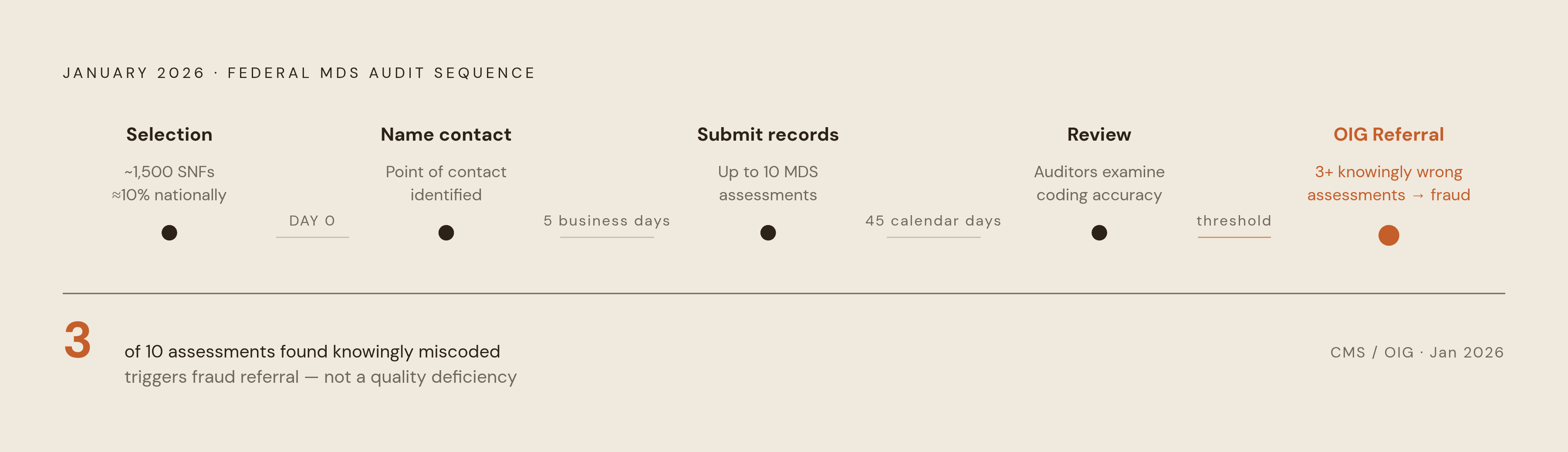
January 2026 is when this stopped being theoretical. A federal audit began that month covering data from two quality initiatives, and Healthcare Management Solutions is currently reviewing records from as many as 1,500 randomly selected skilled nursing facilities, close to 10 percent of all certified providers nationally.
The mechanics don't leave much room to breathe. A selected facility gets five business days just to name a point of contact, then 45 calendar days to submit medical records for up to 10 MDS assessments through a portal. The audits check one thing: does the MDS coding on file match what's actually in the clinical record. That's the direct line from a nurse's note to a facility's reimbursement, and it runs in both directions.
Regulatory guidance defines a pattern as three or more assessments with inaccurate coding where staff knew the coding was wrong, and that pattern gets read as a fraud signal, not a quality miss, referred straight to OIG for investigation. A documentation gap that used to earn a deficiency tag can now open a fraud inquiry. Those are not the same conversation, and facilities that still treat them as interchangeable are underestimating what 2026 changed.
The reimbursement dimension cuts both ways. Research on PDPM coding behavior found the policy's rollout was associated with an added 0.83 diagnoses per SNF claim on average, a 7.1 percent relative jump, and a 0.88-point rise in Elixhauser comorbidity scores, up 13.6 percent relatively. Some documentation-sensitive conditions moved further still: obesity coding rose 7.3 percentage points, and weight loss coding rose by a larger margin. Conditions that go undocumented or get documented inconsistently carry financial risk whether they're overcoded or missed.
Close to 45 percent of facilities are currently operating at a loss or a negative margin. An MDS audit finding in front of an operator running on that margin produces a solvency event, not a compliance headache. Insufficient documentation has long ranked among the primary drivers of improper SNF payments nationally. The audit wave of 2026 is just the mechanism finally catching up to gaps that had been quietly accumulating for months.
Periodic audits and pre-survey reviews and the gap they cannot catch
The standard response has been retrospective: quarterly audits, pre-survey chart pulls, periodic compliance sweeps. It's the tool most facilities reach for, and it's the wrong shape for this problem no matter how well someone executes it. Quarterly review was designed for a world where documentation risk accumulates slowly and predictably. That world doesn't exist anymore, if it ever did.
Start with timing. A quarterly audit that reveals a documentation gap is, by definition, looking at something that may have existed for three months already. Whatever risk built up in that window is baked in now, unresolved, and possibly already past the threshold surveyors are trained to flag. That threshold has sharpened too: three or more instances of inaccurate coding where staff knew the coding was wrong reads as a pattern under current CMS guidance, treated as a potential fraud signal rather than an isolated slip. A quarterly sample can miss that line easily, right up until it's already been crossed.
Then there's the question of who is supposed to be doing the catching. Clinical leaders spend their days managing admissions, fielding family concerns, and putting out whatever operational fire is burning that shift, often across more than one building. Asking that same person to review every chart in real time is a mismatch between the tool and the job. Calling the resulting gaps a leadership failure gets the diagnosis backwards: the design of compliance monitoring itself is what's broken, not the people executing it.
Compliance guidance sets a continuous bar without ever naming it that way. It asks whether assessments are complete, whether care plans are individualized and measurable, whether interventions appear in daily practice notes, whether progress notes track with a resident's current status. Every one of those questions needs an answer that holds true today, not one that held true at the last quarterly review three months back.
Some of the trouble lives inside the EHR itself, not just in staff behavior. Incomplete workflows, inconsistent data flow between modules, documentation triggers that quietly get missed: the system contributes to the gap rather than sitting neutral above it. Periodic review has value, but it is structurally insufficient for a risk that compounds daily. The space between what the rules require and what a quarterly audit can catch is exactly where exposure sits, and it grows every week nobody's looking at it.
The specific incident categories where undocumented patterns become regulatory citations
Surveyors don't review documentation in the abstract. They check specific incident categories, and within each one, they ask the same four questions: was the risk identified, was the physician notified, was the care plan updated, was there post-incident monitoring.
Falls are at the top of the list. OIG flagged falls as an active review area in 2024, and the item remains on the workplan through 2026. Documentation needs to show identification of fall risk, prevention steps taken, a post-fall assessment, and a care plan update reflecting all of it. Antipsychotic and psychotropic medication use is the other long-running OIG focus, active since 2023, with LTCSP guidance updated on how that documentation should read: clinical justification, ongoing monitoring, a documented response when something changes.
Pressure injuries and skin wounds draw their own scrutiny, with surveyors looking for documented prevention measures, accurate staging, treatment notes, and a record of how the wound progressed over time. Medication errors need a trail running from identification through physician notification to a care plan adjustment. Behavioral changes require documented assessment and response, and a missing note reads as an absence of clinical awareness whether or not that awareness existed on the floor. Hydration is the quiet one on this list, easy to lose inside free-text notes, and thin intake tracking carries real clinical risk on top of the compliance exposure it creates.
A nurse who spots a fall risk, intervenes, and verbally updates the team at shift change can still get her facility cited, because the chart doesn't reflect what she actually did. The citation attaches to the record, not to whether the care happened, and that's the entire logic surveyors operate under: the chart is the only witness they recognize.
These categories share one more trait: a pattern only becomes visible across an entire chart, not a single shift. A pattern only becomes visible across an entire chart, not a single shift. A resident whose fall documentation has gone quiet over two weeks, or whose hydration notes have thinned out and gotten vaguer, won't surface in a single day's review. It becomes visible only when something is looking at the whole trajectory at once, across every shift, not just the one someone happened to pull.
Note-level, continuous intelligence in practice
The gap traced through this piece is a visibility problem. The information needed to close it already exists, sitting in the unstructured notes nurses write every shift, inside the EHR the facility already runs. Nothing new needs to be collected.
Continuous, note-level monitoring means reading those existing notes as they're written and surfacing patterns no individual nurse or manager could realistically assemble by hand across a full census. A tool built this way doesn't ask a nurse to enter anything new, and it doesn't add a parallel workflow or a second place to chart. The existing record, whatever platform a facility already runs, stays the single source of truth. The intelligence layer reads it. It doesn't compete with it, and any vendor pitching a second charting interface has misunderstood the problem.
What comes out the other end is practical. Compliance-gap alerts appear before a surveyor walks in. Ranked resident risk scores tell a nursing manager where to look first across a full building, instead of leaving that judgment to whichever charts happen to get pulled that day. Automated reports, built entirely from documentation that already exists, make a pattern visible at the management level without anyone hunting for it manually.
Coverage maps directly onto the incident categories named earlier: falls, medication errors, hydration, skin wounds, behavioral changes. These carry the highest citation and audit risk, and in every one of them, the pattern is visible only across weeks of notes.
One design principle governs anything built for this purpose, and it isn't negotiable: it cannot add documentation burden to staff who already spend close to 40 percent of a shift charting. A tool that demands more typing to solve a visibility problem is the same problem wearing a different coat. Survey readiness guidance has started calling for continuous compliance instead of annual preparation, and that standard only works if the monitoring layer runs off what's already been written, never off something someone has to write in addition.
Closing the accountability loop for nursing managers and facility operators
Right now the loop is broken at every point along it. Nurses can't see their own documentation patterns while they're generating them. Managers can't review every chart in real time across a full census. Operators, more often than not, learn about a gap only when an audit or a survey team finds it for them first, which is the worst possible time to find out.
Closing that loop starts with giving nursing managers a prioritized view: which residents, which incident categories, carry documentation gaps right now, while there's still time to act before a gap hardens into a cited pattern. It extends to operators being able to show continuous compliance instead of staging a well-rehearsed pre-survey scramble, and that distinction carries more weight under the Risk-Based Survey model, which starts publicly separating higher-performing facilities by September 30, 2026. Handled this way, the documentation nurses already produce stops being a liability waiting to surface. Captured and organized as it happens, it becomes something closer to an asset the facility can actually use.
The payoff lands in two places, and both matter more in 2026 than they did even two years ago. On the compliance and financial side, it means less exposure to rising CMPs, fewer adverse audit findings, and less reimbursement risk tied to MDS inaccuracy. On the workforce side, nursing manager time that currently goes to manual chart review gets redirected toward actual clinical leadership, and facilities gain room to manage more residents without growing oversight headcount in proportion, which matters given that AHCA/NCAL's Workforce Report found nine in ten providers still struggling to recruit.
The staffing landscape sharpens all of this further. The repeal of national numeric staffing minimums in December 2025 shifted the basis of accountability away from simple ratios and toward documented performance. Facilities now get evaluated through survey findings, PBJ audits, and historical deficiency patterns, which makes the documentation record itself the primary evidence of whether care was adequate. There's no ratio left to hide behind, and there wasn't much of one to begin with.
Continuous, note-level documentation intelligence isn't a feature bolted onto an already-functioning compliance program. Given where enforcement stands in 2026, it's what makes the accountability structure survivable, for the nurses writing the notes and for the operators standing behind them. The nurses were never the ones failing to document. Nobody, not the nurse, not the manager, not the operator, could see what all that documentation added up to in aggregate, in real time, until now. That's the actual gap, and closing it doesn't ask nurses to do more. It asks someone, or something, to finally look at all of it at once.