Shift Note Patterns That Signal Resident Risk to Nursing Managers
Managers can catch resident decline early by recognizing warning patterns hidden in shift notes.
The shift note is the richest record of a resident's condition in any skilled nursing facility, and it is the record least likely to be read with any consistency. Shift notes capture behavioral and functional change in real time, in a nurse's own words, in a way no structured field in the EHR is built to collect. Most of the data sitting inside an SNF's electronic health record is unstructured narrative text, and that text often holds the only account of something clinically meaningful that happened to a resident on a given day. Narrative text written across hundreds of residents and thousands of shifts cannot be read systematically at scale by a manager flipping through charts one at a time.
The deeper issue lies in the documentation architecture itself. A nurse can write an accurate, clinically sound observation into a narrative note, but that note can sit there indefinitely, never checked against the coded record a surveyor will eventually pull. The space between what a nurse saw and what the chart officially reflects is where a facility's real compliance exposure lives.
None of this is a story about nurses failing to document carefully. The shift note ends up as the least systematically reviewed document in the building, despite being the most clinically informative one a manager has access to. That gap, between the richness of the record and the manager's capacity to read it, is the starting point for everything the rest of this piece addresses.
What deterioration looks like in written language before it becomes a coded event
Adverse events in a skilled nursing facility rarely appear out of nowhere in the chart. They get preceded by a string of narrative descriptions that, read in sequence, trace a trajectory a manager can recognize if given the chance to see it laid out. The shift note holds detail the MDS was never designed to hold: a change in how a resident moves from one day to the next, a behavioral shift that shows up overnight, a refusal that happens once and then happens again three days later, a passing comment made by a family member during a visit. These details are the precursors to the events a facility eventually has to report, and they exist only in narrative form until something or someone connects them.
A recognizable set of warning signs tends to cluster together across these narratives: unexplained bruises or fractures, a new pressure injury, repeated falls, rapid weight loss, dehydration, declining hygiene, sudden sedation, recurring infections, a sudden change in mobility, and emergency room visits nobody on staff can fully account for. A manager trained to notice what a sequence of notes implies, not just what any single note states, is reading the chart the way deterioration actually unfolds.
Fall-related language patterns that appear in shift notes before a fall is reported
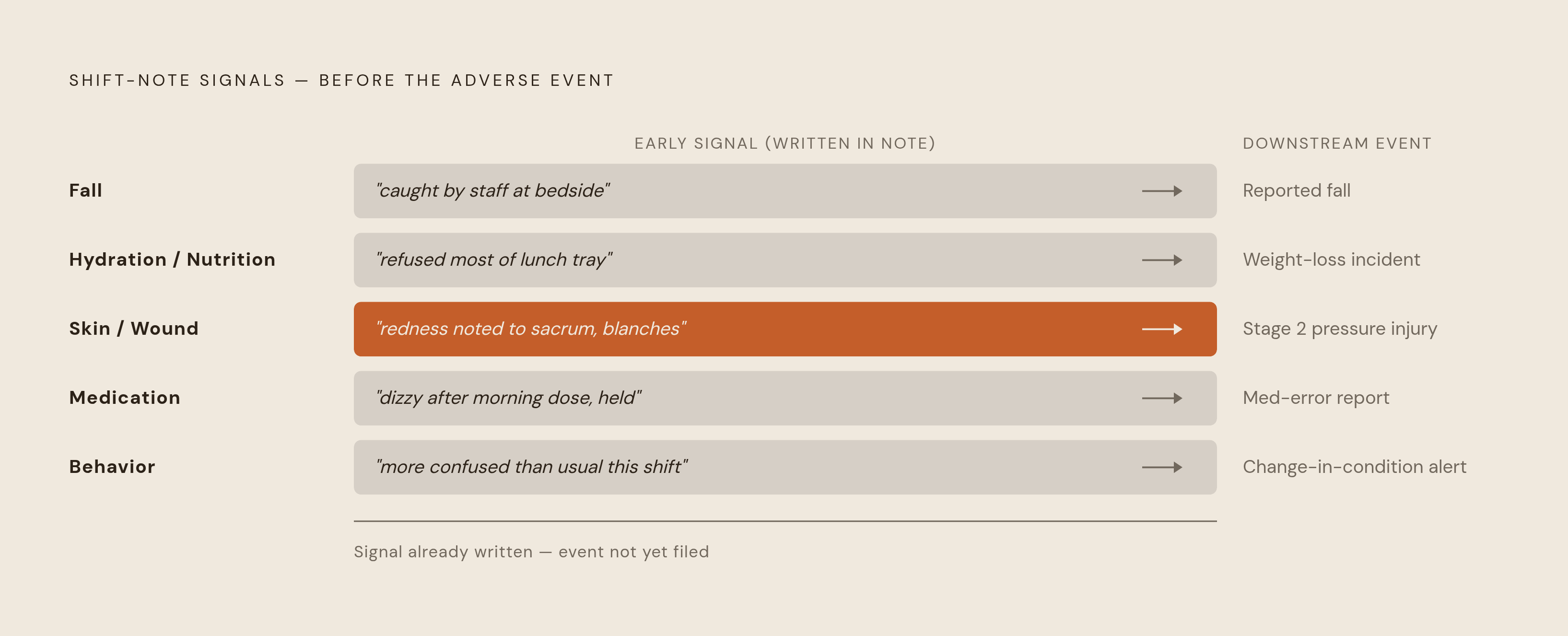
Fall risk rarely shows up fully formed in one note. Near misses deserve particular attention: a note describing a resident "caught by staff" or "found leaning against the bed rail" is describing a pre-fall event, and that event may never make it into a formal incident report.
The regulatory weight behind this category has grown heavier. CMS now weighs long-stay fall prevalence over staffing levels in its Special Focus Facility selection criteria, so fall-related language in shift notes is a compliance exposure as much as a clinical one. A manager who catches pre-fall language before a fall happens is protecting the resident, and at the same time protecting the facility's SFF status, its VBP score, and its five-star rating in one move.
Hydration and nutrition decline as it appears across sequential shift notes
One note is rarely dramatic enough on its own to raise an alarm about hydration and nutrition decline. Read across 48 or 72 hours, the same details form a pattern a manager can act on before the resident's status becomes a crisis.
That lag between individual note and visible pattern is the core problem in this category. Weight loss sits on the standard list of warning signs that should prompt immediate clinical attention, but weight gets measured weekly at best in most facilities, while the narrative clues that precede a measurable drop appear in shift notes days earlier. Read sequentially, shift notes function as an early-warning system that the formal weighing schedule simply cannot match for speed.
Skin and wound language that signals breakdown before a pressure injury is formally staged
Pressure injuries form over time, and the early stages of that process often get written down well before anyone connects them to a developing wound. Each of these is a potential Stage 1 or pre-Stage 1 observation, and each one, taken alone, can resemble routine charting.
The failure mode here is under-description. Catching this pattern requires comparing a given day's note not just against what happened on the same shift, but against documented baseline descriptions from days or weeks earlier, a cross-referencing task that becomes impossible to do by hand once a facility is managing more than a handful of at-risk residents at once.
Medication-related language patterns that precede adverse drug events and missed-dose chains
The medication administration record documents what was given. The shift note documents what happened around it, and that surrounding narrative can hold the earliest sign of an adverse drug reaction, or a missed-dose pattern that is building toward something worse. A manager should watch for a resident refusing medication with or without a stated reason, a behavioral change appearing within hours of a new medication or a dose adjustment, complaints of dizziness or nausea with no obvious cause, a note that a resident was "sleeping through" a scheduled medication pass, or staff documentation that a dose was held without a corresponding note from the physician.
Psychotropic drug use is now under direct survey scrutiny. Survey protocol changes took effect on April 28, 2025 and now require documentation around behavioral health interventions and psychotropic use, so when a shift note describes behavioral change after dosing, that is a direct regulatory concern, not just a background clinical detail. Clinical notes have already been used to build predictive models for adverse drug effects in other care settings, and the same mechanism applies in a skilled nursing facility: the narrative captures a behavioral precursor the MAR was never built to record. Watch for a sequence, a string of "resident refused" or "dose held" entries spread across multiple shifts, especially when none of them is followed by a documented clinical response.
Behavioral change language as the earliest signal of cognitive and systemic decline
Behavioral change is often the first visible sign of a systemic problem, a urinary tract infection, dehydration, a medication reaction, or pain, that won't show up in structured data for days. Shift notes carrying phrases like "resident more confused than usual," "agitated during care," "refused to participate in activities, not typical," "sleeping more than usual," "calling out overnight," or "family reports resident seems 'off'" each flag a potential early indicator of a problem still developing underneath the surface description.
What makes this category harder to read than the others is that behavioral observation depends heavily on who's writing it. Across falls, hydration, skin, medication, and behavior, the same structure repeats: each category carries real predictive signal, and each one stays invisible without some system built to read for it.
Why reading these patterns manually at scale is not a realistic management strategy
Knowing which patterns matter still leaves the task of reading thousands of notes at scale unsolved. A nursing manager responsible for an entire facility's shift notes, across every shift, for every resident, cannot manually cross-reference behavioral, skin, hydration, fall, and medication language in real time and still run the building. Notes get produced continuously, around the clock, and the notes most likely to contain early warning language, night-shift notes and agency-staff notes among them, get the least managerial attention.
The format of shift notes makes the volume of notes even harder to get through. Agency staff amplify this structurally, since a temporary nurse without knowledge of a resident's baseline writes notes that are harder to read for deviation precisely because recognizing deviation requires the kind of longitudinal familiarity an agency nurse hasn't had time to build.
The inverse case makes the underlying point just as clearly. Wooster Community Hospital Health System eliminated redundant note fields from its documentation workflow and recovered nearly 1,600 nursing hours annually in the process, showing that signal quality improves when noise gets reduced and that documentation architecture itself shapes what's findable later. For skilled nursing facilities, reducing documentation noise through field rationalization makes manual pattern recognition somewhat more realistic even before any automation enters the picture. It still leaves a manager facing the scale of a full census of residents.
What systematic shift note analysis produces in practice
Applying clinical note analysis systematically to every note, for every resident, across every shift has produced measurable reductions in the adverse events that shift note patterns predict. A peer-reviewed study in The American Journal of Managed Care covered 2017 through 2022, and it looked at skilled nursing facilities that used an analytics platform pulling both structured and unstructured EHR data multiple times a day, applying more than 300 algorithms to flag clinical changes and concerning trends. The same facilities outperformed their peers on all four CMS claims-based quality metrics, demonstrating the link between shift note pattern detection and regulatory performance. The study went on to model the potential system-wide impact on Medicare spending if this kind of approach were applied more broadly, giving some sense of the scale of what currently goes undetected across the sector.
NLP-based approaches to identifying falls in nursing home clinical notes have shown high sensitivity and specificity on their own. Rule-based NLP algorithms in particular offer more transparency and interpretability than machine-learning models do, which makes them well suited to a setting where clinical staff need to trust and understand why a given note got flagged. Any tool built for this environment also has to work within existing documentation habits rather than demand new ones, since nursing workloads leave no real room for an additional charting burden layered on top of what already exists.
The strongest objection to automated shift note analysis is a fair one: NLP accuracy isn't fully settled across every EHR system and every facility's writing style, and that's a real constraint where template standardization is inconsistent and agency staff write in a wide range of formats. Even so, if a human nursing manager validates what gets flagged, automated pattern recognition is structurally better than no systematic review. A scheduled, sampled survey visit cannot replicate the signal that continuous surveillance produces by design. The design question that matters most is whether a given system ranks and prioritizes what it surfaces, rather than dumping undifferentiated alerts on a manager who already has no time to spare, since more noise alongside more signal creates its own kind of risk through alert fatigue.
The 2026 regulatory environment makes shift note pattern recognition a compliance imperative, not just a clinical one
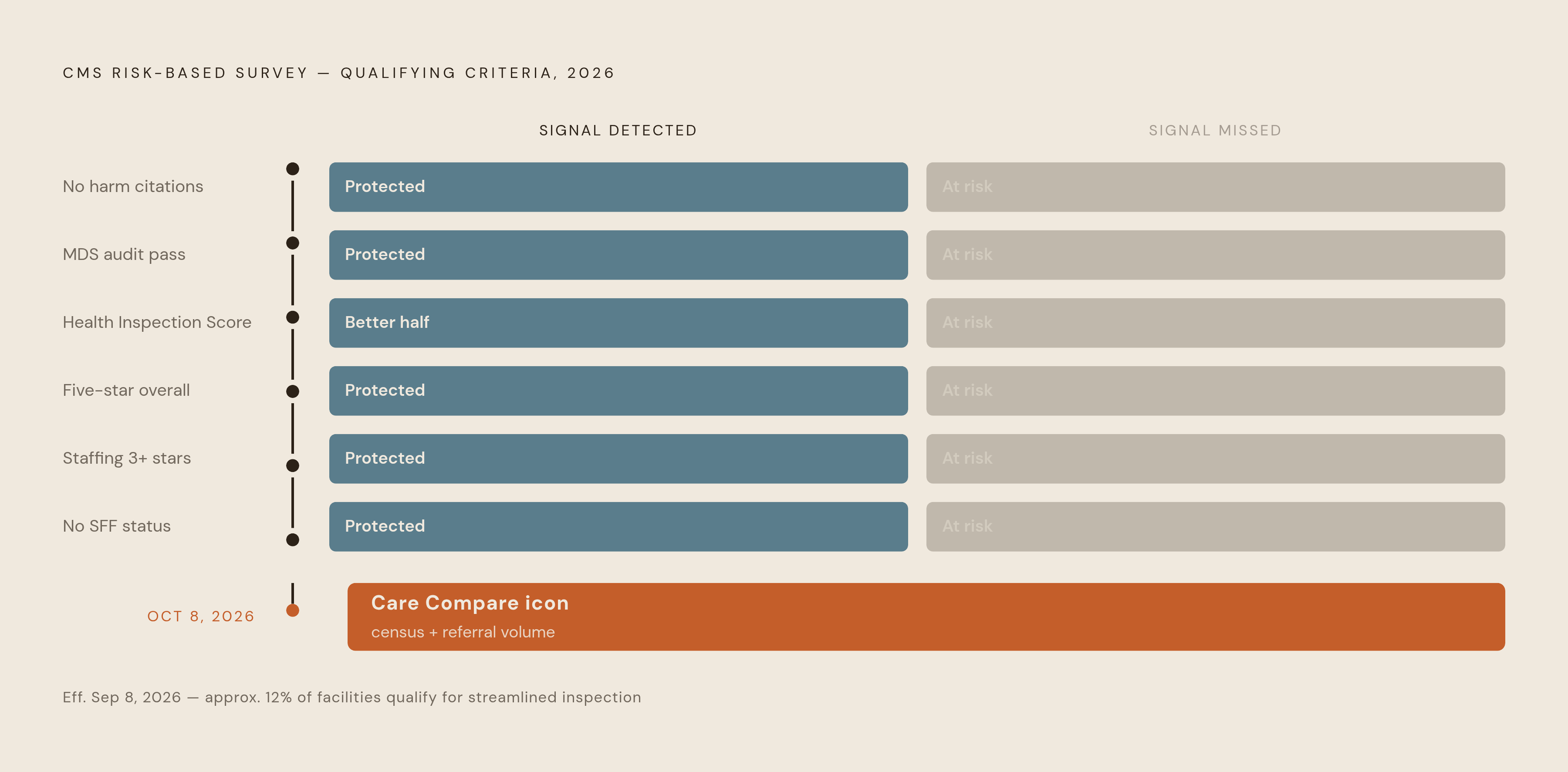
The regulatory landscape changed in 2026, and now more is at stake when a shift note signal goes unread. The same patterns that predict adverse events now shape a facility's survey pathway, its VBP score, its SFF exposure, and the public icon attached to its listing on Care Compare. On July 16, 2026, CMS announced a new risk-based survey approach set to begin September 8, 2026, under which roughly 12% of nursing homes judged lower risk will receive a streamlined inspection involving fewer activities and a smaller resident sample than the standard annual survey. Several of the qualifying criteria tie directly to outcomes that shift note patterns predict well in advance: no citations for actual harm, a passing MDS data audit, and a Health Inspection Score in the better-performing half of the state. The full list of requirements also includes a five-star overall rating, at least a three-star staffing rating, no active staffing waivers, a passing audit of payroll-based staffing data, no recent ownership changes, no Special Focus Facility candidate status, and fewer than two long-stay residents aged 65 or older with a new post-admission schizophrenia diagnosis. Qualifying facilities will carry a visible icon on Care Compare starting October 8, 2026, a public signal that feeds directly into census and referral volume.
CMS has already revised its SFF selection criteria to weight long-stay fall prevalence more heavily, so when two facilities have comparable compliance histories, fall prevalence becomes the deciding factor in SFF designation. That makes fall-related shift note language a direct lever for avoiding that designation. The eight measures now collected under SNF Value-Based Purchasing, including falls with major injury, infections requiring hospitalization, and long-stay hospitalizations, are all foreshadowed in shift note language well before they turn into reportable events on a claim. MDS validation audits are active now, with facilities notified through the iQIES provider preview folder, and the primary finding in these audits is an MDS coding gap tied to documentation that was insufficient or missing. The space between what a nurse wrote in a shift note and what the corresponding MDS field actually records is a live risk a facility carries today, not a hypothetical one. PEPPER reports came back in September 2026 after a three-year pause, so facilities again have a tool to check whether billing levels for certain services might raise a red flag with regulators, and that tool depends entirely on the accuracy of the clinical documentation feeding it.
If facilities build a systematic habit of reading shift note patterns, they do more than improve clinical outcomes for individual residents. They are building the kind of continuous, predictive compliance record that the 2026 survey environment is explicitly designed to reward and to measure. The notes already exist. They get written every shift, for every resident, in language that already contains the signal. What changes outcomes is whether a facility has a way to read them before the event they describe becomes the one CMS counts.