How Nursing Managers Lose Time to Manual Incident Report Consolidation
Four sequential steps in manual consolidation compound delays into missed regulatory deadlines.
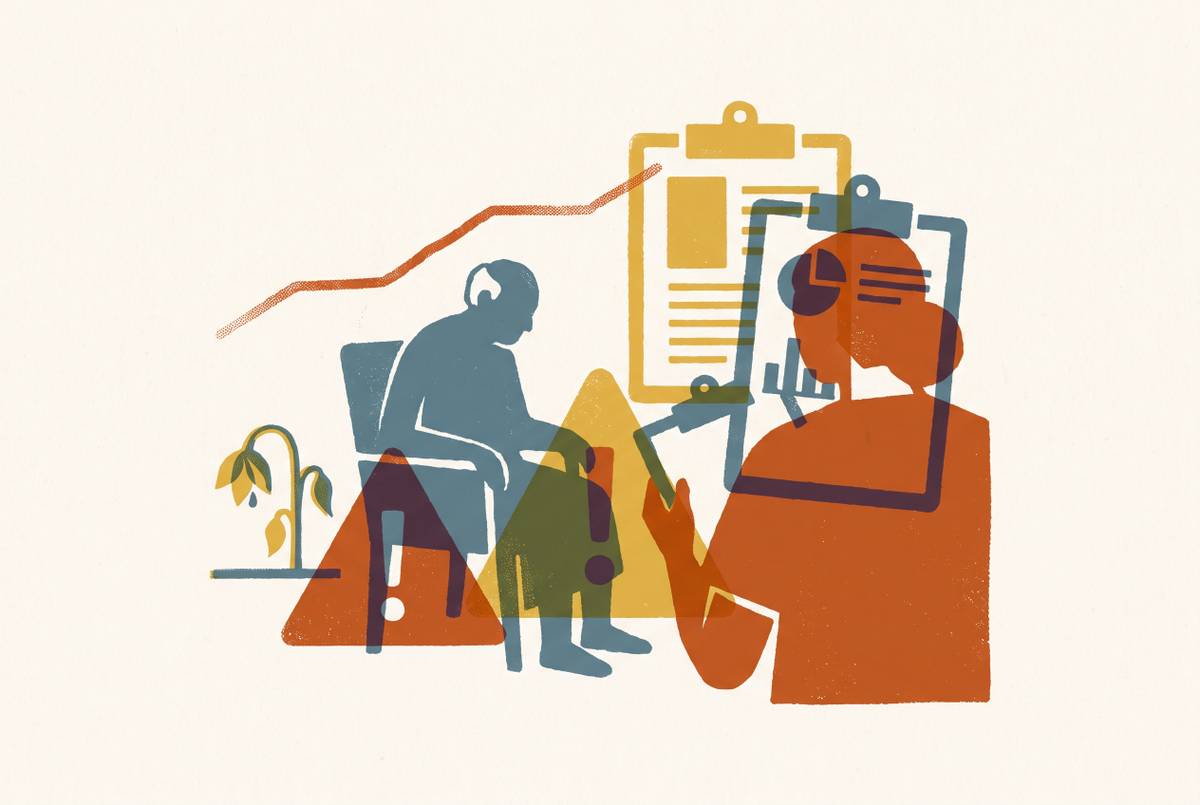
If you manage a nursing unit, manual incident report consolidation doesn't cost you a fixed block of time. It costs them time at four separate points in a chain, each step feeding the next, so that a delay or gap early in the process produces rework, re-contact, or a missed deadline later on. Understanding that chain, link by link, is what makes the drain visible enough to fix.
Why nursing managers are the consolidation bottleneck
The nursing manager role sits at a specific intersection: frontline clinical oversight, regulatory compliance, and quality improvement, all at once. No other position in a skilled nursing facility holds all three responsibilities simultaneously. Incident data, regardless of where it starts, ends up funneled through this one person for consolidation and follow-up.
Every incident category carrying real regulatory weight, falls, medication errors, skin wounds, hydration concerns, behavioral changes, routes through the nursing manager before it becomes a completed record. That routing isn't a matter of convenience or habit. It happens because the nursing manager is the only role positioned to judge clinical significance and compliance obligation in the same glance, so the facility has no alternative but to centralize there.
The burden that results doesn't spread evenly across a nursing team. It concentrates on one person, and that person is also the one responsible for the clinical leadership of the unit. A charge nurse can document an incident. A frontline aide can report what was observed. Only the nursing manager carries the job of turning scattered observations into something a surveyor, a state agency, or an internal quality committee can act on. That concentration is the structural reason the bottleneck exists before any discussion of software, staffing, or workload begins.
Incident reporting across shifts and sources before it reaches the manager
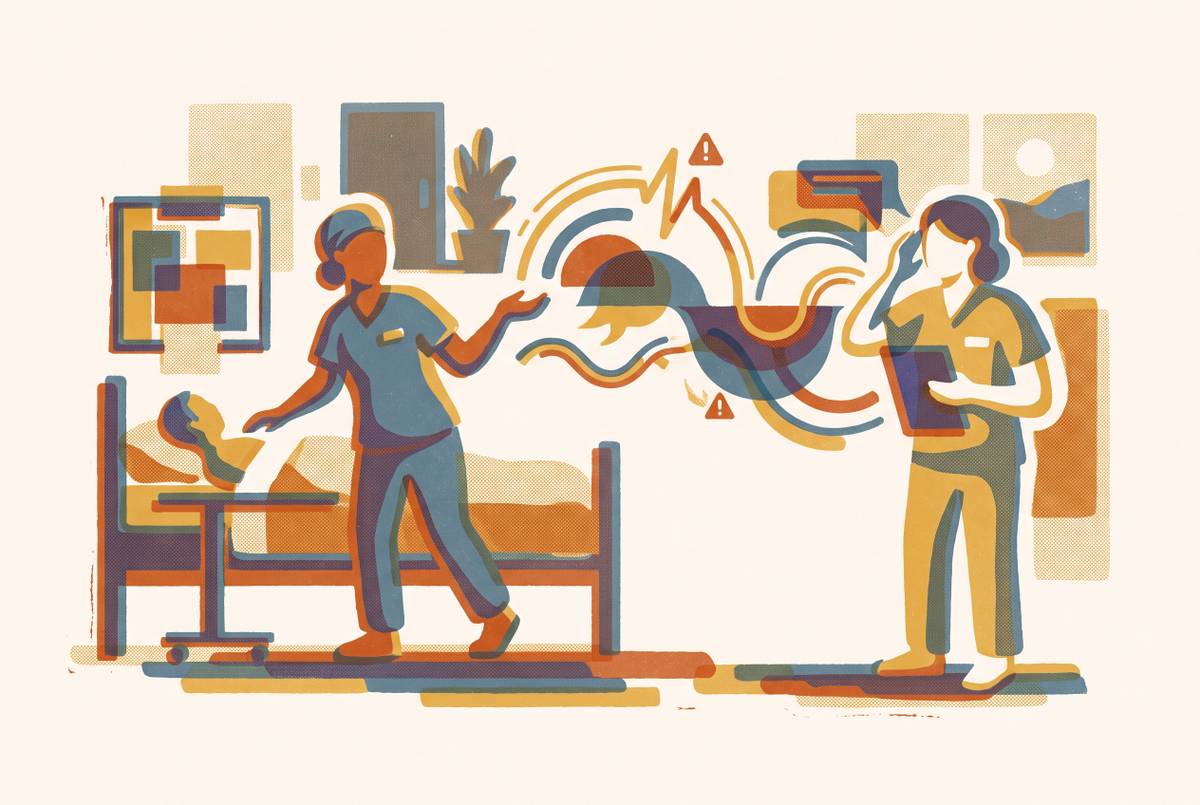
Before a nursing manager can consolidate anything, the raw material has to arrive, and it arrives from everywhere at once. Incident documentation in a skilled nursing facility comes through paper forms, electronic entries, shift-change verbal handoffs, and nursing notes written at different times by different staff members. None of these channels is synchronized with the others. A fall might be logged on paper by the aide who found the resident, mentioned verbally at shift change by the nurse who assessed them, and then entered electronically hours later once someone has time to sit at a terminal.
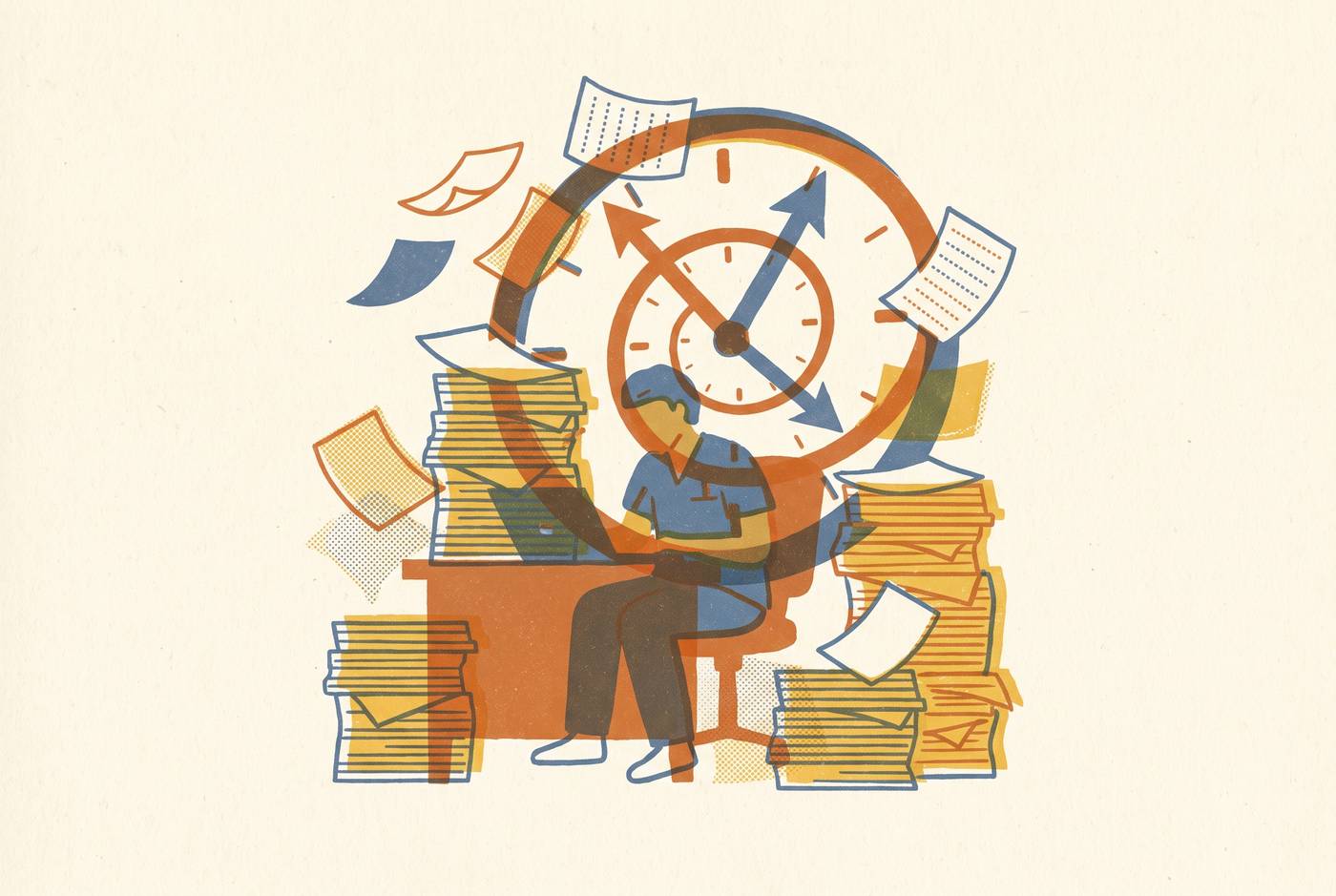
Regulatory deadlines don't wait for that material to settle. Incident reports have to reach state agencies within 24 hours, and full investigation reports are due within five business days. So a nursing manager can't treat consolidation as a task to schedule once a week or once a shift. Consolidation has to happen continuously, squeezed between every other responsibility on the unit, because the clock on each incident starts the moment it occurs rather than the moment someone gets around to writing it up.
The range of incidents that require this kind of tracking is wide: abuse, neglect, medication errors, injuries of unknown origin, falls, elopements, equipment malfunctions. Each category has its own reporting pathway and its own documentation standard, so you can't just run one template across the board. Each incident type needs a different set of fields, a different level of detail, and often a different internal form, even before you get to the question of paper versus electronic entry. That variety, combined with the speed the 24-hour and five-day windows demand, is the landscape a nursing manager has to work inside before any actual consolidation can start.
The compounding chain: four distinct steps that each consume time
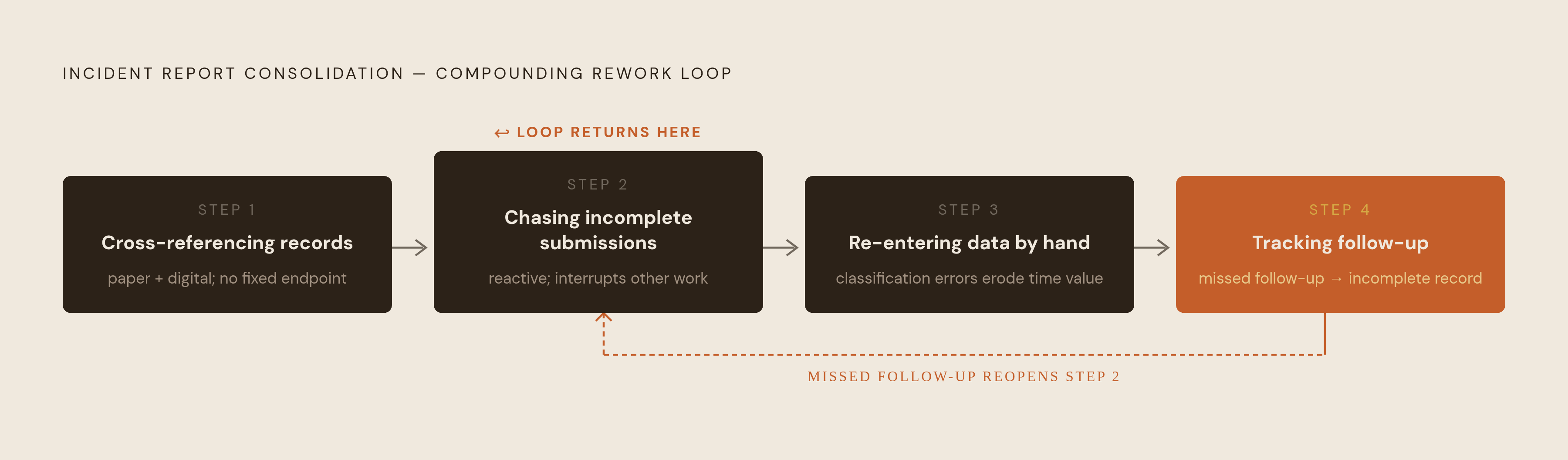
Manual incident report consolidation is a chain of at least four sequential steps that a nursing manager works through, and time lost at any one of them carries forward into the next, so a small delay early in the process compounds into a much larger one by the end.
The first step is cross-referencing paper and digital records. A 2025 qualitative study of nurse and healthcare managers found that a poor reporting tool and risk assessment matrix causes double and manual work for managers: the same incident has to be touched in more than one system before it counts as documented. Where paper processes still run alongside electronic ones, which is common, the manager has to reconcile what exists in each format by hand before any real analysis can begin. This step rarely appears in a written workflow description, yet it tends to consume the most time, because it has no fixed endpoint. A manager can't know a record is complete until every possible source, paper, electronic, verbal, has been checked against the others.
The second step follows directly from the first: chasing incomplete submissions. The same 2025 study found that some report handlers marked reports as processed when they had not actually been completed, a shortcut that emerges under time pressure and that leaves a secondary audit burden for whichever manager discovers the gap later. A Texas OIG inspection of Cypress Creek Rehabilitation and Healthcare Center found one report that was missing the date the incident occurred and the date and time staff noted the resident's post-incident health condition. Gaps like that force a manager to go back, re-contact staff, and reconstruct a timeline well after the fact, when memories have already faded. This step is reactive by nature. A manager has no way of knowing a submission is incomplete until reviewing it, so the work can't be batched or scheduled. It interrupts whatever else is happening on the unit.
The third step is re-entering data, and it follows from the first two because cross-referencing and chasing incomplete records both leave information in the wrong format. Participants in the 2025 study pointed specifically to the need for better terminology, classification, and analysis tools in their reporting software, a finding that reflects how mismatched systems force managers to re-key information by hand. Re-entry isn't simple duplication. When data moves from one format to another by hand, a classification error can slip in, and those errors compound downstream in MDS coding and quality measure reporting. Re-entry also erases the time value of the original documentation. A nursing note written at the bedside, in the moment, has to be re-read, reinterpreted, and keyed into a separate tracking format, often hours after the fact, by which point some of the clinical nuance has already been lost in translation.
The fourth step, tracking follow-up, runs in parallel with everything above it. Incident management doesn't end once a report is submitted. Facilities have to open investigations, put corrective action in place, and keep records of both, so this creates an ongoing tracking obligation that competes for the manager's attention alongside new incidents coming in. Without an automated way to track follow-up, managers rely on spreadsheets, paper logs, or memory, and each of those breaks down under the volume of concurrent incidents across a full resident census. This is the step where the chain closes back on itself: a missed follow-up on one incident becomes an incomplete record, and an incomplete record re-enters the chasing step the next time anyone reviews it.
Why existing reporting software fails to break the chain
Having incident reporting software in place doesn't eliminate this chain. In many facilities it adds steps to the chain. The 2025 qualitative study found that report handlers, usually unit managers, are dissatisfied with the handling features of the incident reporting software they currently use, and that they wanted AI capability built into that software but didn't have it.
Software that uses terminology and classification categories that don't match how incidents are actually documented at the bedside forces a manager to translate between two languages: the clinical language of a nursing note and the categorical language of a dropdown menu. That translation is itself manual work, no different in kind from the re-entry step described above, just wearing a different name.
One might object that better software configuration would solve this mismatch, that the right dropdown structure or a more thoughtful field layout would close the gap. That configuration change wouldn't solve the mismatch either. The mismatch between unstructured clinical documentation and structured reporting fields is a gap in kind, not in design, and no amount of rearranging categories closes it without something that can actually read and extract meaning from the free text nurses already write. Configuration changes the shape of the form. They don't give the system a way to understand a nursing note on its own terms.
What the consolidation drain costs beyond manager hours
The hours nursing managers spend on manual consolidation don't just disappear into administrative overhead. Every hour spent cross-referencing, chasing, re-entering, or tracking by hand is an hour not spent on direct clinical oversight, and that absence carries consequences that extend well past the manager's own schedule.
Compliance exposure is the most direct of these consequences. When consolidation runs through manual, fragmented processes, the gap between what actually happened on the unit and what ends up documented is precisely the kind of discrepancy surveyors are trained to find. CMS has published an updated MDS 3.0 RAI User's Manual, version 1.20.11, effective October 1, 2026, and the agency has already released draft MDS Item Sets, version 1.21.1, for implementation on October 1, 2027. That pace of revision signals that documentation accuracy requirements are tightening rather than settling into a stable baseline, so a facility relying on manual consolidation is trying to hit a moving target with the slowest possible method.
Resident safety is the second consequence, and it follows the same logic. Collecting incident data is only the first step in managing it. Identifying and correcting safety problems depends on the right people being able to access, sort, organize, and analyze that data, and that kind of analysis is difficult to do well when the underlying process is manual and fragmented. A pattern across multiple falls, for instance, is much harder to spot when each fall report sits in a different format, entered at a different time, by a different person.
The third consequence concerns the workforce itself. Administrative documentation burden is a recognized contributor to burnout and turnover among nursing managers, so the consolidation drain is wearing down the very people responsible for catching and correcting problems. These three costs, compliance exposure, resident safety, and manager retention, aren't separate line items. They reinforce each other: a burned-out manager has less capacity to catch a documentation gap, and a documentation gap that goes uncaught becomes a compliance finding that lands squarely on that same manager's desk.
What addressing each link in the chain requires
Each link in this chain has its own cause, so fixing the drain means matching the right intervention to the right step instead of treating consolidation as one undifferentiated problem.
Cross-referencing disappears when incident-relevant information is pulled automatically from the documentation clinicians are already producing. Nursing notes hold the richest signal available for spotting incident patterns, but that signal stays locked away as long as someone has to extract it from unstructured text by hand.
Incomplete submissions get caught immediately when a system monitors documentation on an ongoing basis instead of waiting for a manager to review a batch of reports after the fact. The gap between when an incident occurs and when it becomes a structured, reviewable record is exactly where manual work lives today, and closing that gap in real time removes the need for the reactive chasing described earlier.
Re-entry goes away when the extraction layer feeds directly into whatever format compliance reporting requires, so the manager's job shifts from typing data in to reviewing data that's already there. Follow-up tracking becomes structured and auditable when the same system that flags an incident also tracks its resolution status, so it closes the loop that currently depends on spreadsheets, paper logs, and memory.
The same principle applies to all four fixes: any approach that asks nursing staff to enter new data, fill out an additional form, or learn a new documentation habit trades one burden for another. It just moves a link in the chain. The only approach that breaks the chain without creating a replacement works from documentation that already exists inside the EHR, the notes nurses are writing anyway, in the course of care they're already providing.
A tool built around that principle, one that reads unstructured nursing notes already sitting in the EHR and turns them into automated incident tracking, compliance-gap alerts, and resident risk scores, addresses every link in the chain using data the facility already has. That's the structural requirement this entire chain points toward: a system that asks nothing new of the people at the bedside and gives the nursing manager a finished record.