Structured Shift Handoff Formats That Reduce Cognitive Overload in LTC
Standard handoff formats cut nursing errors by focusing memory, not willpower.
Cognitive overload at shift change in long-term care is a structural failure in overworked nurses. It is a structural failure, and it responds to structural fixes: the right handoff format, used the same way every time, cuts down what a nurse has to remember, sequence, and decide while the clock is running. This piece looks at the formats with evidence behind them in skilled nursing settings and breaks down what each one actually does to the mechanics of a handoff, not just the paperwork around it.
The highest-risk moment in a long-term care facility
Shift change looks administrative from the outside. Shift change carries real clinical weight despite its administrative appearance from the outside. It's the point where a resident's continuity of care depends entirely on whether one nurse can transfer what she knows to another nurse in a matter of minutes, often standing at a counter with a phone ringing and three call lights blinking down the hall.
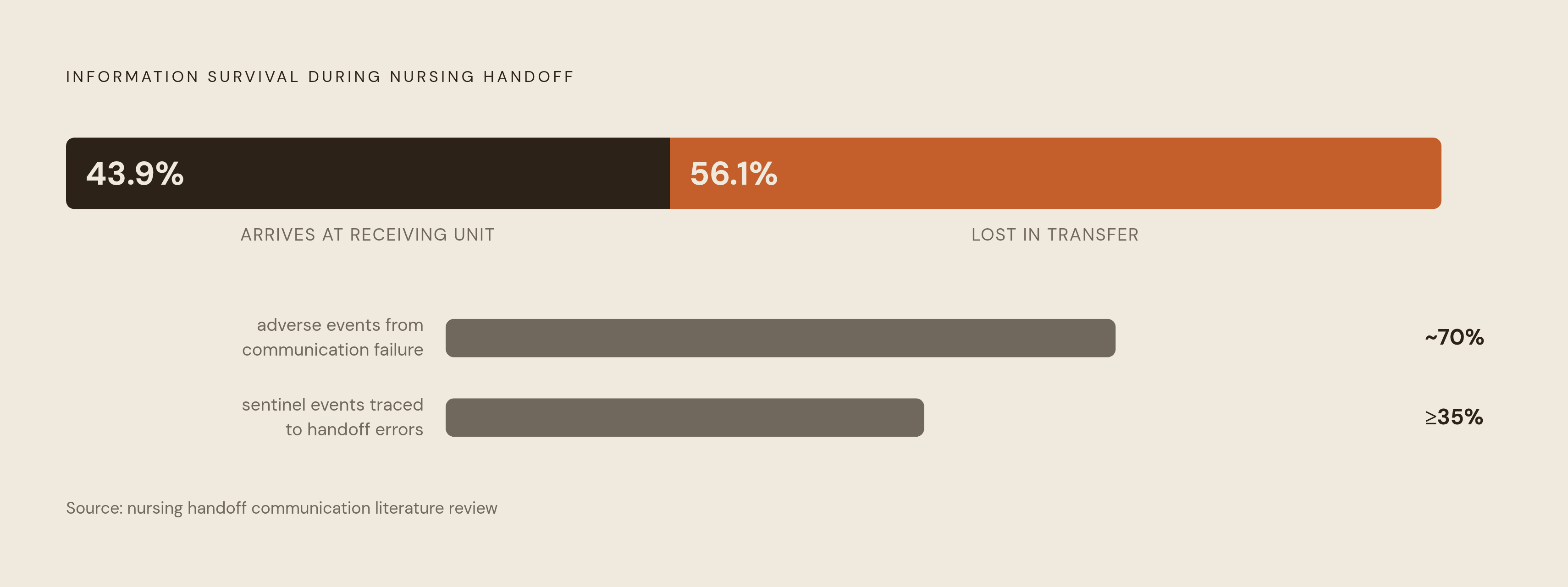
The Joint Commission has put numbers to this. Communication breakdown is the major contributing factor in nearly 70% of adverse medical events, and 75% of those events end in the patient's death. At least 35% of sentinel events trace back to handoff errors specifically, which makes handoff failure one of the single largest identifiable causes of preventable harm in the healthcare system, not a minor procedural gap.
Skilled nursing facilities feel this acutely. Part of this is volume: nurse-to-resident ratios in LTC settings mean more information has to move through fewer people at shift change than in most acute care units. Part of it is complexity: residents carry multi-system conditions, long medication lists, and functional dependencies that all need accurate, current transfer, not a summary from memory. And part of it is biological. Shift work itself degrades the exact capacities a handoff depends on, working memory, attention, response time, all measurably affected by extended or back-to-back shifts.
The scale of the information loss is the most sobering figure in the research. A Journal of Advanced Nursing finding shows that only 43.9% of accurate patient information actually reaches the incoming care unit during transfers. That means the majority of what an outgoing nurse knows about a resident, her history, her risks, what changed two hours ago, simply doesn't make the trip. This is a story about a systemic pattern, not careless individuals. It's a systemic pattern, which means the fix has to be systemic too: a format, applied consistently, not a reminder to try harder.
What cognitive overload does to a nurse during handoff
Cognitive overload at handoff is a specific, definable thing: the demand to recall, organize, prioritize, and communicate dense information under time pressure, usually while getting interrupted. It's a specific, measurable strain on cognitive systems, not vague fatigue. It's a measurable strain on three distinct mental systems, each with its own limits.
Working memory holds only a handful of items at once, and unstructured verbal report blows past that capacity within the first minute of an unstructured report. Attention takes a second hit from the environment itself: nursing stations run loud, alarms, overlapping conversations, phones, all of which degrade the encoding and recall a handoff requires. Shift work causes response time to suffer, with extended or consecutive shifts measurably slowing cognitive processing in ways that appear right at the moment a nurse needs to think fastest.
Layer onto that the outgoing nurse's actual job in the handoff. She has to recall what happened across the shift, assess what's still pending, and frame all of it so the next nurse can act on it immediately. That's three cognitively distinct tasks, recall, assessment, and framing for someone else's use, collapsed into a single rushed exchange. Research on handoff barriers names the usual suspects: distractions, no standardized procedure, not enough time, poor timing between the nurse leaving and the nurse arriving, and a unit culture that doesn't treat safety as the priority. Every one of these adds load. None of them reduces it.
The sharper danger isn't omission. Under cognitive strain, human recall doesn't just drop details, it substitutes plausible but incorrect ones, and a plausible wrong detail is far harder to catch than a blank. That distinction matters enormously for format design. A format that actually works doesn't ask a nurse to try harder or concentrate more. It narrows the decision space so there's less to hold in working memory at any given moment. Bedside Shift Report and I-PASS are both built around that same mechanical premise, even though each one gets there differently.
SBAR: the foundational structure that reduces recall burden
SBAR breaks down into Situation, Background, Assessment, Recommendation, a four-part sequence originally built by the military and later adapted for clinical use. The appeal lies in predictability. It's predictability: a fixed sequence means the outgoing nurse always knows what category of information comes next, so she isn't searching her memory for what to say while also deciding what matters. That search-and-retrieve burden is exactly what a rigid structure removes.
The benefit runs both directions. The incoming nurse, knowing the shape of what's coming, can listen with anticipatory attention rather than sit passively waiting to absorb whatever arrives in whatever order. That shift, from passive reception to structured listening, is itself a cognitive advantage, even before the content of the report is considered.
The evidence for SBAR has held up over time and across settings SBAR Systematic Review. A systematic review published in Nursing Open looked at 15 English-language studies from 2019 through 2024, examining ISBAR and SBAR-based frameworks specifically for their effect on communication errors during nursing shift handovers and patient transfers Nursing Open Systematic Review. AORN separately reported that standardized communication tools cut errors from 6.24 to 1.52 per patient handoff, roughly a fourfold drop. An earlier systematic review, searching through January 2017, found 11 usable records, 8 pre-post studies and one randomized controlled trial, reporting at least one clinical outcome tied to SBAR implementation SBAR Systematic Review. That's a durable evidence base, not a single study riding on novelty.
Still, SBAR has a fit problem in long-term care SBAR Systematic Review. It was built for acute, episode-centric communication, where each element assumes one discrete presenting situation. That logic works cleanly in a hospital, where a shift report often centers on a single acute event. This limitation motivates the formats that follow: each adapts or extends SBAR's structural logic to the LTC environment's specific demands.
Bedside Shift Report in SNFs: what the evidence shows when SBAR meets the resident's room
Bedside Shift Report takes SBAR's sequence and moves it physically into the resident's room, pairing the structured verbal report with direct visual confirmation of how the resident actually looks and presents. That relocation changes the cognitive equation in a way that's easy to underestimate.
The resident's visible condition becomes an external memory aid. The incoming nurse isn't reconstructing a mental picture from someone else's verbal description alone, she's checking that description against what's in front of her, in real time. Any gap between the report and the reality gets caught on the spot instead of surfacing an hour later during the first assessment. And because the resident or a family member can participate, there's a built-in verification layer that costs the nursing staff nothing extra in effort.
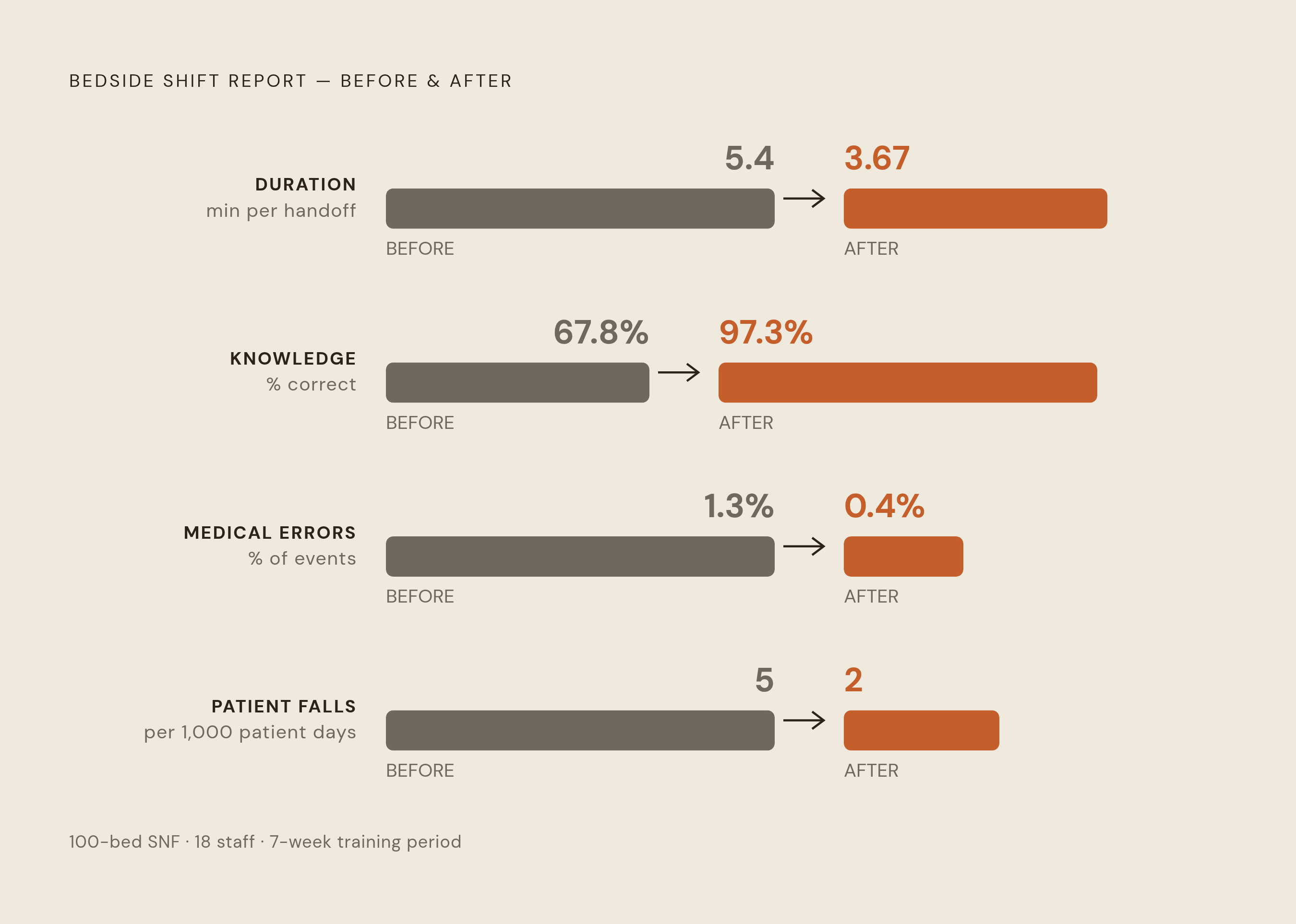
The strongest SNF-specific data on this comes from a December 2025 Walden University DNP study. Staff knowledge scores climbed from 67.8% to 97.3% (p =.001), close to eliminating knowledge gaps in the handoff process itself. Medical errors dropped from 1.3% to 0.4%, and patient falls declined from 5 to 2 per 1,000 patient days. Nurse satisfaction landed at 93.7%, patient satisfaction at 95.4%.
That time finding deserves a second look, because it cuts against the usual objection to structured formats. Facilities resist adopting them on the assumption that more structure means more minutes spent talking. The DNP data says the opposite happened: duration went down while completeness went up. The mechanism isn't mysterious. Structure removes the searching and re-sequencing that quietly bloats an unstructured handoff: the pauses where a nurse tries to remember if she already mentioned the wound check, or backtracks because she forgot the medication change until halfway through. And the investment required to get there was modest: training 18 staff across seven weeks in a 100-bed facility, a manageable lift set against outcome numbers of that size. A 100-bed SNF trained 18 nursing staff (RNs, LPNs, CNAs) on BSR using SBAR over a seven-week implementation. Average shift report duration fell from 5.4 to 3.67 minutes (p =.047), showing that the structured format made handoffs faster, not just more complete.
I-PASS: the format built for handoff completeness across complex, multi-patient loads
I-PASS expands the acronym further: Illness severity, Patient summary, Action list, Situation awareness and contingency planning, Synthesis by receiver. Two design choices set it apart from SBAR, and both matter for a nurse managing a heavy census.
Leading with illness severity forces prioritization before a single detail gets conveyed, so the incoming nurse knows immediately which residents need eyes first, rather than working that out after ten minutes of undifferentiated report https://www.dhcs.ca.gov/wp-content/uploads/2025/10/Skilled-Nursing-Facility-Accountability-Sanctions-Program-FAQs.pdf. And Synthesis by receiver closes the loop on the other end: the incoming nurse repeats back what she heard, out loud, which turns her from a passive listener into an active participant and catches mismatches before the outgoing nurse walks out the door.
The evidence base behind I-PASS is the largest of any format examined here. A prospective study covering 2,735 residents and 760 faculty champions across 32 hospitals, 12 community and 20 academic, found I-PASS implementation tied to a 47.1% drop in major handoff-related adverse events and a 46.9% drop in minor harm events. Inclusion of all five elements in verbal handoffs rose from 20% to 66%, and in written handoffs from 10% to 74%.
That written-communication figure carries particular weight for long-term care. I-PASS doesn't just produce a spoken exchange, it leaves behind a documentation artifact that can feed directly into EHR records, compliance files, and QAPI review without anyone re-entering the same information twice. Its Action List and Situation Awareness fields map onto the trajectory of chronic-care residents almost naturally, pending labs, a behavior change to watch, a wound-staging check due tomorrow, a hydration flag, all of it has a defined place to live rather than getting mentioned in passing and forgotten. The tradeoff, though, is that I-PASS asks more of new staff to learn than SBAR does, and facilities with high turnover or thin training capacity may need extra scaffolding before the full benefit becomes visible.
The Patient Report Template: a format designed explicitly to reduce cognitive load through synthesis
The Patient Report Template, developed at the University of Iowa Health Care System, starts from a different premise entirely: reduce cognitive load by doing the synthesis work before the nurse ever opens her mouth. Where SBAR and I-PASS structure what gets said, PRT restructures what gets prepared beforehand.
That's the real distinction from the formats above: PRT doesn't just structure the conversation, it moves the retrieval burden out of working memory and onto the page before the conversation starts.
The developers' stated long-term goal is pairing PRT with large language models to build a clinical decision support tool, which makes PRT the only format in this review explicitly designed with AI integration in mind from the outset.
For SNFs, the relevance is direct. A nurse there is managing more residents per shift than her acute-care counterpart, and a document that already organizes medications, diagnoses, functional status, risk flags, and recent incidents matters most exactly when working memory is stretched across the largest census. PRT is still at the research and evaluation stage, not a packaged commercial product, which means facilities willing to build early can adapt its principles now rather than waiting on a finished rollout. A survey was distributed to 2,118 nurses at the University of Iowa Health Care System; 108 nurses participated and shared their opinions on handoff needs and format design (University of Iowa Patient Report Template Study, SBAR Systematic Review).
How EHR-embedded checklists change the handoff before it happens
Every format above assumes the outgoing nurse arrives at handoff with organized information ready to give. EHR-embedded checklists exist for the moments when that assumption doesn't hold, when the preparation itself is the weak link.
The clearest data point here comes from the hospital-to-SNF transition. Between October 2023 and May 2024, use of an EHR-embedded SNF discharge checklist climbed from 41% to 88%. Post-intervention surveys tied that rise to real gains in resident confidence around verbal handoffs, medication communication, wound care, and catheter management.
A checklist built into the EHR at the moment of documentation, not bolted on as an extra task later, turns the act of charting into the act of preparing the handoff. No extra recall gets demanded, because the nurse is prompted while the information is still fresh in front of her, not hours later when she's trying to reconstruct it from memory. For SNF nurses, who log falls, medication events, skin changes, hydration notes, and behavioral shifts throughout a shift anyway, a checklist can draw from those same entries to pre-populate a structured handoff summary, shrinking the end-of-shift task down to verification instead of reconstruction. That's the through-line across every format examined here: the best ones don't ask a nurse to remember more, they capture what she already knows at the moment it exists and hand it back to her at the moment she needs it.
The right handoff format and compliance readiness under CMS's risk-based survey framework
None of this happens in a regulatory vacuum. The Long-Term Care Survey Process determines if a facility complies with Title 42, Chapter IV, Subchapter G, Part 483, Subpart B of the CFR, and both SNFs and nursing facilities have to clear that bar to keep receiving Medicare and Medicaid payment.
Two developments landing in 2026 raise the stakes considerably. Risk-based survey implementation is set to begin in September 2026, following state agency training, with high-performing facility designations expected to appear on Care Compare that same month, a real shift away from uniform survey cycles toward oversight that's differentiated by performance.
Structured handoffs sit right at the center of readiness for all of this. SBAR and I-PASS fields generate a written, timestamped record of what got communicated and when, exactly the kind of contemporaneous documentation surveyors look for when they examine gaps in care planning or incident response. Nursing homes are encouraged to route that kind of data through the iQIES Electronic Plan of Correction system for survey and certification purposes, so structured handoff records can feed directly into the compliance pipeline rather than sitting separate from it. Format standardization is already a requirement for many facilities: the Joint Commission mandates standardized handoff processes for accredited facilities, meaning format standardization is already a compliance requirement for many SNFs. It is the compliance work itself, running quietly in the background of every shift change, whether or not anyone in the building is thinking about a survey that day. CMS updated its LTC Survey Resources folder effective 2/3/2026, with revised Critical Element Pathways including the QAPI/QAA Review pathway (2/2026) and the Unnecessary Medications, Chemical Restraints/Psychotropic Medications and Medication Regimen Review pathway (2/2026), and updates due to iQIES integration.
Sources
- Shift Transition Communication Among Nurses: A Systematic Review of ISBAR and SBAR‐Based Structured Handover Tools - PMC
- AI‐powered nursing handoffs: Introducing and evaluating the patient report template - PMC
- Perceptions of Cognitive Load and Workload in Nurse Handoffs: A Comparative Study Across Differing Patient-Nurse Ratios and Acuity Levels - PubMed
- Use of Structured Handoff Protocols for Intrahospital Within-Unit Transitions - Making Healthcare Safer IV - NCBI Bookshelf
- Improving Hospital-to-Skilled Nursing Facility Transitions: Resident-Led Implementation and Evaluation of an EHR-Embedded Discharge Checklist - PubMed
- Clinician Cognitive Overload and Its Implications for Nurse Leaders - ScienceDirect
- Date of Conferral
- Effects of the I-PASS Nursing Handoff Bundle on ...