Alteration in Condition Documentation Requirements for LTC Nurses
CMS now requires nursing notes to prove clinical reasoning, not just describe care delivered.
Alteration-in-condition documentation in long-term care must now do more than describe care. Recent CMS guidance treats the chart as legal-grade evidence that must support the diagnosis, explain treatment decisions, and corroborate structured reporting. For LTC nurses and facility leaders, the central requirement is a defensible record built from continuous clinical documentation.
How CMS redefined LTC documentation from a care record to legal-grade evidence
February 24, 2025, was the effective date for a change in how CMS judges documentation of a resident’s condition. A nurse’s note became evidence expected to independently demonstrate that the standard of care was met at a specific moment. Description alone is no longer the test. The record must show what care staff provided and why that clinical response fit the resident’s condition.
CMS subsequently issued Rev. 232 on July 23, 2025, amending Appendix PP of the State Operations Manual, with provisions effective April 25, 2025, and an implementation date of April 28, 2025. CMS then issued QSO-26-03-NH on January 30, 2026, effective April 30, 2026, updating Chapters 5 and 7 to standardize investigations and facility responses to deficiencies. These changes form a sequence. Each adds to the rules surveyors use to check whether the chart supports the care that was given. Consequently, documentation considered adequate because it described an intervention may still be deficient when it does not establish the reasoning behind that intervention.
The four-element standard CMS now applies to mental health and diagnosis documentation
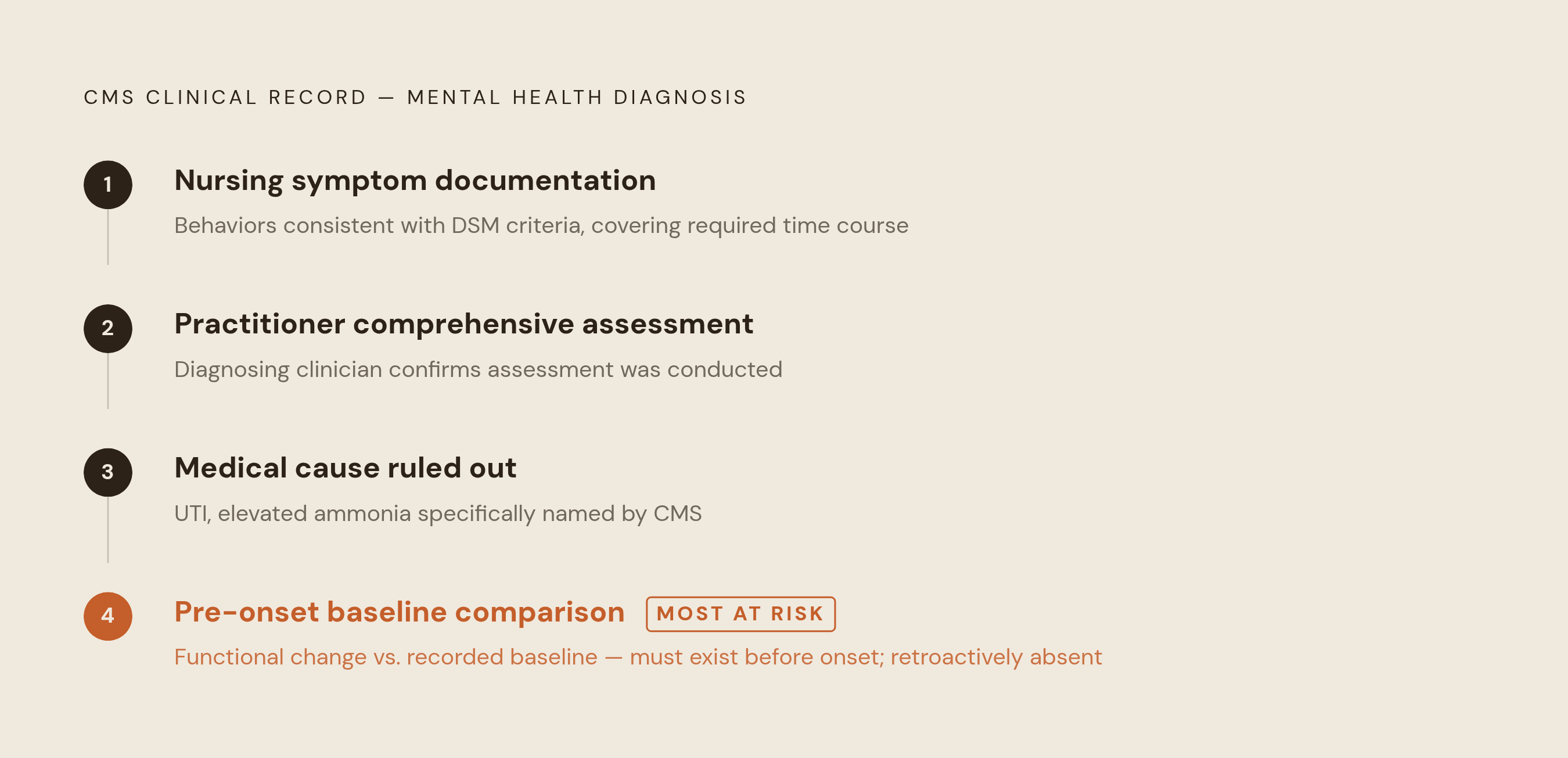
CMS makes the evidentiary requirement particularly concrete for mental health diagnoses. The record must have all four required elements. The first is nursing documentation of symptoms, disturbances, or behaviors consistent with DSM criteria, present for the period those criteria require. A recorded behavior therefore needs more than a description of its appearance at one moment. The nursing record must support the time course on which the diagnosis depends.
The second element is documentation from the diagnosing practitioner confirming that the diagnosis rested on a comprehensive assessment. A quick clinical impression does not meet that requirement. The third element is documentation ruling out other medical causes for the resident’s presentation. CMS names urinary tract infection and elevated ammonia levels as specific examples. Those examples show how closely the agency expects the record to connect an observed change with the assessment of possible causes.
The fourth element is documentation that shows how the condition changed the resident’s function compared with a pre-onset baseline. That baseline must have been recorded before the condition began. CMS developed its audit process to identify unsupported schizophrenia diagnoses, including records lacking comprehensive psychiatric evaluations and behavioral documentation to justify the diagnosis and related antipsychotic MDS coding. Although the diagnosing practitioner is responsible for the assessment, nursing observations over time are part of what makes the resulting diagnosis defensible.
Why psychotropic medication documentation now carries the same evidentiary burden as the diagnosis itself
A supported diagnosis does not, by itself, justify starting a psychotropic medication. The chart must show that behavioral interventions were tried and found inappropriate or unsafe before medication began. This separates the evidence for the condition from the evidence for the chosen response. A facility may make a clinically defensible decision and still face a citation if the record omits the consideration and exclusion of nonpharmacological options.
The requirement also applies when medication is stopped. Any medication change requires documentation of an evaluation of the resident’s physical, behavioral, mental, and psychosocial signs and symptoms, together with the reasoning behind the treatment chosen. A record of clinical action alone does not show the clinical reasoning behind it. For nursing documentation, observations of the resident’s condition are therefore part of the evidence supporting medication decisions.
CMS respecified the Long-Stay Antipsychotic quality measure effective January 1, 2026, with an errata clarification issued March 30, 2026, tightening MDS coding and reporting requirements. CMS also began using more claims data on antipsychotic medication use to calculate Five Star ratings effective January 2026. Psychotropic documentation feeds reporting that shapes the facility’s public rating on Care Compare.
Falls documentation and the gap between a good narrative note and accurate MDS coding
A nurse can document a fall in precise clinical detail while the facility’s MDS assessment fails to reflect the same event accurately. The compliance gap sits between the narrative record and the structured assessment, where information about the event must retain its clinical significance. That discrepancy can affect public quality rankings as well as a surveyor’s review.
The OIG’s 2025 report found that a large share of nursing home falls resulting in major injury and hospitalization were never reported in required MDS resident assessments. For-profit, chain-affiliated, and large nursing homes were more likely to underreport. The assessment’s structure also creates a limitation. The MDS records whether a fall occurred since admission or the prior assessment, but not its exact date. Because that span can range from days to many weeks, a fall may still be misclassified even when nursing staff document carefully.
CMS released the Falls with Major Injury Technical Specification Report on November 26, 2025, with feedback from a Technical Expert Panel held May 12 and 14, 2025. CMS has signaled that additional guidance and public reporting timelines will follow. Separately, CMS changed how it selects Special Focus Facility candidates in January 2026 to give weight to how common resident falls are when candidates have similar compliance histories. More falls can thus lead to selection as well as a citation. As quality measure algorithms expose coding mismatches, the nursing implication is direct. The narrative and the MDS must corroborate the same event and its clinical significance.
Transfer and discharge documentation under the consolidated F-Tag framework
CMS combined seven separate transfer and discharge F-Tags into two so that citations overlap less and surveyors can more easily spot noncompliance. The medical record becomes the deciding evidence of whether the discharge was appropriate. Clinical judgment alone is insufficient when the chart does not reconstruct the reasoning behind the decision.
For nurses documenting a transfer, that reconstruction includes why the transfer was appropriate, which interventions were attempted beforehand, the notification sequence, and the timing. A note confirming departure establishes only that the event occurred. It does not establish the clinical basis for the transition. The record must connect the resident’s condition to the attempted response and then to the decision to transfer.
The severity implications are substantial for these records. Violations of F-Tag 627 are usually cited at Harm, Level 3, or Immediate Jeopardy, Level 4. A documentation gap can therefore fall within the same citation category as a direct care failure. Although an omitted detail does not automatically warrant a finding at that level, the absence of supporting discharge documentation remains a substantive issue even when the underlying decision appeared clinically appropriate.
How the Risk-Based Survey and Five Star changes mean documentation gaps are now visible before a surveyor walks in the door
CMS uses more of the information facilities have already reported to guide oversight and public ratings. Documentation quality is no longer evaluated only during an on-site survey. A gap that affects a quality measure can influence a rating and survey selection risk before a surveyor arrives. Under this structure, readiness depends on the existing record rather than a final review performed in anticipation of a visit.
CMS issued QSO-26-14-NH on July 16, 2026, to put the Nursing Home Risk-Based Survey in place nationwide beginning September 8, 2026. CMS estimates that about 12% of nursing homes nationwide will qualify at first. The RBS uses a smaller resident sample, fewer survey activities, and roughly half the time of the traditional LTC survey process. Beginning October 8, 2026, CMS publicly identifies qualifying facilities on Nursing Home Care Compare with a “High Performing Facility” icon. Facilities qualify when their documentation record, quality measures, and compliance history already show lower risk.
CMS also changed health inspection rating calculations in July 2025 from considering three standard surveys to considering the two most recent standard surveys. Recent deficiencies carry more weight in the shorter window. Combined with quality measures and risk-based selection, it makes documentation gaps cumulative across inspections. Treat documentation discipline as continuous work, because the information determining oversight and public recognition is already being generated in the chart.
Why the evidence CMS requires already exists in nursing notes — and why it stays invisible until a surveyor finds it
Much of the required clinical evidence already exists. It is scattered across narrative notes, divided between disciplines, and spread over time. Unstructured documentation makes up the large majority of medical data, yet remains underused in compliance review and predictive monitoring. A structured report does not automatically surface the clinical nuance contained in free text. Nursing observations often need to be made visible in practice.
Research in post-acute settings found that models trained on unstructured discharge notes outperformed models built on structured clinical variables for readmission prediction. That finding demonstrates the usable clinical signal within narrative documentation. It does not establish that every required compliance element is present in every chart. Rather, it shows why reviewing structured fields alone can overlook information that changes the interpretation of a resident’s condition.
Research using an NLP algorithm to extract fall dates from EHRs and compare them with MDS data illustrates the same problem more directly. The algorithm found that the process for documenting falls in the MDS may miss falls recorded in other parts of the medical record and cannot capture a fall’s exact date. The narrative held information the assessment did not reflect. For facilities, the corresponding operational change is continuous extraction and organization of existing notes, rather than waiting for a surveyor to assemble the evidence manually. That review must distinguish evidence that is present but disconnected from evidence that is genuinely missing.
What continuous, automated documentation review means for nursing manager workload and facility compliance posture
Asking nurses to chart more does not fix how this information is scattered. Nurses in EHR-based SNF environments already document a very large number of discrete data points per shift. Research has shown that clinicians can spend close to two hours on documentation and administrative tasks for every hour of direct patient care. Additional entry therefore competes with time available for care. The U.S. Surgeon General’s Advisory on health worker burnout also says documentation takes up a large part of nurses’ shifts and links that burden to burnout across the workforce.
For nursing managers, the alternative is systematic review of the information already being produced. A clinical intelligence tool that reads existing nursing documentation, surfaces compliance gaps, and ranks residents by risk can support that approach without duplicate entry or new workflows. Its purpose is to make the existing record actionable. That is particularly important for MDS and PDPM coding, where a single miscoded item can both create compliance exposure and change Medicare reimbursement.
Automated review cannot fill in a missing assessment or create a pre-onset baseline that no one recorded. Its value is in exposing those omissions and organizing the evidence that does exist. Facilities that make this a continuous operational function are better positioned to support reduced survey burden under the RBS framework and maintain the public signals associated with high performance on Care Compare. The solution is a review process that makes nurses’ existing observations usable as evidence before an external reviewer must reconstruct them.