Behavioral Change Documentation for Residents With Dementia
Complete behavioral records must connect baseline, context, and interventions.
Behavioral change documentation for residents with dementia must explain more than an incident. It must connect the resident’s baseline, the behavior’s context and progression, and the response to attempted interventions. That connected record is what supports early clinical action, justifies individualized care decisions, and makes regulatory compliance defensible.
Why behavioral documentation for dementia residents carries stakes beyond compliance
CMS has brought psychotropic medication oversight into sharper focus by consolidating guidance under F605, incorporating the former F758. QSO-25-12-NH introduced that consolidation, and surveyor use of revised Appendix PP began April 28, 2025, following the superseding guidance. A record that cannot explain the clinical reasoning behind medication use leaves a facility exposed at the point where treatment decisions and chemical restraint concerns meet.
The clinical consequences are equally important. The ROSA cohort study of residents with dementia in long-term care facilities found that frequent emergency department presentations, a history of physical violence, being male, and prior delirium were among the strongest predictors of delirium or dementia-related hospitalization. These findings show why an isolated account of an incident is not enough to understand risk. When the chart is missing that history, the clinical team loses those signals that could help it act early.
CMS is also examining the evidence behind reported diagnoses. CMS schizophrenia audits found facilities with multiple residents carrying new diagnoses of schizophrenia or schizoaffective disorder without adequate supporting documentation. Structured data validation audits are targeting approximately 10% of SNFs in 2026, adding further pressure on the quality of the underlying record.
What CMS now requires behavioral documentation to show — and why a diagnosis alone is not enough
CMS QSO-25-14-NH superseded QSO-25-12-NH effective March 10, 2025, and makes the central requirement explicit. Diagnoses alone do not necessarily warrant psychotropic medication use. The record must demonstrate an individualized clinical rationale, including documentation that the facility attempted behavioral, nonpharmacological interventions and that interventions were deemed inappropriate or unsafe for the resident. Without that evidence, psychotropic medication use is citable as noncompliance.
The same guidance broadens the definition of “convenience” to include medication use that causes symptoms consistent with sedation and/or requires less effort by facility staff to meet the resident’s needs. A diagnosis identifies a condition, but it does not explain why a particular treatment was appropriate for that resident. The supporting record must make that reasoning visible to the surveyor.
CMS also changed the Long-Stay Antipsychotic Quality Measure to use a hybrid method as of January 1, 2026. It uses MDS data, Medicare/Medicaid claims data, and Medicare Advantage encounter data, so gaps in the record can also affect publicly reported quality measure scores. Facilities therefore need evidence that supports both the care decision and the information reported about it. Meeting that standard requires a documented process over time.
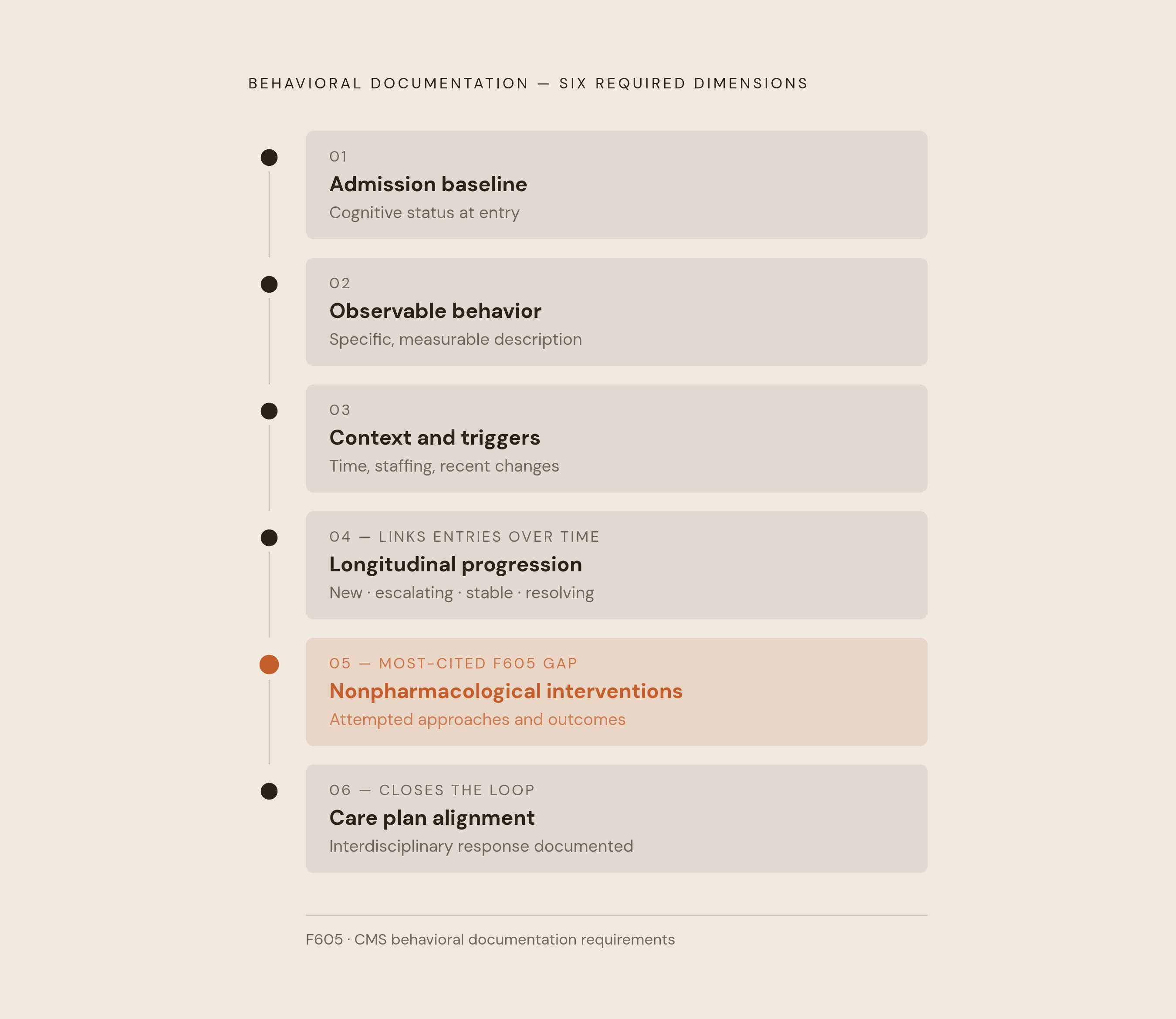
The six dimensions complete behavioral documentation must capture
A surveyor’s chart review needs a starting point, which is the resident’s baseline behavior and cognitive status at admission. That baseline gives later observations their meaning by establishing what has changed. A note describing “increased agitation” cannot support a clear comparison if the earlier pattern was never recorded.
The second dimension is a specific description of observable behavior. The note must describe what the resident did, said, or was observed doing rather than rely on labels such as “agitated” or “combative”. ICD-10-CM codes reflect documented symptoms. For example, F02.B18 (dementia in other diseases classified elsewhere, moderate, with other behavioral disturbance) requires an underlying clinical description that supports the code. Specificity gives the clinical team something to interpret and the surveyor something to evaluate.
The third dimension is context, including time of day, environmental triggers, staffing conditions, and recent changes in medication, physical health, or care routine. These details help show whether the facility looked into why the behavior occurred. The fourth dimension is longitudinal progression, which establishes whether the behavior is new, escalating, stable, or resolving. Notes need to link back to earlier entries so that the record shows how events relate to one another over time.
The fifth dimension is the record of attempted nonpharmacological interventions and their outcomes. It must make clear what was tried and how the resident responded, including the basis for deeming an intervention inappropriate or unsafe. That evidence serves a clinical purpose as well as the F605 requirement because it preserves what the team has learned about this resident’s care.
The sixth dimension is alignment with the care plan and the interdisciplinary response. Behavioral observations need to connect to an updated plan that shows how the team responded to the documented change. CMS QSO-25-14-NH addresses care planning, but it does not establish a specific “real-time care planning” standard requiring updates within a defined period after behavioral changes. Together, these six dimensions tell the resident’s clinical story rather than fill six bureaucratic boxes.
Why nurses produce thin, templated behavioral notes even when they know better
Producing that connected narrative takes more than knowing what a good note contains. It requires time to describe an observation precisely, compare it with previous entries, and relate the response to the care plan. Under routine workload pressure, those tasks compete with direct care and other documentation demands. Behavioral notes are especially vulnerable to compression because their value depends on nuance that a short category label cannot preserve.
A template can make notes more consistent but may still leave out that nuance. If an entry records a behavioral category but omits the antecedent or response, it appears complete while remaining clinically thin. Repeated across the record, such entries can obscure the history that gives a new event its significance. Such entries provide weak evidence for a survey and create a false clinical picture in which meaningful risk signals are absent.
This is primarily a structural problem. Nurses may understand the need for a longitudinal account while lacking a workable way to assemble it during normal care. Training can explain the standard, but it cannot by itself create the time or workflow needed to meet it. A credible solution must therefore reduce the work of producing and connecting useful evidence, rather than repeat the instruction to document better.
How facilities can close the gap between required and actual behavioral documentation without adding to nursing workload
Natural language processing can extract relevant information from unstructured notes, including behavioral disturbances, cognitive changes, and fluctuating mental status. This approach can find evidence in the notes without asking staff to enter it again in another record. Extraction supports clinical assessment through the use of observations already recorded in notes.
For nonpharmacological interventions, structure can reduce the effort required to record a meaningful trial. Wec et al. developed a prototype checklist for nonpharmacological strategies in nursing home dementia care, published in November 2025. The tool offers nursing home staff and physicians a structured but person-centered way to document strategies without creating a narrative from scratch. Its prototype status matters, and it should not be presented as proof that a checklist alone secures F605 compliance. The useful principle is to make the attempted strategy and its outcome easier to capture together.
Alert logic can also help keep care plans in line with behavioral notes by flagging notes when no care plan update follows within a window set by the facility. That facility-set window is an operational safeguard. It can point nursing managers to possible gaps so they do not have to find each one by reviewing charts by hand. The clinical team still needs to determine what the documented change means for the plan.
QAPI gives facilities a way to oversee these approaches as part of everyday work. Tracking documentation trends and conducting root cause analyses of citation patterns can distinguish recurring workflow failures from isolated omissions. That distinction matters because a repeated gap calls for a process correction. The goal is to stay ready through everyday work instead of packing the effort into the time before a survey.
The clinical individualization argument and why better documentation serves it, not undermines it
The concern that documentation requirements could constrain individualized care deserves a direct response. She has also warned that guidance reclassifying psychotropics as chemical restraints “could result in a reluctance to admit residents with any psychotropic medications”. That is a legitimate concern about access and clinical judgment.
A thin record removes the evidence that distinguishes a resident-specific treatment decision from convenience prescribing. Thorough documentation can show the distress being treated, the interventions attempted, and the rationale for the chosen response. In that sense, documentation supports individualization by preserving the reasons a general rule cannot fully describe a particular resident’s needs.
Patricia Nistor and colleagues’ 2026 work on dementia risk prediction emphasizes the importance of the information feeding predictive models. When behavioral records are incomplete, those models can show only part of the picture, especially for residents whose complex needs are hard to describe with broad labels. Better documentation is therefore not a substitute for judgment, whether clinical or analytical. The goal is a record that tells the resident’s full story and protects both the facility and the resident.
What continuous behavioral documentation readiness looks like in practice
Continuous readiness means that the record develops as care unfolds, rather than being reconstructed after a deficiency is identified. The Joint Commission’s move toward continuous compliance under Accreditation 360 points to a broader shift toward showing evidence of quality on an ongoing basis. That program now applies to hospitals, and dates for its use in behavioral health have yet to be confirmed. It should not be treated as a new long-term care requirement, but the operational principle is relevant.
For behavioral documentation, that principle begins at note entry. Structured prompts can help staff capture context and antecedents while recording the behavior. Alert logic can then flag gaps between notes and care plans, while QAPI review cycles use documentation trends as data on the quality of care. Together, they make the quality of the record a system responsibility rather than a matter of exceptional individual effort.
The resulting record is useful before any surveyor opens it. Behavioral signals in existing notes can be drawn out, linked to care plan status, and checked for progression that needs clinical attention. Documentation then becomes a clinical asset because it preserves both what happened and what the team learned in response. A facility that makes this work continuous does not need to approach a survey as a test it might fail. It can approach it as an external review of work already done.